••
0% Balance Transfer vs Personal Loan: Which Is Better for Credit Card Debt?
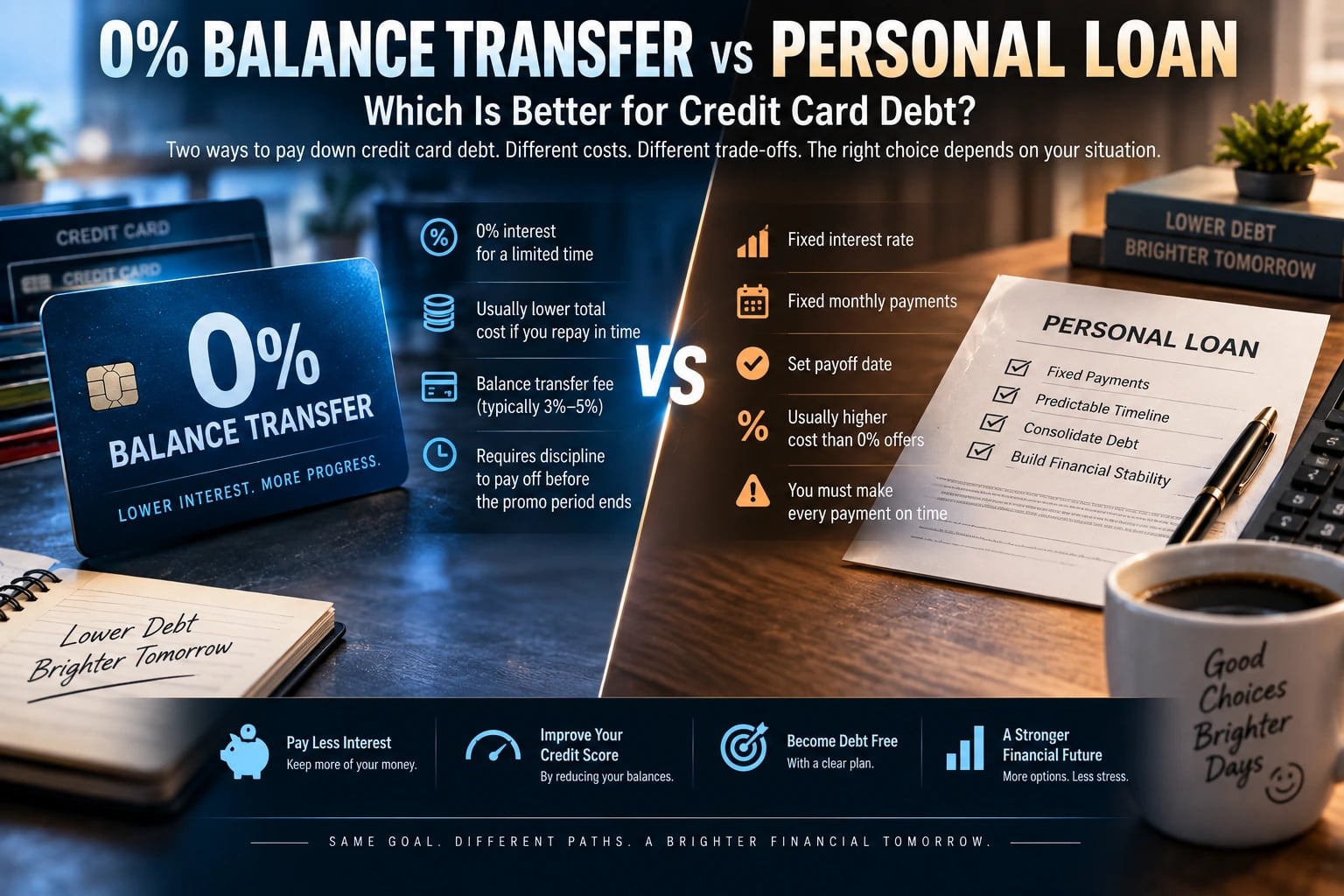
A 0% balance transfer may save more if you can repay the debt during the promotional period. A personal loan offers fixed payments and more time. Compare the real costs before choosing.
Share Article:
A 0% balance transfer will usually cost less if you qualify for a competitive offer and can repay the transferred balance before the promotional period ends. A personal loan may cost more, but it provides fixed monthly payments and a scheduled payoff date—provided you make every payment on time.
For U.S. consumers, the better choice depends mainly on how much you owe, the offers you qualify for, the fees involved and how quickly you can realistically repay the debt.
How Each Option Works
A balance transfer moves credit-card debt from one or more existing cards to a new card. The new card may offer a 0% introductory APR on qualifying transferred balances for a limited period, commonly 12 to 21 months.
The card issuer generally charges a balance-transfer fee, often calculated as a percentage of the amount transferred. Once the promotional period ends, any unpaid balance becomes subject to the card’s regular balance-transfer APR.
A personal loan provides a lump sum that can be used to pay off credit-card balances. The borrower then repays the loan through fixed monthly installments over a defined term, often two to seven years.
The basic difference is straightforward:
- A balance transfer provides a limited interest-free repayment window.
- A personal loan converts revolving credit-card debt into an installment loan with a fixed repayment schedule.
Neither option eliminates debt. Both simply change how the debt is structured and repaid.
Interest Rates and Fees: The Real Cost Comparison
The advertised rate does not always show the full cost.
According to WalletHub’s September 2026 credit-card rate data, the average regular APR among new credit-card offers was 22.19%. That figure applies to new offers and is not the rate every cardholder pays.
Bankrate reported an average personal-loan rate of 12.44% as of September 16, 2026, for borrowers with a 700 FICO score seeking a $5,000 loan with a three-year term. Actual rates vary according to credit history, income, debt-to-income ratio, loan amount, term and lender.
| Cost factor | 0% balance transfer | Personal loan |
|---|---|---|
| Promotional or initial rate | 0% on qualifying transfers | Fixed rate based on borrower and lender |
| Rate after promotional period | Regular variable APR applies to the remaining balance | Not applicable if the loan rate is fixed |
| Upfront fee | Commonly 3%–5%, but terms vary | May range from 0% to 10% and, in some cases, higher |
| Annual fee | Depends on the card | None |
| Monthly payment | May vary, subject to the card minimum | Normally fixed |
| Prepayment penalty | Generally none on credit cards | Uncommon, but check the agreement |
| Main risk | High APR on the unpaid balance after the promotion | Paying substantial interest over a longer term |
The balance-transfer fee is normally added to the new card balance. For example, transferring $10,000 with a 3% fee creates a starting balance of $10,300.
Personal-loan origination fees work differently depending on the lender. A fee may be deducted from the loan proceeds, added to the amount financed or reflected through the loan’s pricing.
This is why borrowers should compare the APR, not only the interest rate. As the Consumer Financial Protection Bureau explains, a loan’s APR incorporates the interest rate and certain additional lender fees.
Some lenders advertise personal loans without origination fees. LightStream, Discover and Navy Federal currently advertise qualifying personal loans without origination fees. SoFi offers some no-fee term options, while other SoFi offers may include an origination fee.
These lenders are included as neutral examples, not recommendations. Product terms and eligibility requirements can change, so verify the lender’s current disclosures before applying. Navy Federal products also require membership eligibility.
Calculate the Required Balance-Transfer Payment First
Before applying for a balance-transfer card, calculate the monthly payment required to clear the balance during the promotional period:
Required monthly payment = Transferred balance plus fee ÷ Number of promotional months
For a $10,000 transfer with a 3% fee and a 21-month promotional period:
$10,300 ÷ 21 = approximately $490.48 per month
If paying about $491 every month is realistic, the balance transfer may work. If that payment is not affordable, the borrower risks carrying a balance into the card’s regular APR period.
You can also use the MoneyAllotment Debt Payoff Calculator to compare repayment methods and estimate a debt-free timeline.
Payoff Timeline Example
Consider a U.S. borrower with $10,000 in credit-card debt who is comparing a 21-month balance-transfer offer with a three-year personal loan.
Scenario 1: 0% Balance Transfer With a 3% Fee
The 3% transfer fee adds $300 to the balance:
- Existing debt: $10,000
- Transfer fee: $300
- New balance: $10,300
- Promotional period: 21 months
- Monthly payment: $500
At $500 per month, the borrower would make 20 payments of $500 and a final payment of approximately $300 in month 21.
The result would be:
- Total interest: $0
- Total fee: $300
- Total borrowing cost: $300
- Payoff time: 21 months
This outcome assumes every required payment is made on time and the issuer does not terminate the promotional offer under the card agreement.
What If the Borrower Pays Only $400 per Month?
After 21 payments of $400, exactly $1,900 would remain.
If that balance then carried a 20% APR and the borrower continued paying up to $400 per month, repayment would require four full payments followed by a smaller fifth payment. The additional interest would be approximately $96.
The approximate total borrowing cost would become:
- Transfer fee: $300
- Post-promotion interest: $96
- Total cost: approximately $396
- Additional repayment period: approximately five months
The balance transfer would still be relatively inexpensive in this example, but the borrower would remain in debt beyond the promotional period.
Scenario 2: Personal Loan With a 12% Interest Rate and 5% Origination Fee
Assume the origination fee is deducted from the loan proceeds. To receive enough money to pay off $10,000 in credit-card debt, the borrower would need a gross loan of approximately $10,526.32.
A 5% fee on $10,526.32 is approximately $526.32, leaving $10,000 in net proceeds.
At a 12% nominal interest rate over 36 months:
- Gross loan amount: approximately $10,526.32
- Net proceeds: $10,000
- Origination fee: approximately $526.32
- Estimated monthly payment: approximately $349.62
- Estimated total of payments: approximately $12,586.48
- Interest paid on the gross loan: approximately $2,060.16
- Total borrowing cost relative to the $10,000 received: approximately $2,586.48
The precise final payment may vary slightly because lenders round scheduled monthly payments to the nearest cent.
The 12% figure in this example is a nominal interest rate before accounting for the origination fee. A lender’s disclosed APR would incorporate qualifying fees and would therefore be higher than the nominal interest rate in this scenario.
| Metric | 0% balance transfer | Personal loan |
|---|---|---|
| Credit-card debt repaid | $10,000 | $10,000 |
| Transfer or origination fee | $300 | Approximately $526 |
| Monthly payment | $500 | Approximately $350 |
| Repayment period | 21 months | 36 months |
| Estimated interest | $0 | Approximately $2,060 |
| Estimated total borrowing cost | $300 | Approximately $2,586 |
| Main benefit | Lowest cost in this example | Lower fixed monthly payment |
These calculations are illustrative. Actual results depend on the issuer, lender, repayment timing, fee method and borrower’s approved terms. Figures are rounded.
The balance transfer clearly wins on total cost in this example. The personal loan offers a lower monthly payment and more time, but that flexibility produces a higher overall borrowing cost.
When a Balance Transfer Becomes Less Attractive
A balance transfer does not automatically produce the best result.
Suppose the borrower transfers $10,000, pays a 3% fee and then pays only $350 per month during a 21-month promotional period.
After 21 months, exactly $2,950 would remain. If the card’s regular APR were 22% and the borrower continued paying up to $350 monthly, repayment would require nine full payments followed by a smaller tenth payment. The post-promotion interest would be approximately $284.
The approximate total borrowing cost would be:
- Transfer fee: $300
- Post-promotion interest: $284
- Total cost: approximately $584
- Additional repayment period: approximately 10 months
That remains cheaper than the personal-loan example above, but it exposes the borrower to a variable rate and extends the repayment period.
The balance-transfer advantage can narrow or disappear when:
- The promotional period is short.
- The transfer fee is high.
- The approved credit limit cannot accommodate the full debt.
- The borrower pays only the minimum.
- A large balance remains when the regular APR begins.
- The borrower makes late payments or violates the promotional terms.
- New purchases are added to the card.
The correct comparison is between actual offers—not between a theoretical 0% card and a theoretical personal loan.
Credit Score Impact
Both options can affect a borrower’s credit.
Balance Transfer
Applying for a new balance-transfer card normally creates a hard inquiry. Opening the account may also reduce the average age of the borrower’s credit accounts.
However, the new credit limit may reduce overall credit utilization, particularly if the old cards remain open with zero balances. Lower utilization may help a credit score over time when accounts are managed responsibly.
Do not automatically close an old credit card immediately after transferring its balance. Closing it can reduce available credit and increase utilization. However, closing may still make sense if the card has an annual fee or keeping it open creates a serious risk of additional spending.
Personal Loan
A personal-loan application may also create a hard inquiry and add a new account to the borrower’s credit report.
Using the proceeds to pay credit cards in full may sharply reduce revolving-credit utilization. The new installment loan also changes the borrower’s credit mix.
The most important factor for either option is payment history. Late or missed payments can cause substantial credit damage.
Experian provides additional detail in its guide to how a balance transfer can affect a credit score.
Avoid Using the Balance-Transfer Card for New Purchases
A common mistake is using the new card for everyday purchases after transferring a balance.
A 0% balance-transfer offer does not necessarily provide 0% APR on purchases. The purchase promotion may have different terms or may not exist at all.
A transferred balance may also cause the cardholder to lose the usual grace period on new purchases. According to the Consumer Financial Protection Bureau, a cardholder may be charged interest on new purchases unless the entire card balance—including the transferred balance—is paid by the due date.
The safest approach is usually to avoid new purchases on a balance-transfer card and use it only for the planned debt repayment.
Which Option Fits Your Situation?
| Your situation | Option to consider |
|---|---|
| You can repay the balance plus the transfer fee within the promotional period | 0% balance transfer |
| You qualify for a long 0% offer with a manageable transfer fee | 0% balance transfer |
| You need several years to repay the debt | Personal loan |
| You want a fixed payment and predictable repayment schedule | Personal loan |
| You cannot afford the payment required to finish within the 0% period | Personal loan or nonprofit debt-management plan |
| The personal-loan APR is significantly lower than the card’s post-promotion APR | Personal loan |
| The personal-loan APR is close to or above the existing card APR | Neither may provide meaningful savings |
| You are likely to run up new card balances after consolidation | Address the spending problem before using either option |
A specific debt amount should not determine the decision by itself. A $15,000 balance might work with a balance transfer for a high-income borrower, while a $5,000 balance may still be difficult for someone with limited monthly cash flow.
The required monthly payment and total cost are more useful than arbitrary debt thresholds.
Compare Offers Using These Five Steps
1. Add Every Upfront Fee
For a balance transfer, add the transfer fee to the transferred balance.
For a personal loan, determine whether the origination fee is deducted from the proceeds or added to the loan. If it is deducted, make sure the net proceeds are sufficient to pay the intended credit-card balances.
2. Compare APRs, Not Only Interest Rates
APR provides a more complete measure of borrowing cost because it incorporates the interest rate and certain fees.
3. Calculate the Total Amount Repaid
A lower monthly payment does not necessarily mean a cheaper loan. Extending repayment over five or seven years can substantially increase total interest.
4. Confirm the Realistic Monthly Payment
Do not build the plan around the highest payment you could make in a perfect month. Use a payment that remains affordable after essential expenses and a basic emergency buffer.
The 50/30/20 budgeting guide can help you estimate how debt repayment fits into your monthly budget.
5. Read the Agreement Before Applying
Confirm:
- Promotional expiration date
- Balance-transfer deadline
- Transfer fee
- Regular APR after the promotion
- Purchase APR
- Late-payment consequences
- Origination fee
- Fixed or variable rate
- Prepayment penalty
- Total payment amount
- Eligibility and membership requirements
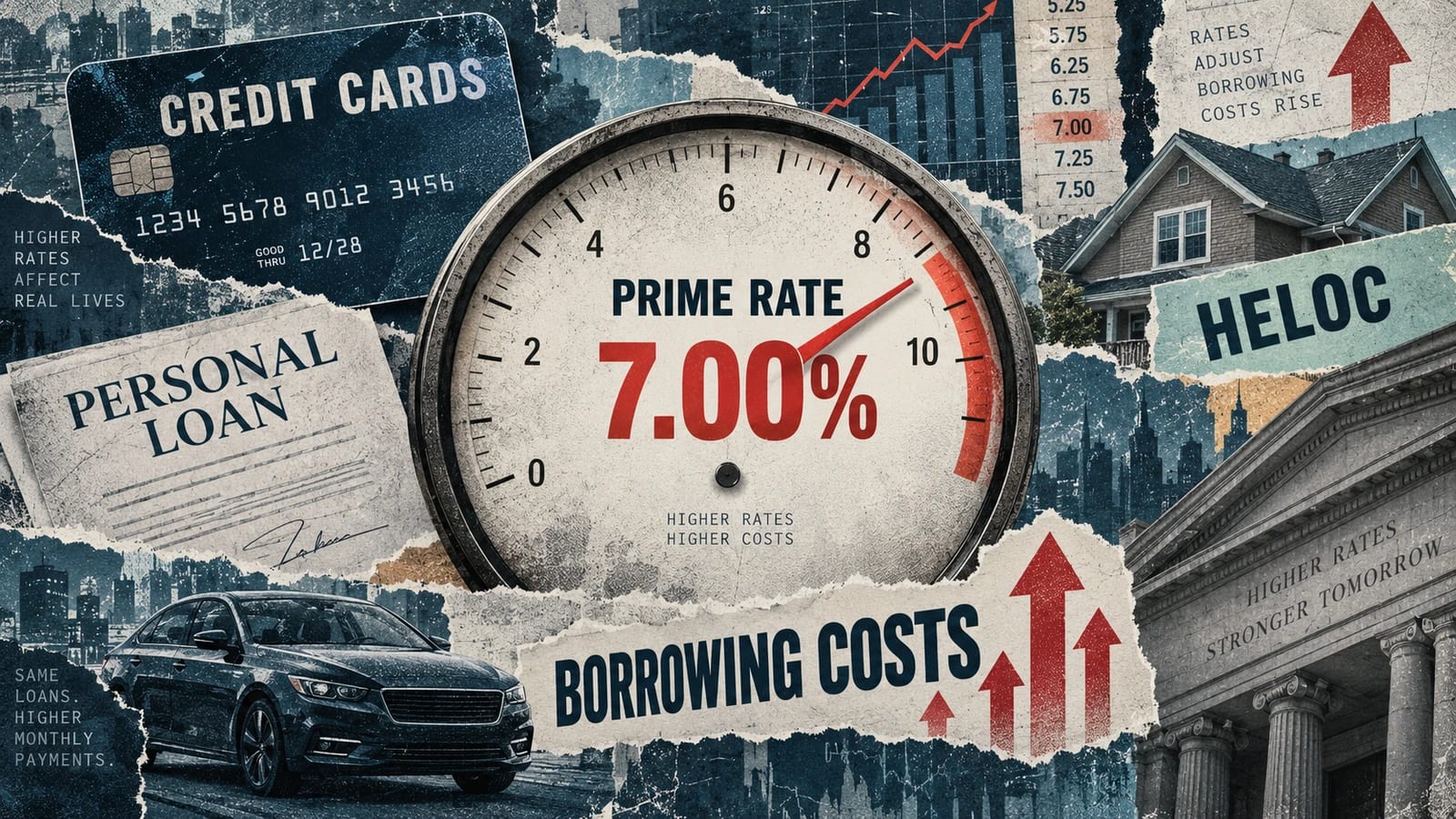
Credit-card rates may also change as benchmark rates move. MoneyAllotment’s guide to the prime rate and consumer borrowing costs explains how variable card APRs may respond to changing interest-rate conditions.
Alternatives to Consider
Neither a balance-transfer card nor a personal loan is suitable for every borrower.
Other possibilities include:
- A nonprofit credit-counseling program
- A structured debt-management plan
- Negotiating a lower rate directly with the card issuer
- Using the debt-avalanche or debt-snowball method without opening a new account
- Increasing monthly payments through temporary spending reductions
- Seeking professional bankruptcy advice when the debt is no longer realistically repayable
Debt settlement is different from nonprofit credit counseling. Settlement programs may involve intentionally stopping payments, can severely damage credit and may charge substantial fees. Review the risks carefully before enrolling.
Disclaimer: This article is for informational and educational purposes only. It does not constitute personalized financial, investment, tax or legal advice. Rates, fees and eligibility requirements can change. Verify current terms directly with the card issuer or lender and consider consulting a qualified financial professional or nonprofit credit counselor.
Frequently Asked Questions
Is a 0% balance transfer better than a personal loan?
A 0% balance transfer is generally cheaper if you qualify, pay a reasonable transfer fee and repay the full balance before the promotional period ends. A personal loan may be more suitable if you require a longer repayment period or prefer fixed monthly payments.
What happens if I do not repay the balance transfer before the promotion ends?
The card’s regular APR will apply to the remaining balance after the promotional period. With a genuine 0% introductory APR offer, interest is generally charged going forward on the remaining balance rather than retroactively for the entire promotional period.
Read the offer carefully because deferred-interest promotions operate differently from standard 0% introductory APR offers.
Can I use a balance transfer and a personal loan together?
Yes. For example, a borrower may use a balance transfer for an amount that can be repaid during the promotional period and a personal loan for the remaining debt.
However, using both products creates two accounts, multiple fees and more repayment complexity. Compare the combined cost before proceeding.
Does a personal loan hurt my credit score?
The application and new account may temporarily affect the score. Paying credit cards down and making every loan payment on time may help over the longer term by reducing revolving utilization and building positive payment history.
Can I obtain a personal loan with bad credit?
Some lenders offer personal loans to borrowers with weak credit, but the APR and fees may be high. If the loan’s APR is close to or higher than the existing credit-card APR, consolidation may not create meaningful savings.
From the Desk
All Personal Finance →More in Personal Finance

Why Car Payments Are Still So High in 2026: Interest Rates, Vehicle Prices and Longer Loan Terms Explained
Car payments remain high in 2026 as near-record vehicle prices combine with elevated auto-loan rates and longer financing terms. This guide breaks down current payment data, loan costs, negative equity and the trade-offs behind longer car loans.

Fresh Reporting
Browse All Stories →Latest from The Ledger

Bitcoin Rebounds Above $80K After Falling Below $75K: What Drove the Move?
Bitcoin recovered from below USD 75,000 to above USD 80,000 after a week of major policy and market shocks. The rebound reflected already-priced-in macro news, short liquidations, volatile ETF flows and reduced immediate fears of a yen carry-trade unwind.


Leave a Comment
Your email address will not be published. Required fields are marked *