••
Fed Rate vs Mortgage Rate: Why Mortgage Rates Don't Move Exactly With the Fed
The Fed raised rates on September 16, 2026, but mortgage rates had already priced in the move. Here's why mortgage rates track the 10-year Treasury yield and MBS spreads, not the fed funds rate.
Share Article:
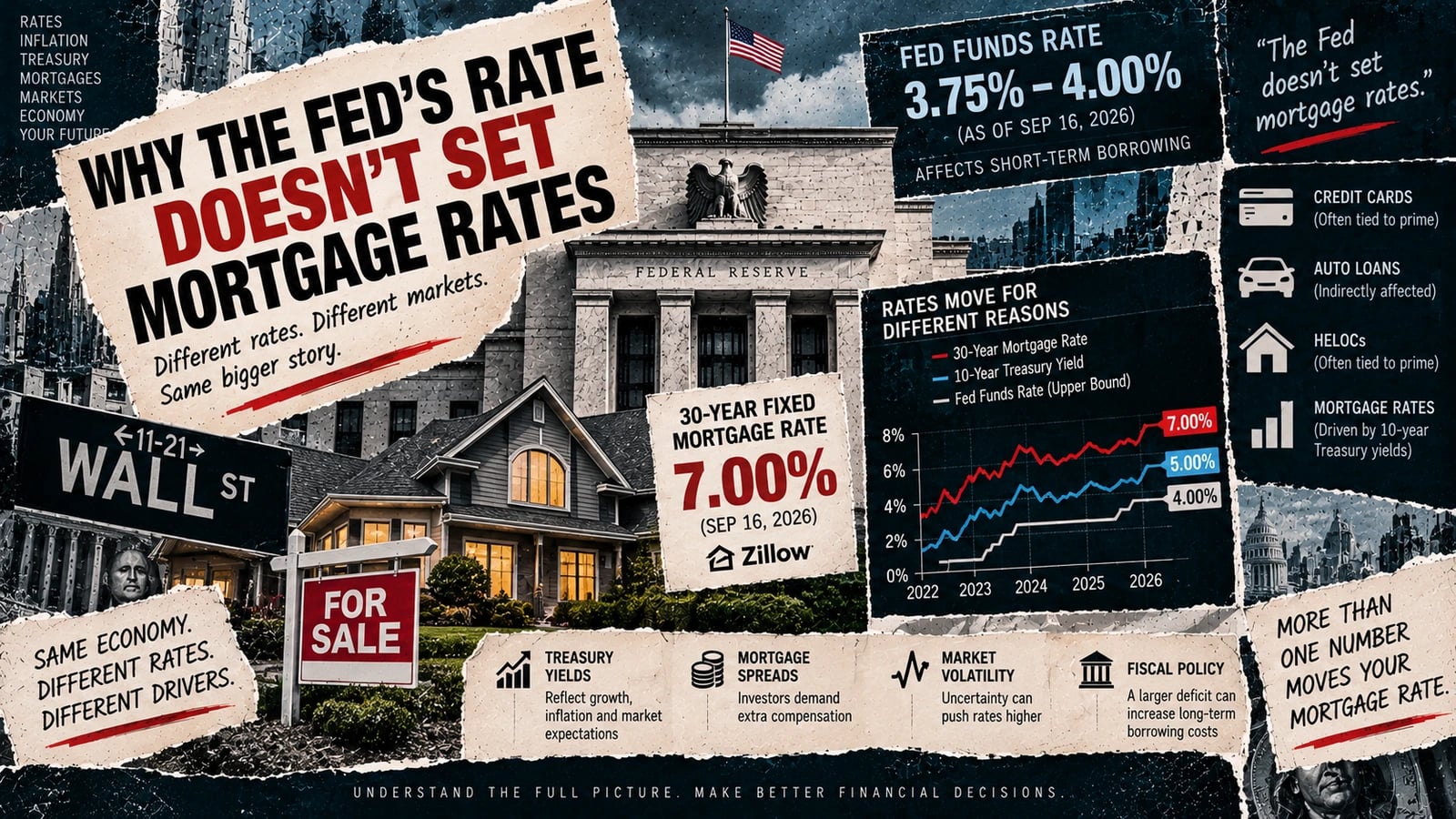
The Federal Reserve raised its benchmark rate to 3.75%–4.00% on September 16, 2026, its first hike since 2023. The average 30-year fixed mortgage rate stood at 7.00% the same day, according to Zillow lender marketplace data. If the Fed sets the cost of short-term money, why didn't mortgage rates follow in lockstep? Because the Fed does not directly set mortgage rates.
The Fed's Rate Is a Short-Term Tool, Not a Mortgage Benchmark
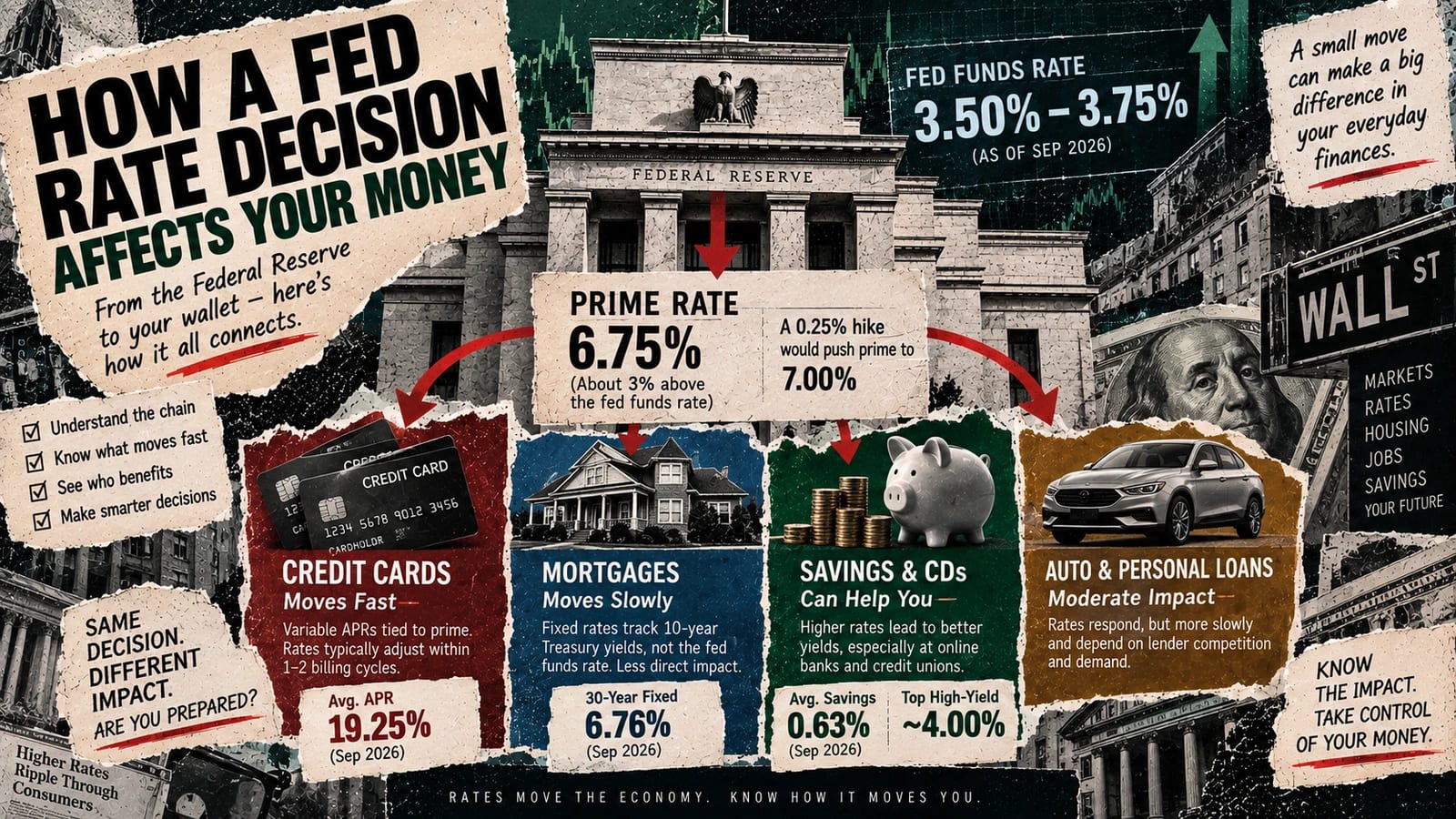
The federal funds rate is the target range for overnight lending between banks. It directly influences many credit card and home equity line of credit rates and indirectly affects other borrowing costs, including auto loans.
Mortgage rates work differently. They are driven primarily by long-term bond markets, especially the 10-year Treasury yield and yields on mortgage-backed securities.
Research from the Federal Reserve Bank of Atlanta makes the distinction clear. Over the past two decades, mortgage rates have tracked the 10-year Treasury yield much more closely than the federal funds rate.
Cato Institute analysis also found that correlations between mortgage rates and the funds rate have weakened compared with earlier decades. Market interest rates often move before the Fed acts because investors continuously price in inflation, economic growth, fiscal policy, and expected monetary policy.
What Actually Drives Mortgage Rates
Several market forces explain much of where mortgage rates sit on any given day, while Federal Reserve policy influences them indirectly.
The 10-Year Treasury Yield
The 10-year Treasury yield reflects investors' expectations about inflation, economic growth, fiscal policy, and future interest rates.
When those expectations shift, mortgage rates can move before the Fed meets. A weak jobs report, hotter-than-expected inflation data, changing oil prices, or stronger economic growth can all affect longer-term yields.
The 10-year Treasury yield crossed 5% in September 2026 for the first time since 2023. Mortgage rates had already climbed from around 6% in late February 2026 to roughly 7% by mid-September, according to National Association of Realtors data.
The Fed's September hike and the earlier increase in mortgage rates reflected some of the same underlying pressures, particularly inflation concerns and shifting expectations about future monetary policy.
The Mortgage Spread Over Treasuries
Mortgages do not trade at the same yield as Treasury securities.
Lenders bundle mortgages into mortgage-backed securities, or MBS, which are sold to investors. These securities differ from Treasuries because mortgage borrowers repay principal gradually and can often refinance when interest rates fall.
That prepayment option creates additional risk for investors.
When rates fall, homeowners may refinance and investors receive their principal back when reinvestment yields are lower. When rates rise, borrowers are less likely to refinance, leaving investors holding lower-rate mortgages for longer.
Investors demand compensation for that uncertainty, which contributes to the spread between mortgage rates and Treasury yields.
The mortgage spread over the 10-year Treasury was around 200 basis points in mid-2026, according to Federal Reserve Bank of Boston research. The spread has varied substantially over time, exceeding 300 basis points during parts of the 2007–2009 financial crisis and falling below 100 basis points during parts of 2021.
Boston Fed research found that factors affecting the value of the mortgage prepayment option, including interest-rate expectations, rate volatility, and refinancing costs, explain about 80% of the variation in the coupon spread since 2006.
Rate Volatility and Market Expectations
Interest-rate volatility also matters.
When investors face greater uncertainty about future rates, they may demand wider spreads to hold mortgage-backed securities.
Federal Reserve Bank of Dallas research found that roughly 70% of the variation in mortgage spreads can be explained by the level of 10-year rates, the slope of the yield curve, and implied interest-rate volatility.
This helps explain why mortgage rates can move even when the Fed holds its benchmark steady.
Cato Institute analysis found that between December 2025 and July 2026, while the Fed left its target range unchanged, the 30-year mortgage rate increased by about 45 basis points and the 2-year Treasury yield rose by roughly 62 basis points.
Markets were repricing inflation, growth, and future policy expectations without an immediate change in the federal funds target.
Why the Fed's September 2026 Hike Didn't Send Mortgage Rates Soaring
The Fed's quarter-point increase was widely expected.
Fed funds futures implied a probability above 90% that policymakers would raise rates in the days leading up to the September meeting. By the time the FOMC announced the decision, much of the expected move had already been reflected in financial markets.
Mortgage rates are forward-looking. Investors price expectations about inflation, economic growth, and future Fed policy into Treasury and MBS markets before an FOMC decision becomes official.
That is why a Fed announcement does not automatically produce an equal move in mortgage rates on the same day.
CBS News also noted that mortgage rates tend to follow the 10-year Treasury yield more closely than the federal funds rate. Treasury yields can move well before a Fed meeting as investors react to economic data and changing expectations.
The message accompanying a Fed decision can matter as much as the rate change itself.
If policymakers suggest that a hike is likely to be temporary, longer-term yields may respond differently than they would if the Fed signals a series of additional increases.
Mortgage rates therefore depend less on one individual Fed move and more on what investors believe that move says about inflation, growth, and the future path of interest rates.
The Federal Deficit and Mortgage Rates
Fiscal policy can also influence long-term borrowing costs.
In its September 2026 mortgage-rate commentary, the National Association of Realtors argued that the large and growing federal deficit was contributing to pressure on long-term borrowing costs because heavier government borrowing increases competition for investor capital.
When the Treasury issues large amounts of debt, the additional supply can put upward pressure on longer-term yields and compete with other fixed-income assets, including mortgage-backed securities, for investor demand.
The relationship is not mechanical, and Treasury yields are influenced by many factors. But fiscal policy and government borrowing can matter for the long end of the yield curve, where mortgage rates are most sensitive.
What This Means for Borrowers
A future Fed cut does not automatically translate into a cheaper mortgage. Treasury yields and mortgage-market spreads can move for reasons that have little to do with the decision made at a single FOMC meeting.
If the Fed cuts during a weakening economy and longer-term yields fall, mortgage rates may decline. If investors remain worried about inflation, fiscal policy, or Treasury borrowing, they may stay elevated.
The 10-year Treasury yield is therefore useful to watch alongside mortgage spreads rather than in isolation. A stable Treasury yield does not guarantee stable mortgage rates if investors demand more compensation for holding MBS.
For borrowers approaching a purchase or refinance, the quoted mortgage rate is only part of the comparison. Fees, closing costs, rate-lock terms, loan structure, and the expected time in the property can all affect the real cost of borrowing.
One Fed meeting is only one input. Inflation data, economic growth, Treasury issuance, and bond-market volatility can all change mortgage rates before policymakers meet again.
Disclaimer: This article is for informational and educational purposes only and is not personalized financial, investment, tax, or legal advice. Consult a licensed professional for advice specific to your situation.
Frequently Asked Questions
Does the Fed set mortgage rates?
Mortgage lenders set their own rates based largely on conditions in bond and mortgage-backed securities markets. The Federal Reserve controls the federal funds target range, which influences financial conditions but does not directly determine a 30-year mortgage rate.
Why did mortgage rates rise before the Fed hiked?
Financial markets do not wait for an FOMC announcement to react. Investors continuously adjust Treasury and MBS pricing as inflation, growth, fiscal policy, and expected Fed decisions change. A widely anticipated hike can therefore be reflected in mortgage rates before it becomes official.
Will mortgage rates fall if the Fed cuts rates?
A cut can help if longer-term Treasury yields and mortgage spreads decline at the same time. But persistent inflation concerns or stronger demand for higher long-term yields can keep mortgage rates elevated even after the Fed lowers its short-term target.
What is the mortgage spread?
Think of it as the extra yield mortgage investors require above a comparable Treasury benchmark. That premium reflects factors such as prepayment risk, interest-rate volatility, MBS demand, and lender intermediation costs.
Should I wait for a Fed rate cut to buy a home?
A Fed cut by itself does not guarantee a lower mortgage rate. Affordability also depends on the quoted mortgage rate, home price, down payment, fees, income stability, and other personal financial circumstances.
From the Desk
All Personal Finance →More in Personal Finance
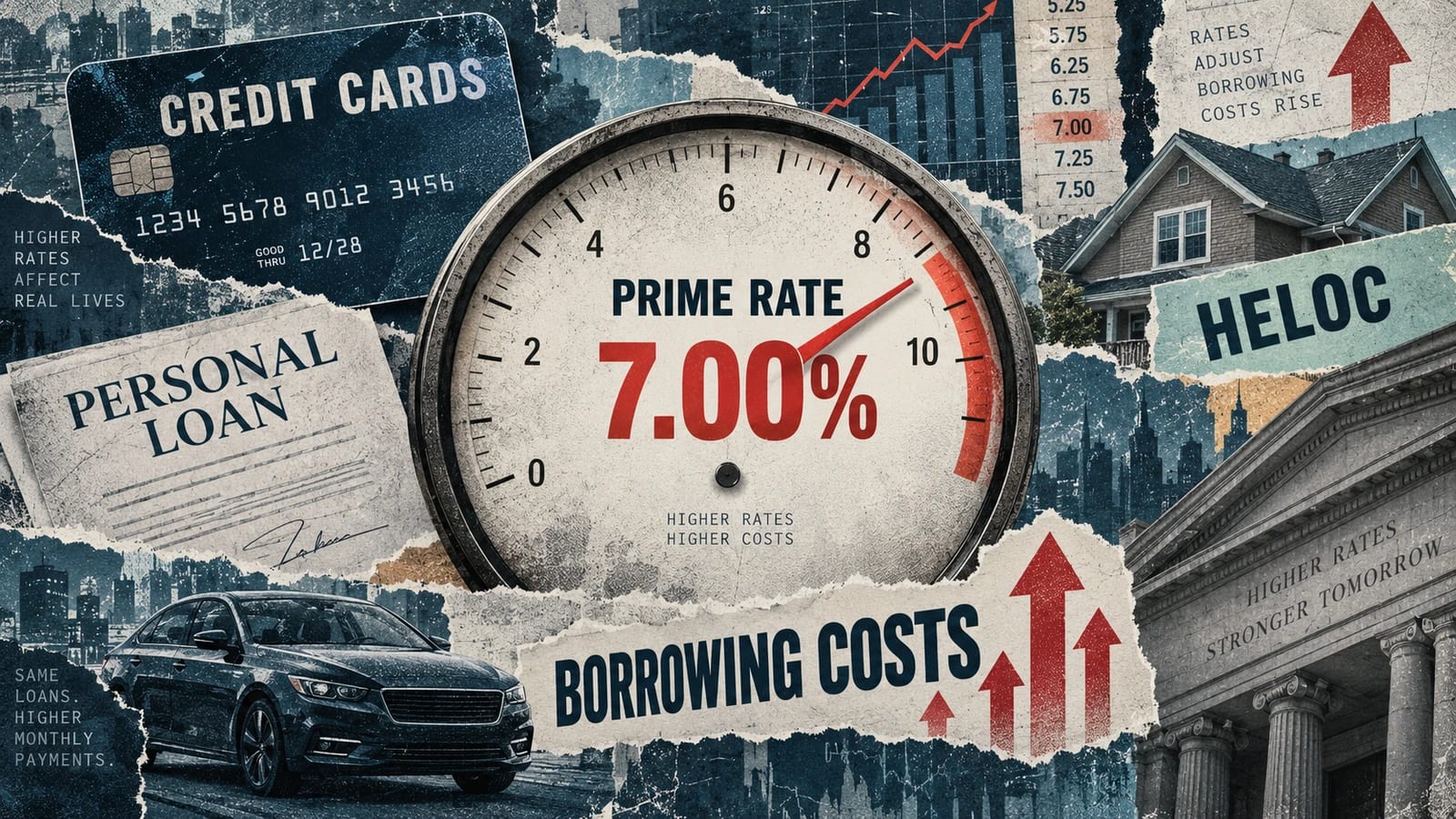
Prime Rate Explained: How It Affects Credit Cards, Personal Loans and Borrowing Costs
The U.S. prime rate is 7.00% as of September 17, 2026. Learn how it affects credit cards, HELOCs, personal loans, auto financing, and other borrowing costs.
Fresh Reporting
Browse All Stories →Latest from The Ledger
Prime Rate Explained: How It Affects Credit Cards, Personal Loans and Borrowing Costs
The U.S. prime rate is 7.00% as of September 17, 2026. Learn how it affects credit cards, HELOCs, personal loans, auto financing, and other borrowing costs.


Leave a Comment
Your email address will not be published. Required fields are marked *