••
Bitcoin Rebounds Above $80K After Falling Below $75K: What Drove the Move?
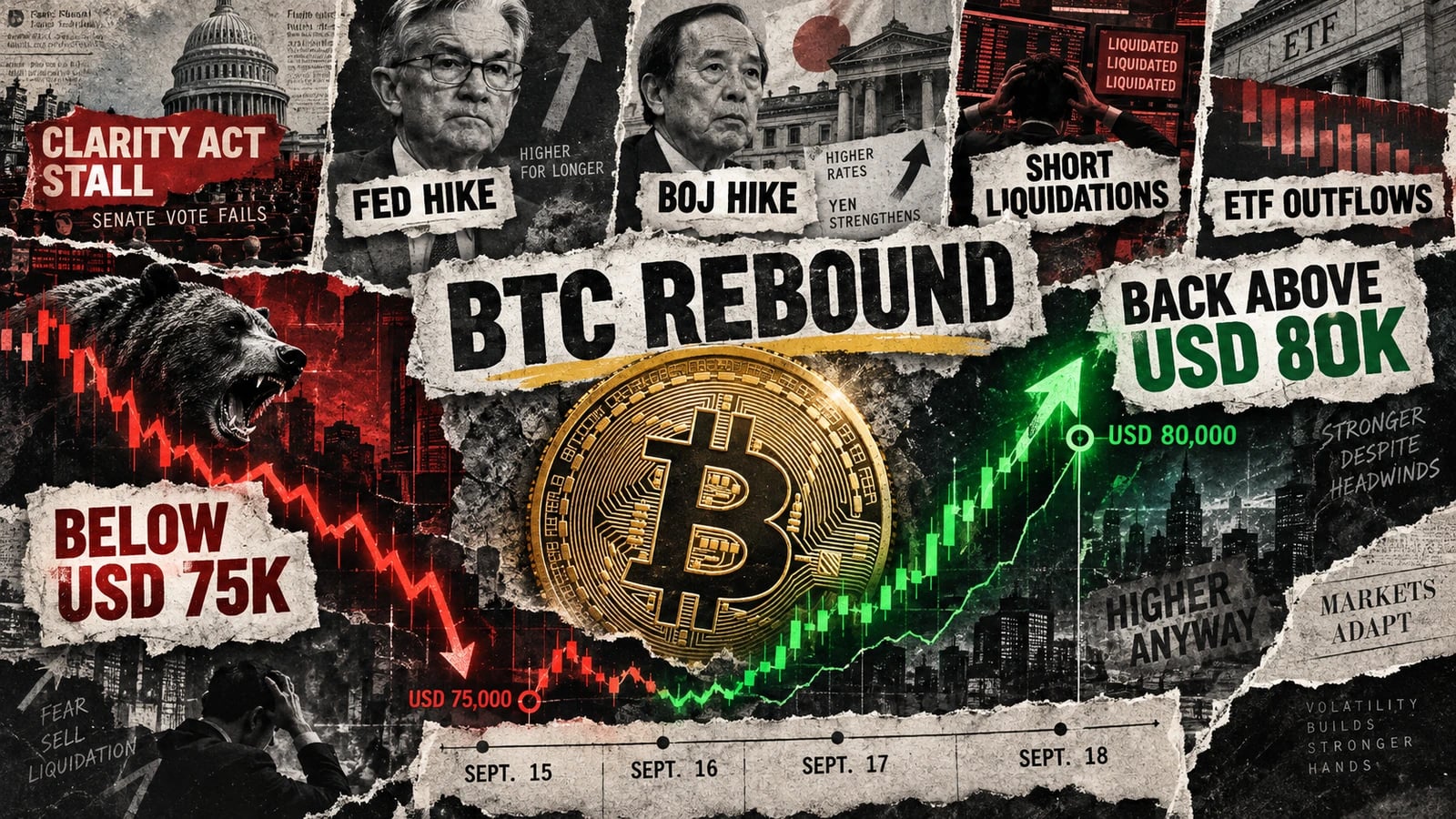
Bitcoin recovered from below USD 75,000 to above USD 80,000 after a week of major policy and market shocks. The rebound reflected already-priced-in macro news, short liquidations, volatile ETF flows and reduced immediate fears of a yen carry-trade unwind.
Share Article:
Editorial Illustration · MoneyAllotment
Quick Take
- Bitcoin's rebound from below USD 75,000 to above USD 80,000 was not driven by one bullish headline. Instead, several negative events — including the failed CLARITY Act vote, a Federal Reserve rate hike and the Bank of Japan's increase to 1.25% — failed to trigger the deeper selloff many traders expected. Once Bitcoin held near USD 75,000, short liquidations accelerated the recovery.
- ETF demand, lower near-term selling pressure and the absence of a disorderly yen carry-trade unwind also helped stabilize the market. The rebound improves short-term sentiment, but Bitcoin remains well below its 2025 record high, and the next phase will depend heavily on Fed policy, institutional flows, leverage and broader risk conditions.
Bitcoin fell below USD 75,000 on September 15 before recovering above USD 80,000 by September 18, 2026.
The rebound came during an unusually volatile week. The U.S. Senate failed to advance the Digital Asset Market Clarity Act, the Federal Reserve raised interest rates for the first time since 2023, and the Bank of Japan lifted its benchmark rate to the highest level in more than three decades.
None of those events was obviously bullish for Bitcoin.
Yet BTC recovered roughly 7% to 8% from its September 15 intraday low, helped by a combination of already-priced-in macro news, short liquidations, intermittent ETF demand and a reduction in immediate fears around a disorderly yen carry-trade unwind.
Bitcoin's September Rebound in Context
The week unfolded quickly.
| Date | Event | Approximate BTC Reaction |
|---|---|---|
| Sept. 15 | Senate fails to advance CLARITY Act | Falls below USD 75,000 |
| Sept. 16 | Fed raises rates to 3.75%–4.00% | Recovers toward USD 76,000 |
| Sept. 18 | BOJ raises rate to 1.25% | BTC moves above USD 78,000 |
| Sept. 18 | Short liquidations accelerate | BTC breaks above USD 80,000 |
Bitcoin traded as low as roughly USD 74,945 on September 15.
By September 18, it had climbed above USD 80,000 and briefly traded near USD 81,000.
The rebound did not come from one catalyst. Several forces overlapped.
The CLARITY Act Vote Was Negative — but Not a Complete Surprise
On September 15, the U.S. Senate voted 49–50 on cloture for the motion to proceed to the Digital Asset Market Clarity Act.
The measure needed 60 votes to advance.
The failed procedural vote weakened expectations that Congress would pass a comprehensive digital-asset market-structure law in the near term.
Bitcoin dropped below USD 75,000 as the market reacted.
U.S. spot Bitcoin ETFs also recorded roughly USD 450 million in net outflows around the same period, adding to the risk-off tone.
But expectations for the bill had already deteriorated before the vote.
Bitwise Investments described the setback as a "speed bump, not a roadblock," arguing that markets had already been pricing in a meaningful chance that the legislation would stall.
Prediction-market odds of passage had also fallen sharply before the final procedural vote.
That may help explain why the initial selloff did not turn into a deeper breakdown.
Crypto Regulation Kept Moving Without Congress
The failed Senate vote did not freeze U.S. crypto regulation.
On September 17, the Commodity Futures Trading Commission submitted a regulatory action titled "Regulation Crypto Asset Transactions and Regulation Crypto Asset Markets" to the White House Office of Information and Regulatory Affairs.
The filing is tracked under RIN 3038-AF80 and remains at the prerule stage.
The CFTC also issued a no-action position covering certain passive software providers interacting with regulated derivatives markets.
Separately, the Securities and Exchange Commission introduced a temporary conditional framework for certain tokenized U.S.-listed stocks.
That matters because it showed that regulatory agencies were still using their existing authority even as Congress struggled to pass broader legislation.
Strategy Executive Chairman Michael Saylor also argued that Bitcoin's institutional adoption does not necessarily have to wait for Congress, pointing to regulators, financial institutions and existing legal frameworks as other channels through which adoption can continue.
That is different from saying the failed bill itself was good for Bitcoin.
The Fed Hike Was Expected. The Outlook Mattered More.
On September 16, the Federal Reserve raised the federal funds target range by 25 basis points to 3.75%–4.00%.
It was the Fed's first rate increase since 2023.
Bitcoin had traded around USD 75,400 before the announcement and moved toward USD 76,000 afterward.
The relatively muted immediate reaction suggested that much of the rate increase had already been reflected in market prices.
The more important signal came from policymakers' projections.
Sixteen of 18 FOMC participants projected at least one additional rate increase before the end of 2026.
Fed Chair Kevin Warsh did not submit his own dot-plot projection.
The shift pushed market attention toward the possibility of another increase later in the year.
Higher rates can tighten financial conditions, increase funding costs and make cash, money-market instruments and government bonds relatively more attractive than non-yielding risk assets.
That can create a more difficult environment for Bitcoin and other speculative assets.
But the relationship is not mechanical.
Bitcoin's 2022 decline occurred during a major Federal Reserve tightening cycle, but crypto-specific shocks including Terra/Luna, Three Arrows Capital and FTX also contributed heavily to that downturn.
The BOJ Hike Did Not Trigger the Feared Yen Shock
The Bank of Japan delivered another major policy move on September 18.
It raised its benchmark rate by 25 basis points to 1.25%, the highest level in 31 years, in a 7–2 vote.
A BOJ hike can matter for global risk assets because investors have historically borrowed cheaply in yen and invested the proceeds in higher-yielding assets elsewhere.
If the yen strengthens sharply, some of those carry trades can become more expensive to maintain and may need to be unwound.
That can force selling across multiple asset classes.
The immediate reaction did not follow that pattern.
The yen weakened after the decision, initially trading near 157 per dollar and later reaching roughly 158.
That reduced immediate fears of a disorderly yen carry-trade unwind.
Bitcoin moved above USD 78,000 during the session.
That does not prove carry trades remained profitable across the board. It simply means the feared sudden yen-strengthening shock did not materialize immediately.
A Short Squeeze Accelerated the Move
By September 18, bearish positioning had built up after Bitcoin's decline below USD 75,000.
When BTC failed to continue lower and began recovering, some short positions came under pressure.
Reports citing CoinGlass showed that more than USD 192 million in leveraged crypto positions were liquidated within roughly one hour.
Short positions accounted for more than USD 183 million of that total.
Bitcoin represented about USD 119 million of the liquidations, while Ethereum accounted for roughly USD 36 million.
Short liquidations can accelerate a rally because traders closing bearish positions are forced to buy back the asset.
That buying can push prices higher, trigger additional liquidations and create a feedback loop.
Bitcoin's move from the mid-USD 76,000 range toward USD 81,000 occurred within hours.
ETF Flows Added Support — but Remained Volatile
U.S. spot Bitcoin ETF flows have provided another source of institutional demand, but the pattern has been uneven.
On September 3, U.S. spot Bitcoin ETFs recorded roughly USD 731 million in net inflows, their strongest daily total since January.
BlackRock's IBIT accounted for about USD 454 million, while ARK 21Shares and Fidelity also recorded significant inflows.
August was a strong month overall, with approximately USD 3.5 billion in net inflows.
The broader three-week period through early September produced roughly USD 3.8 billion in cumulative inflows.
But the flows were far from one-directional.
September 1 recorded around USD 236 million in net outflows, while September 15 saw approximately USD 450 million leave U.S. spot Bitcoin ETFs.
The better conclusion is that ETF demand remained an important source of capital, but it arrived in bursts rather than as a constant underlying bid.
On-Chain Data Shows Lower Selling Pressure
On-chain data also suggested that some selling pressure had eased.
CryptoQuant data cited during the recovery showed short-term-holder supply falling from around 6 million BTC to roughly 3 million BTC since February, while long-term-holder supply increased from approximately 13 million to 16 million BTC.
Part of that change reflects coins simply aging into the long-term-holder category rather than fresh accumulation.
Even so, a larger share of Bitcoin sitting with longer-term holders can reduce the amount of supply actively moving through the market.
Glassnode also placed its True Market Mean, a measure of the average acquisition cost of economically active Bitcoin supply, near USD 76,700.
Bitcoin's recovery above that area helped improve the short-term market structure.
That does not guarantee further gains. Cost-basis metrics describe positioning and investor behavior; they are not reliable price targets on their own.
The USD 83K–86K Area Remains Important
Glassnode research identified the USD 83,000 to USD 86,000 region as an important overhead area based on a combination of investor cost bases, liquidation positioning and ETF break-even levels.
That makes the zone useful for understanding where additional selling or short-covering pressure could emerge.
It should not be treated as a guaranteed resistance level or a trading signal.
Bitcoin remains substantially below its October 2025 all-time high of roughly USD 126,200.
At around USD 81,000, BTC was approximately 36% below that record.
Bitcoin was also still down on the year through September 18, although the exact year-to-date percentage depends on the price source and cutoff time.
If 2026 finishes negative, it would add to Bitcoin's previous losing calendar years, which include 2014, 2018, 2022 and 2025.
What Could Matter Next
The rebound above USD 80,000 removed some of the immediate bearish pressure, but the macro backdrop remains challenging.
One major variable is Federal Reserve policy.
If inflation remains persistent and the Fed continues tightening, higher yields and tighter financial conditions could weigh on risk assets.
ETF flows are another factor. Renewed institutional inflows could support demand, while another period of large outflows could create pressure.
The regulatory environment also remains unsettled.
Congress has not completed comprehensive crypto-market legislation, while the SEC and CFTC continue to develop narrower frameworks under existing authority.
Finally, leverage matters.
The September 18 rally was amplified by forced short liquidations. Moves driven partly by leverage can reverse quickly when positioning changes.
What Actually Changed Between USD 75K and USD 80K?
There was no single bullish headline that suddenly changed Bitcoin's outlook.
Instead, several bearish events failed to produce the deeper selloff traders had expected.
The CLARITY Act vote was disappointing but increasingly anticipated. The Fed hike was largely priced in. The BOJ decision did not produce an immediate yen-driven deleveraging shock.
Once Bitcoin stopped falling, crowded bearish positioning became vulnerable.
Short liquidations then accelerated the rebound, while intermittent ETF demand and reduced near-term selling pressure provided additional support.
That combination was enough to take BTC from below USD 75,000 to above USD 80,000 within several days.
Whether that move develops into a broader recovery will depend less on one chart level and more on monetary policy, institutional flows, leverage and the wider risk environment.
Disclaimer: This article is for informational and educational purposes only and is not personalized financial, investment, tax or legal advice. Cryptocurrency markets are highly volatile, and historical market behavior does not guarantee future results.
From the Desk
All Crypto →More in Crypto

CFTC Sends Crypto Rules to White House for Review as Congress Stalls on CLARITY Act
The CFTC sent a crypto-market regulatory action to White House review on September 17 after the Senate failed to advance the CLARITY Act. The filing remains at the prerule stage, while the SEC and CFTC continue pursuing separate crypto initiatives under existing authority.

Fresh Reporting
Browse All Stories →Latest from The Ledger

Strong Dollar Explained: Who Wins and Who Loses When the US Dollar Rises?
A stronger U.S. dollar can lower import costs and make overseas travel cheaper, while creating pressure for exporters, multinational companies and borrowers with dollar debt. This guide explains why the dollar rises and who benefits or loses.



Leave a Comment
Your email address will not be published. Required fields are marked *