••
Prime Rate Explained: How It Affects Credit Cards, Personal Loans and Borrowing Costs
The U.S. prime rate is 7.00% as of September 17, 2026. Learn how it affects credit cards, HELOCs, personal loans, auto financing, and other borrowing costs.
Share Article:
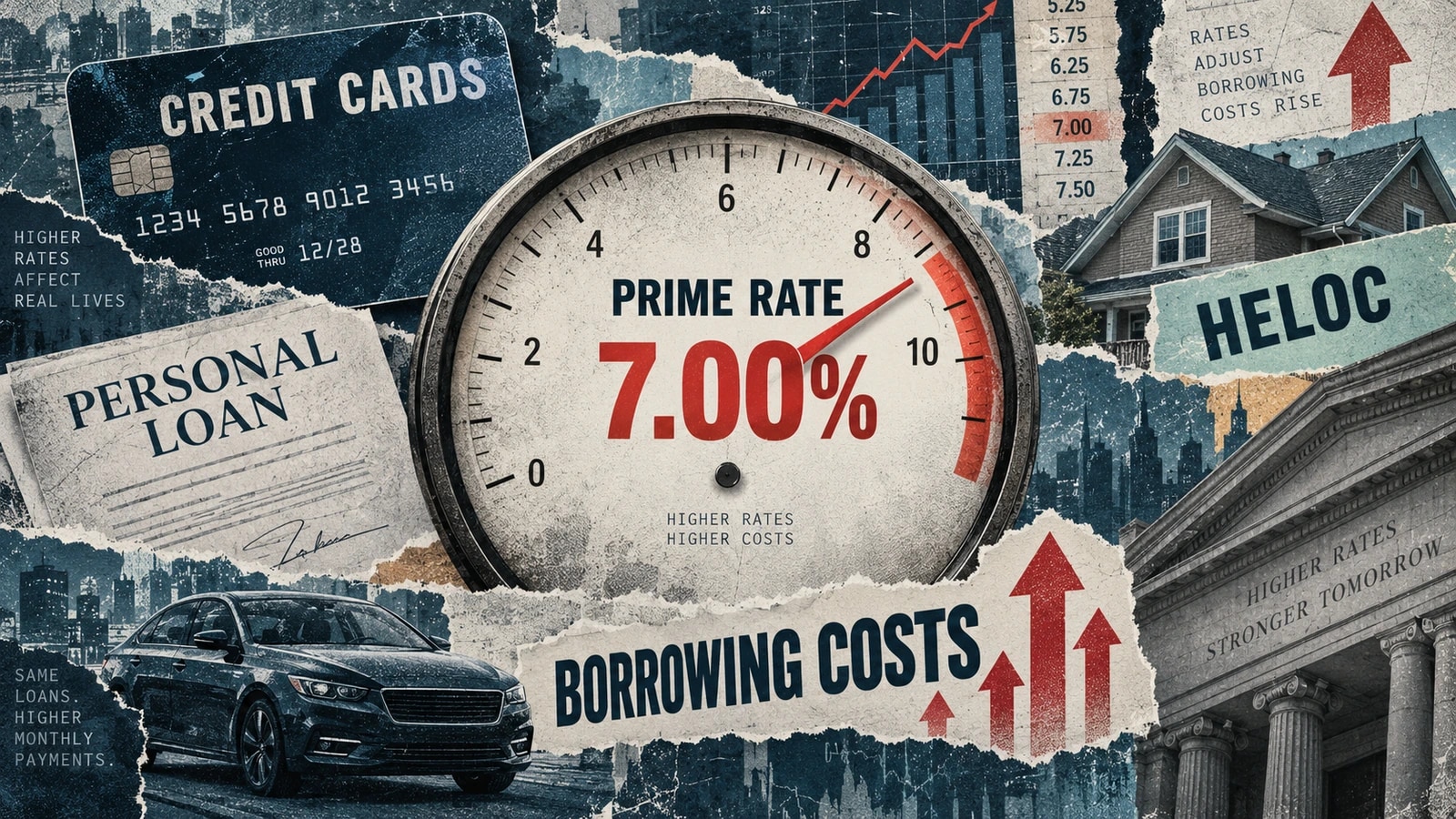
The U.S. prime rate is 7.00% as of September 17, 2026, after major banks raised their benchmark following the Federal Reserve's latest rate increase. The prime rate helps lenders price credit cards, home equity lines of credit, some personal borrowing products, and other variable-rate debt. When it moves, borrowing costs can follow quickly.
What the Prime Rate Is — and What It Is Not
The prime rate is a benchmark interest rate used by banks when pricing loans for highly creditworthy borrowers. It is not directly set by the Federal Reserve.
The Wall Street Journal publishes a widely followed U.S. prime rate based on rates posted by major banks. In practice, large U.S. banks generally move their prime rates together following significant changes in Federal Reserve policy.
The prime rate is an index, not a typical consumer borrowing offer. Consumers generally pay the prime rate plus a margin based on factors such as creditworthiness, loan type, collateral, and the lender's pricing model.
The prime rate is also different from the federal funds rate. The Fed sets a target range for overnight lending between banks. After the September 16, 2026 FOMC meeting, that target range increased to 3.75%–4.00%.
The U.S. prime rate has historically tended to run about three percentage points above the upper end of the federal funds target range. With the upper bound now at 4.00%, that convention is consistent with a 7.00% prime rate.
The Spread Between Prime and the Fed Funds Rate
The roughly 300-basis-point gap between the prime rate and the upper end of the federal funds target range is not required by law. It is a long-standing banking convention.
Fidelity's Econoday data notes that the spread averaged roughly 302 basis points during the 1990s and has remained close to three percentage points for much of the period since.
That relationship matters because prime-linked borrowing costs usually respond when the Fed changes rates. If banks raise the prime rate by 25 basis points, a variable-rate loan priced at prime plus a fixed margin will generally rise by the same 25 basis points once the new benchmark takes effect under the loan agreement.
How the Prime Rate Affects Credit Cards
Most credit cards carry variable APRs tied directly or indirectly to the prime rate. A card agreement may price the account at prime plus a margin such as 14.99%, 19.24%, or another amount set by the issuer.
When the prime rate increases, the APR on a prime-linked card can increase by the same amount, depending on the account terms and adjustment schedule.
The average credit card interest rate among new offers was about 22.19% in September 2026, according to WalletHub. That figure is far above the prime rate because credit card issuers add substantial margins to compensate for credit risk, servicing costs, rewards programs, and unsecured lending risk.
For a cardholder carrying a steady USD 5,000 balance at 22% APR, a simple annual-interest approximation is about USD 1,100 before considering daily compounding, payments, fees, or changes in the balance.
A 25-basis-point increase in APR would add roughly USD 12.50 per year to the interest cost on a constant USD 5,000 balance.
Different card types carry very different margins. WalletHub data showed store-card APRs averaging around 33.14%, secured cards around 21.8%, and student cards around 19.04%. The benchmark may be similar, but the margin added by the issuer creates most of the difference.
How the Prime Rate Affects Personal Loans
Most traditional personal installment loans are fixed-rate products. Their interest rate is set when the loan is originated and does not change simply because the prime rate later moves.
Some variable-rate personal loans and personal lines of credit are different. They may use a formula based on the prime rate plus a lender-specific margin.
For example, 1st United Credit Union lists a personal line of credit using a prime-based formula with a minimum margin of 4.65 percentage points. The actual rate available to a borrower depends on the lender's current benchmark, creditworthiness, and other underwriting factors.
Bankrate Monitor data from August 2026 showed an average rate of about 12.43% for a three-year personal loan for a borrower with a 700 FICO score. Some advertised personal-loan rates started around 6.20% for highly qualified borrowers.
The wide gap between those rates reflects much more than the prime rate. Credit score, income, loan term, debt levels, lender funding costs, loan amount, and competition can all influence the final APR.
Fixed personal loans are therefore not necessarily tied directly to prime.
| Loan Type | How It Typically Prices | Prime-Rate Relationship | Recent Rate Example |
|---|---|---|---|
| Credit card | Benchmark + issuer margin | Often directly prime-linked | About 22.19% average new offer |
| HELOC | Variable index + lender margin | Commonly prime-linked | About 7.09%–7.27% in recent Curinos samples |
| Home equity loan | Fixed at origination | Influenced by market rates, but fixed after closing | About 7.42% in recent market data |
| Personal line of credit | Often benchmark + margin | May be prime-linked | Varies by lender and borrower |
| Fixed personal loan | Fixed market rate | Not necessarily directly prime-linked | About 12.43% in one Bankrate sample |
| New auto loan, super-prime | Usually fixed | Indirectly influenced by broader rates | About 4.41% |
Rates vary by lender, credit profile, loan amount, term, collateral, and market conditions. Current advertised rates may change.
How the Prime Rate Affects HELOCs
Home equity lines of credit are among the consumer products most commonly linked to the prime rate.
A HELOC generally uses a variable benchmark plus a lender-defined margin, although the exact formula differs by lender and borrower. Some lenders may also offer introductory discounts or other pricing adjustments.
Curinos data cited by Yahoo Finance showed an average adjustable HELOC rate of about 7.09% on September 16, 2026. A separate Curinos sample cited by Forbes, based on USD 100,000 HELOCs at a 60% loan-to-value ratio, showed an average APR of about 7.27%.
Those figures come from different samples, so they should not be treated as identical market measures.
Credit score, loan-to-value ratio, relationship discounts, loan size, lender policy, and promotional pricing can all affect the final rate.
The impact of a benchmark-rate change depends on the loan contract and adjustment schedule. Some variable-rate HELOCs may adjust relatively quickly, while others reprice monthly, quarterly, or according to another schedule.
For illustration, a 25-basis-point increase on a USD 50,000 outstanding balance represents roughly:
USD 50,000 × 0.25% = USD 125 per year
That works out to approximately USD 10.42 per month in additional interest before considering principal changes or compounding.
Fixed-rate home equity loans work differently. Their interest rate is established at origination and generally remains unchanged for the loan term.
How the Prime Rate Affects Auto Loans
Auto loans are less directly tied to the prime rate than credit cards or HELOCs.
Most auto loans are fixed-rate products. Lenders price them using funding costs, borrower credit risk, loan term, vehicle type, competitive conditions, manufacturer incentives, and broader interest-rate conditions.
Prime therefore influences auto lending more indirectly.
Experian data for the second quarter of 2026 showed that super-prime borrowers averaged about 4.41% APR on new-vehicle financing, while deep-subprime borrowers averaged about 16.11%.
That gap demonstrates how strongly credit risk can affect auto-loan pricing. Two borrowers purchasing similar vehicles can receive dramatically different APRs even when the broader interest-rate environment is identical.
The Prime Rate's Recent History
The U.S. prime rate was 7.50% in August 2025.
It subsequently moved lower as banks followed Federal Reserve rate cuts:
- 7.25% effective September 18, 2025
- 7.00% effective October 30, 2025
- 6.75% effective December 11, 2025
The prime rate then remained at 6.75% for much of 2026.
On September 16, 2026, the Federal Reserve raised the federal funds target range by 25 basis points to 3.75%–4.00%.
Major banks subsequently announced a 7.00% prime rate effective September 17, 2026, restoring the conventional three-percentage-point spread above the upper end of the Fed's target range.
The sequence illustrates how closely the U.S. prime rate tends to follow major changes in Federal Reserve policy, even though the Fed does not directly set the prime rate.
What Borrowers Should Watch
The prime rate itself is an index, so an individual borrower generally cannot negotiate it. The margin, fees, loan structure, and credit profile can matter just as much.
- Check the margin on variable-rate debt. A credit card or HELOC agreement should explain the benchmark and the margin added to it.
- Compare fixed and variable structures. Fixed-rate borrowing can provide payment certainty, while variable rates can move as benchmarks change.
- Pay attention to high-APR debt. Higher-rate balances generally generate more interest expense than lower-rate debt for the same outstanding balance.
- Follow Federal Reserve decisions. Prime rates often move closely with changes in the federal funds target range, although banks ultimately set their own prime rates.
- Evaluate refinancing carefully. Refinancing may reduce borrowing costs when the new APR and fees are lower, but closing costs, loan terms, and other charges should be included in the comparison.
Disclaimer: This article is for informational and educational purposes only and is not personalized financial, investment, tax, or legal advice. Consult a licensed professional for advice specific to your situation.
Frequently Asked Questions
Does the prime rate affect fixed-rate loans?
Not after a fixed-rate loan has been originated. The rate and scheduled payment generally remain unchanged even if the prime rate later rises or falls.
Prime and broader market rates can still influence the rates lenders offer on new fixed-rate loans.
Is the prime rate the same as the federal funds rate?
No. The federal funds rate is the target range set by the Federal Reserve for overnight lending between banks.
The prime rate is set by banks and widely reported through benchmarks such as the Wall Street Journal prime rate. It has historically tended to run about three percentage points above the upper end of the federal funds target range.
Why did my credit card rate go up if the Fed did not change rates?
Several factors can affect a credit card APR independently of the prime rate.
An introductory rate may have expired, an issuer may have changed pricing where permitted under the card agreement and applicable law, or a penalty APR could apply in certain circumstances. The prime rate is only one component of the final APR.
Do all HELOCs use the prime rate as their index?
No. Prime is a common HELOC benchmark, but lenders can use other indexes or pricing structures.
The loan agreement should identify the benchmark, margin, adjustment schedule, rate caps, and other terms that determine how the HELOC rate changes.
From the Desk
All Personal Finance →More in Personal Finance
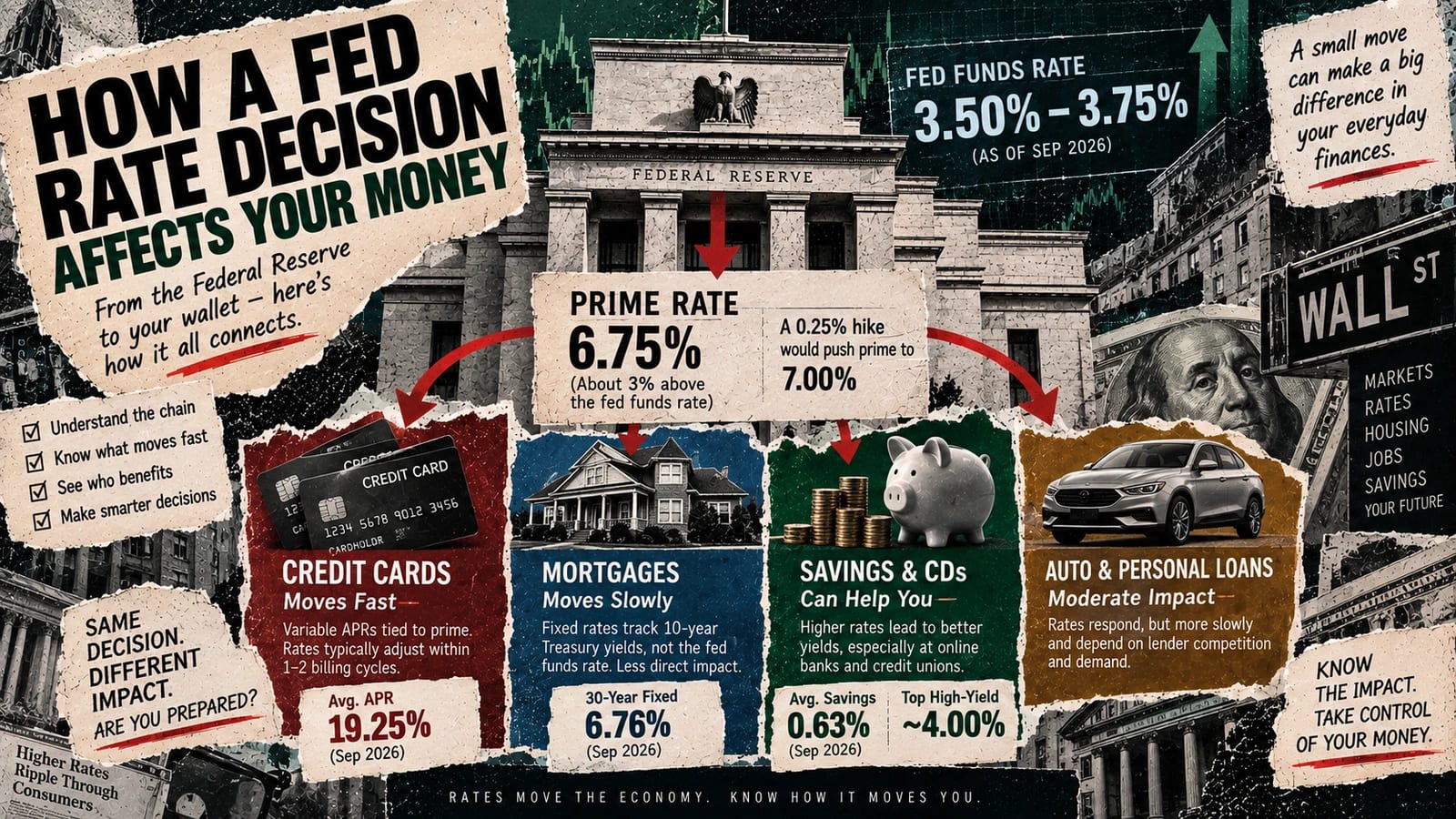
How the Fed's Rate Decisions Actually Affect Your Wallet: A Complete Guide
A complete guide to how Fed rate decisions move through the prime rate to your credit cards, mortgage, and savings account, with current September 2026 rates for each.
Fresh Reporting
Browse All Stories →Latest from The Ledger
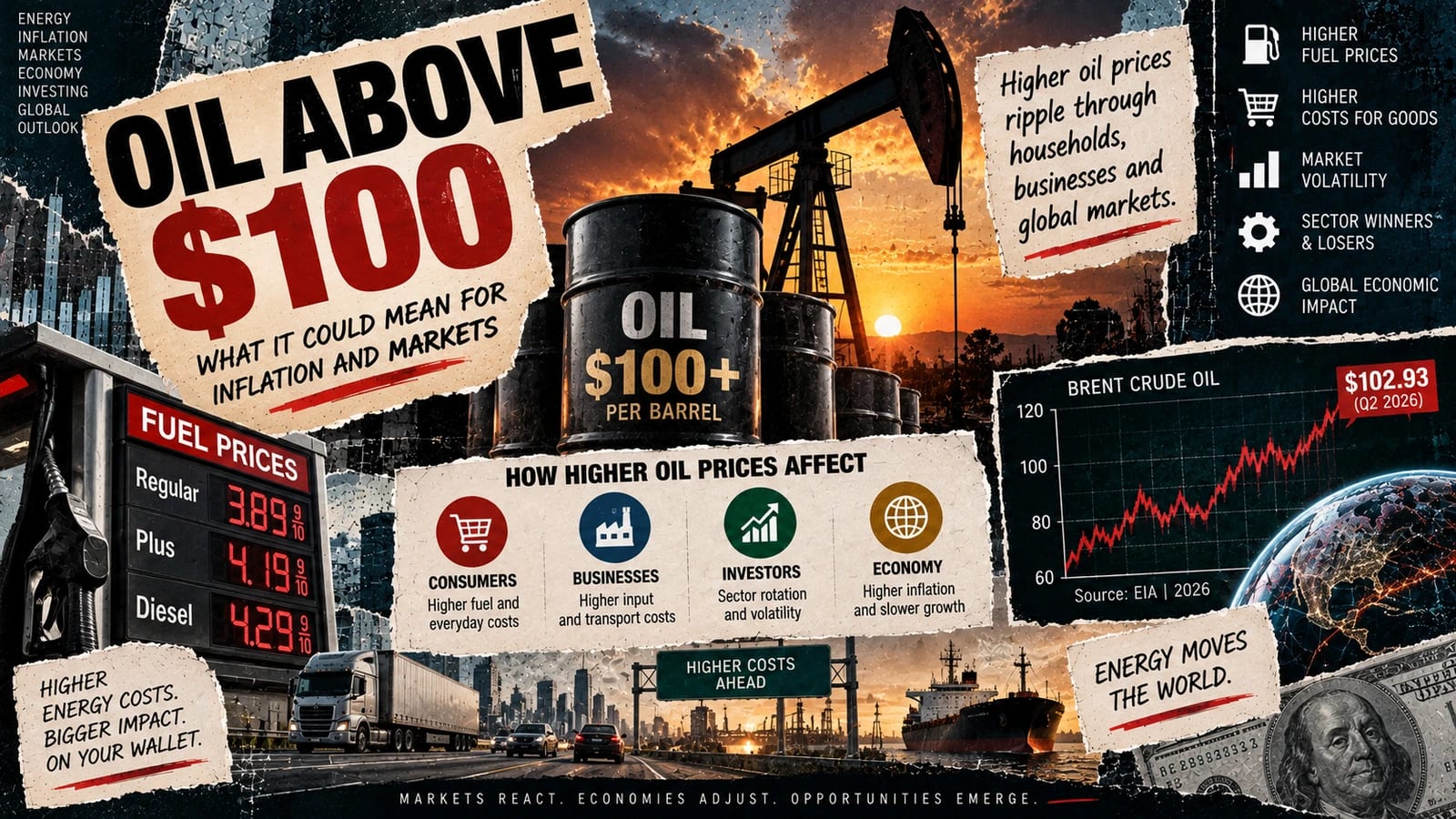
Oil Above 100 USD Inflation Pressures and Market Shifts
Oil above USD 100 per barrel raises inflation, pressures consumer spending, and reshapes sector performance. This guide explains the transmission channels, Fed dilemma, and practical implications.

Leave a Comment
Your email address will not be published. Required fields are marked *