••
Strong Dollar Explained: Who Wins and Who Loses When the US Dollar Rises?
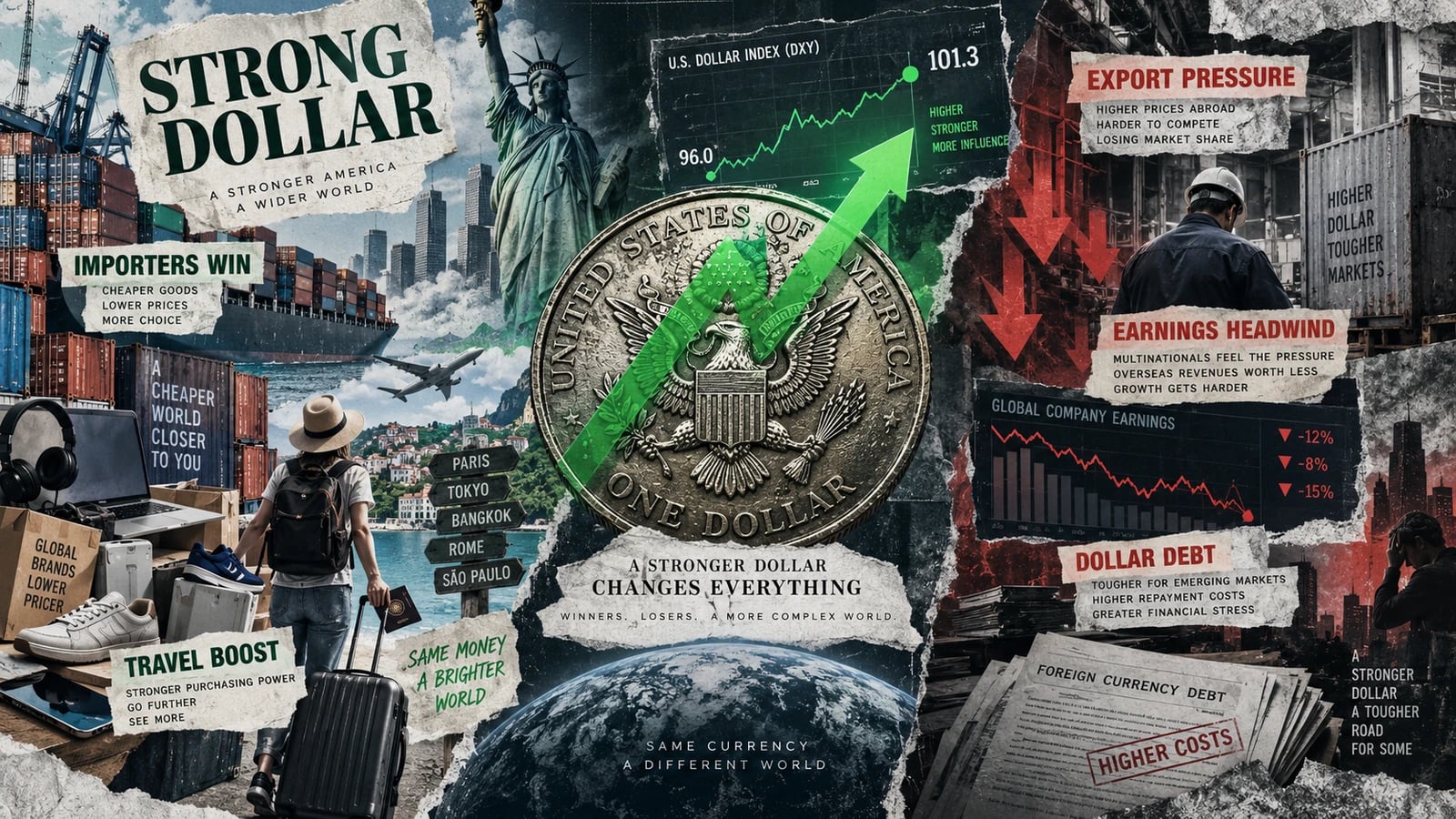
A stronger U.S. dollar can lower import costs and make overseas travel cheaper, while creating pressure for exporters, multinational companies and borrowers with dollar debt. This guide explains why the dollar rises and who benefits or loses.
Share Article:
Editorial Illustration · MoneyAllotment
A strong dollar means the U.S. currency can buy more foreign currency than before.
The U.S. Dollar Index, or DXY, was around 96.1 in late January 2026 before climbing to an intraday high of 101.80 on June 24, its highest level in about 13 months. That represented a rise of nearly 6% from the late-January level before the dollar gave back part of the move later.
A stronger dollar creates winners and losers across the global economy. U.S. importers and international travelers can benefit, while exporters, multinational companies and borrowers with dollar-denominated debt can face additional pressure.
The effects are rarely universal. They depend on exchange-rate hedging, interest rates, supply chains and which currencies are moving against the dollar.
What a "Strong Dollar" Actually Means
The ICE U.S. Dollar Index measures the dollar against a fixed basket of six major currencies:
| Currency | Weight in DXY |
|---|---|
| Euro | 57.6% |
| Japanese yen | 13.6% |
| British pound | 11.9% |
| Canadian dollar | 9.1% |
| Swedish krona | 4.2% |
| Swiss franc | 3.6% |
The euro alone accounts for 57.6% of the index, so large movements in EUR/USD can have a major influence on DXY.
When the index rises, the dollar is strengthening against the weighted basket. When it falls, the dollar is weakening.
That does not mean the dollar is strengthening against every currency.
It can rise against the yen while falling against the euro, for example. DXY also should not be confused with the dollar's purchasing power inside the United States. Domestic purchasing power depends heavily on U.S. inflation.
Why the Dollar Strengthened in 2026
Several forces contributed to the dollar's 2026 rebound.
A More Hawkish Federal Reserve
Kevin Warsh took office as Federal Reserve Chair on May 22, 2026.
By June, the Federal Reserve's Summary of Economic Projections showed policymakers moving toward a firmer interest-rate outlook as inflation remained above target.
The projections are submitted by FOMC participants, which include both voting and non-voting officials. They should not be described simply as the views of "voters."
In July, the Fed kept the federal funds target range at 3.50%–3.75% in a 9–3 vote. Beth Hammack, Neel Kashkari and Lorie Logan dissented because they preferred an immediate 25-basis-point rate increase.
That was an unusually hawkish set of dissents.
The shift eventually became an actual rate increase. On September 16, the Fed raised its target range to 3.75%–4.00%.
Higher U.S. interest rates can support the dollar because they increase the relative return available on some dollar-denominated assets. The effect is strongest when U.S. rates rise relative to rates in other major economies.
U.S. Economic Resilience
Relative economic performance also matters.
Strong capital expenditure, particularly investment connected with data centers, artificial intelligence and other technology infrastructure, supported U.S. growth and demand for capital during 2026.
When investors expect stronger returns in the United States than in other major economies, capital can move toward U.S. assets.
Those flows can increase demand for dollars.
Safe-Haven Demand
Periods of geopolitical or financial stress can also strengthen the dollar.
The Middle East conflict that escalated in 2026 increased uncertainty across energy and financial markets. During periods of stress, global investors and businesses often increase demand for highly liquid dollar assets.
That relationship is not guaranteed. Confidence in U.S. institutions, fiscal policy and Federal Reserve independence can also affect the dollar's safe-haven appeal.
Who Can Benefit From a Strong Dollar?
U.S. Consumers and Importers
A stronger dollar makes foreign currencies cheaper in dollar terms.
That can reduce the dollar cost of imported products and components. U.S. retailers or manufacturers buying goods from abroad may therefore face lower currency-related costs if their contracts and hedging arrangements allow them to benefit from the exchange-rate move.
Consumers may eventually benefit through lower prices on imported goods.
The pass-through is not immediate or complete. Shipping costs, tariffs, retailer margins, contracts and inventory purchased before the currency move can all affect how much of the exchange-rate benefit reaches the final customer.
Americans Traveling Abroad
The effect is more direct for international travelers.
If the dollar strengthens against the euro, yen or another destination currency, the same amount of dollars buys more local currency.
A hotel, meal or train ticket priced in euros can therefore cost fewer dollars even if its local-currency price does not change.
Domestic-Focused U.S. Companies
Companies earning most of their revenue and paying most of their expenses in the United States tend to have less direct foreign-currency translation exposure.
That does not make them immune to dollar movements. Supply chains, commodity costs and competitors can still create indirect effects.
But they generally face less earnings translation risk than companies generating a large share of revenue overseas.
Unhedged Foreign Holders of Dollar Assets
A foreign investor holding U.S. Treasuries, corporate bonds or equities can receive an additional local-currency gain when the dollar appreciates against the investor's home currency.
That benefit applies primarily when the currency exposure is unhedged.
An investor using currency hedges may receive little or none of the dollar's appreciation because the purpose of the hedge is to reduce foreign-exchange exposure.
Who Faces Pressure From a Strong Dollar?
U.S. Exporters
A stronger dollar can make U.S.-produced goods more expensive for overseas buyers.
Suppose a U.S. manufacturer sells equipment for USD 50,000. If the dollar appreciates sharply against the customer's currency, the local-currency cost of that same equipment rises even though the U.S. price has not changed.
That can reduce competitiveness against local or non-U.S. suppliers.
U.S. Multinationals
Companies earning revenue abroad can face a currency-translation headwind.
When overseas sales earned in euros, yen or other currencies are converted back into a stronger dollar, those revenues translate into fewer dollars.
Estimates of how much S&P 500 revenue originates outside the United States vary substantially because companies report geographic revenue differently.
The safer conclusion is that a substantial share of large U.S. companies' revenue is internationally exposed, making exchange rates meaningful for reported sales and earnings.
Emerging Markets With Dollar Debt
A strong dollar can create a more serious problem for borrowers whose debts are denominated in dollars but whose income is earned in another currency.
If the local currency weakens, more of that currency is required to make the same dollar debt payment.
The OECD's Global Debt Report 2026 highlights the refinancing pressure facing lower-income countries. About 29% of outstanding low-income-country bonds are due to mature by the end of 2026, with 52% maturing by 2028.
A stronger dollar can compound that refinancing challenge, particularly when global interest rates are also high.
Dollar strength does not automatically cause sovereign default. Debt structure, foreign reserves, fiscal policy, export revenue and access to capital markets all matter.
Commodity Importers
Many globally traded commodities, including oil, are commonly priced in U.S. dollars.
When a country's currency weakens against the dollar, it can pay more in local-currency terms for the same dollar-priced commodity.
That can raise energy and production costs and contribute to domestic inflation.
Again, the relationship is not perfectly mechanical because commodity prices themselves frequently move in the opposite direction to the dollar.
Japan Shows Why Currency Effects Are Mixed
Japan demonstrates why describing an entire economy as a simple "winner" or "loser" can be misleading.
The yen weakened to around 163.99 per dollar in July 2026, a roughly four-decade low, before strengthening later.
A weak yen can benefit Japanese exporters because overseas earnings translate into more yen. Exporters with foreign production and revenues can therefore report stronger yen-denominated results.
Japanese households and import-dependent businesses can face the opposite effect.
Japan imports significant amounts of energy and raw materials. A weaker yen raises the local-currency cost of those imports, which can increase household expenses and corporate input costs.
The correct conclusion is therefore not that "Japan loses" when the dollar rises.
The distribution of gains and losses depends on who earns foreign currency and who must purchase foreign goods.
Strong Dollar: Winners and Pressure Points
| Group | Typical Effect of a Stronger Dollar |
|---|---|
| U.S. consumers | Imported goods may become cheaper |
| U.S. travelers abroad | Foreign travel can cost less in dollar terms |
| U.S. importers | Foreign inputs can become cheaper in dollars |
| Domestic-focused companies | Less direct FX translation exposure |
| Unhedged foreign holders of USD assets | Dollar appreciation can increase local-currency returns |
| U.S. exporters | Products can become more expensive overseas |
| U.S. multinationals | Foreign revenue translates into fewer dollars |
| Dollar-indebted foreign borrowers | Debt service becomes more expensive in local currency |
| Commodity-importing economies | Dollar-priced imports can become more expensive |
| Japanese households/import-dependent firms | A weak yen can raise import costs |
| Japanese exporters | A weaker yen can increase yen value of foreign earnings |
These are common directional effects, not guaranteed outcomes. Hedging, contracts, supply chains and broader market conditions can change the result.
The Dollar Smile Theory
The dollar smile is a framework associated with currency strategist Stephen Jen.
It suggests that the dollar can perform well under two very different global conditions.
One side of the framework involves a strong U.S. economy. If the United States is growing faster or offering more attractive returns than other major economies, capital can flow toward dollar assets.
The other side involves severe global risk aversion. During crises, investors may seek the liquidity and perceived safety of U.S. assets, also supporting the dollar.
The dollar can be weaker in the middle, when global growth is healthy enough for investors to seek opportunities outside the United States while U.S. economic performance is no longer exceptional.
Parts of 2026 have resembled the strong-U.S.-economy arm of this framework, while episodes of geopolitical stress have also generated safe-haven demand.
The framework is useful for understanding possible forces behind dollar moves, but it is not a forecasting rule.
What Could Reverse Dollar Strength?
The dollar's direction depends on relative conditions rather than one variable.
Interest-Rate Differentials
Federal Reserve policy matters because global investors compare U.S. yields with yields available elsewhere.
If the Fed were to cut rates while other central banks held steady or tightened, the dollar's relative yield advantage could narrow.
But a Fed cut would not guarantee a weaker dollar. If global risk aversion simultaneously increased, safe-haven demand could offset the rate effect.
The reverse also applies.
The Fed's September 2026 rate increase supported the dollar partly because it reinforced expectations that U.S. policy would remain comparatively tight.
Relative Economic Growth
Currencies respond to differences in economic performance.
If U.S. growth slows while Europe, Japan or other major economies accelerate, international capital may find non-U.S. assets relatively more attractive.
If the U.S. continues outperforming, the dollar can remain supported even without substantially higher interest rates.
Inflation and Monetary-Policy Expectations
What matters is not simply today's inflation rate.
Currency markets respond to what inflation implies for future central-bank policy.
Persistent U.S. inflation can support the dollar if markets conclude that the Fed must maintain higher rates for longer.
On the other hand, inflation severe enough to undermine confidence in U.S. policy credibility could produce a different reaction.
Safe-Haven Confidence
The dollar's international role rests partly on the depth and liquidity of U.S. financial markets.
Confidence in institutions, fiscal policy and Federal Reserve independence can influence whether global investors continue treating dollar assets as a preferred destination during periods of stress.
Is a Strong Dollar Good or Bad?
There is no universal answer.
A strong dollar can reduce imported inflation, improve Americans' purchasing power abroad and lower some import costs.
At the same time, it can reduce export competitiveness, lower the translated value of multinational earnings and tighten financial conditions for countries or companies with dollar-denominated debt.
Its impact therefore depends on who is earning dollars, who is spending dollars, who has foreign-currency exposure and who owes money in dollars.
That is why the same currency move can be beneficial for one household, company or country while creating a significant problem for another.
From the Desk
All Markets →More in Markets
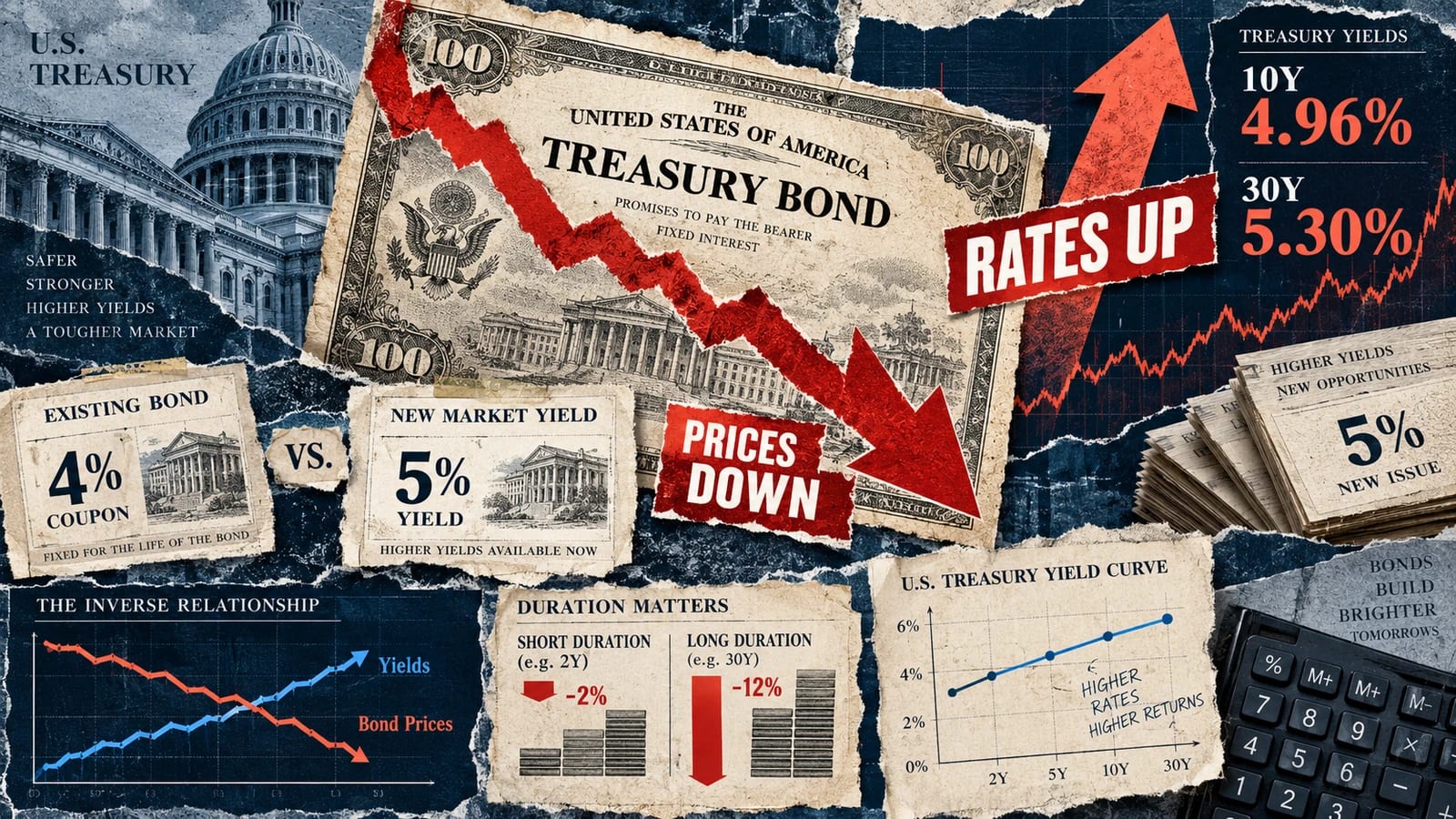
Why Bond Prices Fall When Interest Rates Rise: A Simple Guide to Bond Yields
Bond prices and interest rates generally move in opposite directions. This guide explains why, using clear bond-pricing examples, duration and yield concepts, and the 2026 interest-rate environment.
Fresh Reporting
Browse All Stories →Latest from The Ledger

Why Car Payments Are Still So High in 2026: Interest Rates, Vehicle Prices and Longer Loan Terms Explained
Car payments remain high in 2026 as near-record vehicle prices combine with elevated auto-loan rates and longer financing terms. This guide breaks down current payment data, loan costs, negative equity and the trade-offs behind longer car loans.



Leave a Comment
Your email address will not be published. Required fields are marked *