••
CFTC Sends Crypto Rules to White House for Review as Congress Stalls on CLARITY Act
The CFTC sent a crypto-market regulatory action to White House review on September 17 after the Senate failed to advance the CLARITY Act. The filing remains at the prerule stage, while the SEC and CFTC continue pursuing separate crypto initiatives under existing authority.
Share Article:
Editorial Illustration · MoneyAllotment
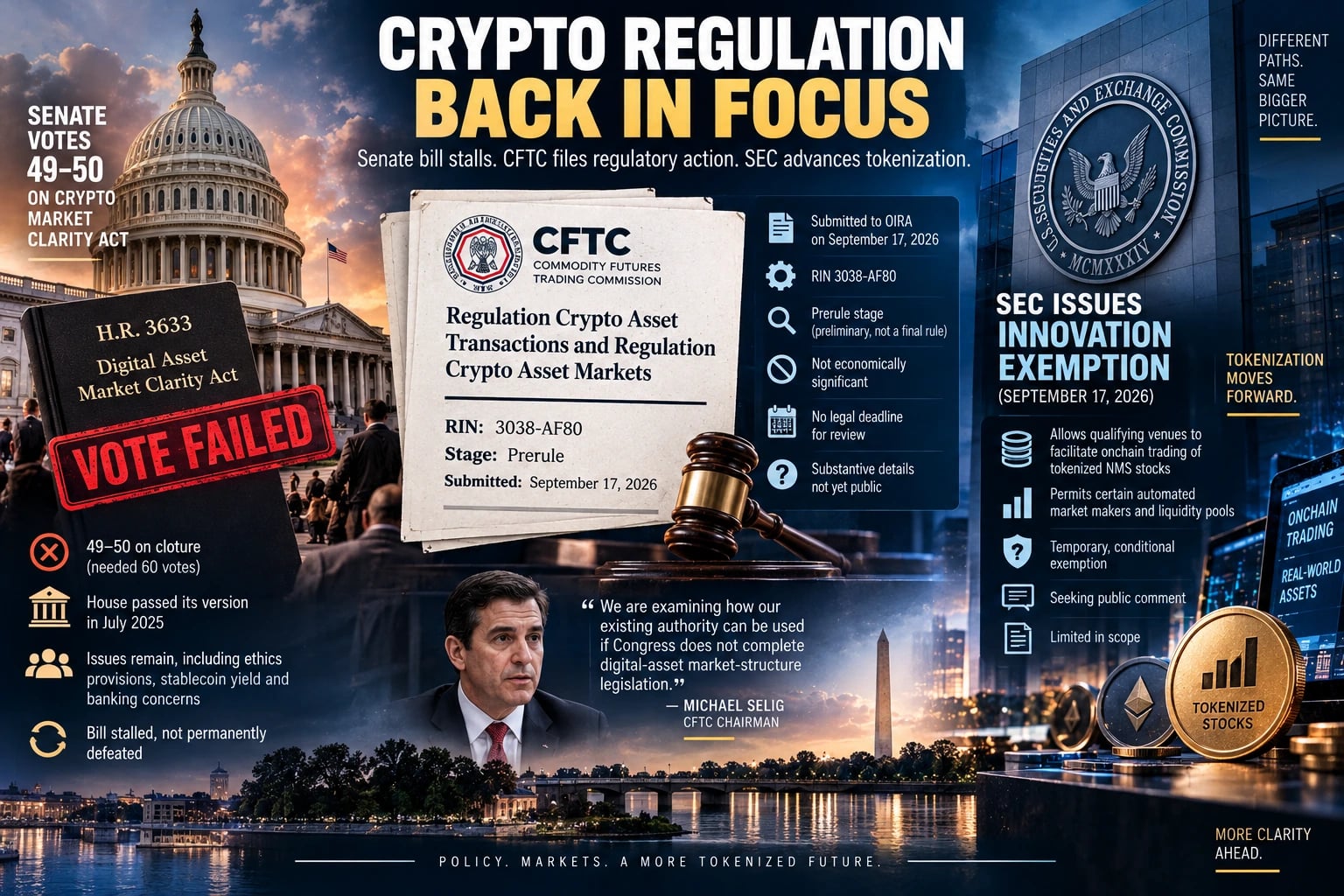
The Commodity Futures Trading Commission submitted a crypto-market regulatory action to the White House Office of Information and Regulatory Affairs on September 17, 2026, two days after the Senate failed to advance the Digital Asset Market Clarity Act.
The filing, titled "Regulation Crypto Asset Transactions and Regulation Crypto Asset Markets," is tracked under RIN 3038-AF80 and remains at the prerule stage. It is still at a preliminary point in the federal regulatory process and does not create enforceable requirements for crypto exchanges, investors or token issuers.
The CLARITY Act Vote and the CFTC's Next Move
On September 15, the Senate voted 49–50 on cloture for the motion to proceed to H.R. 3633, the Digital Asset Market Clarity Act.
The motion required three-fifths support to invoke cloture and move the legislation toward debate. It failed, leaving the bill stalled rather than finally defeated.
The House had previously passed its version of the legislation in July 2025. The bill is intended to establish a broader federal market-structure framework for digital assets and clarify the respective regulatory roles of the Securities and Exchange Commission and the CFTC.
Several issues remained disputed during Senate negotiations.
Among them were ethics provisions involving senior government officials and digital-asset interests, along with questions about rewards or yield linked to payment stablecoins. Banking groups have also raised concerns that yield-bearing stablecoin products could compete with traditional bank deposits.
The failed procedural vote sharply reduced expectations for near-term passage, but it did not permanently end consideration of the legislation. Senate leaders could attempt to revisit the measure later.
What the CFTC Actually Filed
The OIRA submission was received on September 17 and remains under White House regulatory review.
Its official title is:
Regulation Crypto Asset Transactions and Regulation Crypto Asset Markets
The action is tracked under RIN 3038-AF80 and listed at the prerule stage.
That designation is important.
A prerule action occurs before a formal Notice of Proposed Rulemaking and can include preliminary regulatory work, requests for information, advance notices or other steps that may eventually lead to a proposed rule.
It does not mean the CFTC has already issued a binding rule or even a formal proposed rule.
OIRA also lists the action as not economically significant under Executive Order 12866 and shows no legal deadline for completion of the review.
The public filing does not yet reveal the substantive details of the potential rule.
It remains unclear which crypto assets would fall within its scope, what obligations could apply to trading platforms or how the CFTC would define the limits of its existing statutory authority.
After OIRA review, the CFTC can determine how to proceed. If the agency advances a formal proposed rule, the process would generally include Commission action, publication, a public-comment period and additional steps before any final binding regulation could take effect.
Selig Had Already Signaled Rulemaking
The CFTC's move did not begin only after the Senate vote.
Chairman Michael Selig had already signaled in August that the agency was examining how its existing authority could be used if Congress did not complete digital-asset market-structure legislation.
At an August 20 Innovation Advisory Committee event, Selig discussed the absence of a comprehensive federal crypto-market structure and the agency's role in addressing digital-asset markets under existing law.
One concept under discussion has been a CFTC-regulated market structure for crypto assets, including the possible use of designated contract market frameworks for certain leveraged or margined activity.
Designated contract markets operate under core principles established by the Commodity Exchange Act, including requirements related to market integrity, financial resources, recordkeeping and regulatory oversight.
Selig was confirmed by the Senate on December 18, 2025, and sworn in on December 22 as the 16th Chairman of the CFTC.
The SEC Is Moving on a Parallel Track
The SEC also took a major tokenization-related step on September 17.
The Commission issued a temporary, conditional Innovation Exemption allowing qualifying Tokenized Securities Venues to facilitate limited onchain trading of tokenized National Market System stocks.
The framework permits certain permissioned automated market makers and liquidity pools to support tokenized versions of U.S.-listed stocks under defined conditions.
The exemption is limited in scope.
Eligible tokenized stocks must meet the conditions established by the SEC, and the framework is designed to allow controlled experimentation while regulators gather additional information.
The SEC describes the relief as a temporary, conditional exemption, rather than a permanent regulatory framework.
The agency is also seeking public comment as it considers whether more durable rules for onchain securities trading are needed.
The action applies specifically to qualifying tokenized NMS stocks. It should not be interpreted as a general exemption covering all crypto assets or all tokenized securities.
CFTC Also Gives Relief to Passive Software Providers
The CFTC made another crypto-related regulatory move on September 17.
Its Market Participants Division issued a no-action position covering certain providers of passive software used to facilitate trading with registered futures commission merchants, introducing brokers and designated contract markets.
Subject to specified conditions, staff said they would not recommend enforcement action solely because qualifying software providers had not registered as introducing brokers or associated persons of introducing brokers.
The relief is designed for software that facilitates users' interaction with already regulated derivatives-market participants.
It does not create a broad exemption from CFTC oversight, and providers must continue to satisfy the conditions established in the staff letter.
The timing is notable because it shows the agency pursuing several digital-market initiatives under its existing authority while broader legislation remains unresolved.
Regulation Cannot Fully Replace Legislation
Agency rulemaking and congressional legislation serve different functions.
The SEC and CFTC can interpret and apply statutes that Congress has already enacted. They can also issue rules, exemptions and staff guidance where existing law provides authority.
What regulators cannot do is create unlimited new statutory powers for themselves.
That distinction is central to the CLARITY Act debate.
Supporters of market-structure legislation argue that a statute could establish more durable boundaries between securities and commodities regulation and give agencies clearer authority over categories of digital-asset activity.
Agency rules, by comparison, remain subject to the statutes on which they rely and can face judicial review or later revision.
The CFTC filing and the SEC's tokenized-stock exemption therefore represent regulatory efforts within existing law rather than a complete replacement for congressional legislation.
Market Reaction Was Volatile
Crypto markets reacted negatively around the failed Senate procedural vote.
Bitcoin fell to roughly USD 76,000, while shares of several crypto-related companies also declined sharply.
The moves occurred as investors reassessed the likelihood of a comprehensive federal digital-asset market-structure law advancing in 2026.
Sentiment later improved as markets digested the SEC and CFTC actions and broader financial conditions shifted.
That rebound should not be attributed to regulation alone. Crypto prices and related equities respond to many factors, including interest rates, liquidity, risk sentiment and broader macroeconomic conditions.
What the CFTC Filing Does — and Does Not — Mean
The September 17 submission is significant because it shows that the CFTC is preparing a regulatory initiative focused specifically on crypto-asset transactions and markets.
But its current status is limited.
The filing does not:
- create a new enforceable crypto rule;
- automatically classify individual tokens as commodities or securities;
- authorize every crypto exchange to operate as a CFTC-regulated market;
- replace the CLARITY Act;
- eliminate the SEC's jurisdiction over securities; or
- establish a final compliance framework for the industry.
The filing instead marks another stage in the federal regulatory process.
The details will matter far more once the CFTC releases public text explaining exactly what it proposes.
What Comes Next
OIRA is currently reviewing the CFTC action.
There is no public legal deadline shown for the filing, and the regulatory process could continue for months or longer depending on what the agency does after White House review.
If the CFTC publishes a proposed rule, market participants and the public would generally have an opportunity to submit comments before the agency considers a final version.
Congress can also continue working on the CLARITY Act or related digital-asset legislation. The September 15 vote blocked cloture on the motion to proceed; it was not a final vote on enactment of the bill itself.
For now, U.S. crypto regulation is developing along two tracks.
Congress continues debating a broader statutory framework, while the SEC and CFTC use existing authorities to address specific areas such as tokenized securities, regulated derivatives markets, software interfaces and crypto-market structure.
Whether those agency initiatives become durable long-term rules will depend on the final regulatory text, existing statutory authority, public comment, judicial review where applicable and future policy decisions.
Disclaimer: This article is for informational and educational purposes only and is not personalized financial, investment, tax or legal advice. Regulatory proposals and agency guidance can change. Readers should consult official agency materials or a qualified professional for current legal or compliance information.
From the Desk
All Crypto →More in Crypto

What Are Tokenized Treasuries? How Wall Street Is Putting Government Debt on Blockchain
Tokenized Treasuries bring U.S. government debt onto blockchain rails. Learn how BUIDL, BENJI, USYC and Ondo products work, why institutions use them, and the key risks.

Fresh Reporting
Browse All Stories →Latest from The Ledger
What Are Tokenized Treasuries? How Wall Street Is Putting Government Debt on Blockchain
Tokenized Treasuries bring U.S. government debt onto blockchain rails. Learn how BUIDL, BENJI, USYC and Ondo products work, why institutions use them, and the key risks.




Leave a Comment
Your email address will not be published. Required fields are marked *