••
What Are Tokenized Treasuries? How Wall Street Is Putting Government Debt on Blockchain
Tokenized Treasuries bring U.S. government debt onto blockchain rails. Learn how BUIDL, BENJI, USYC and Ondo products work, why institutions use them, and the key risks.
Share Article:
Quick Take
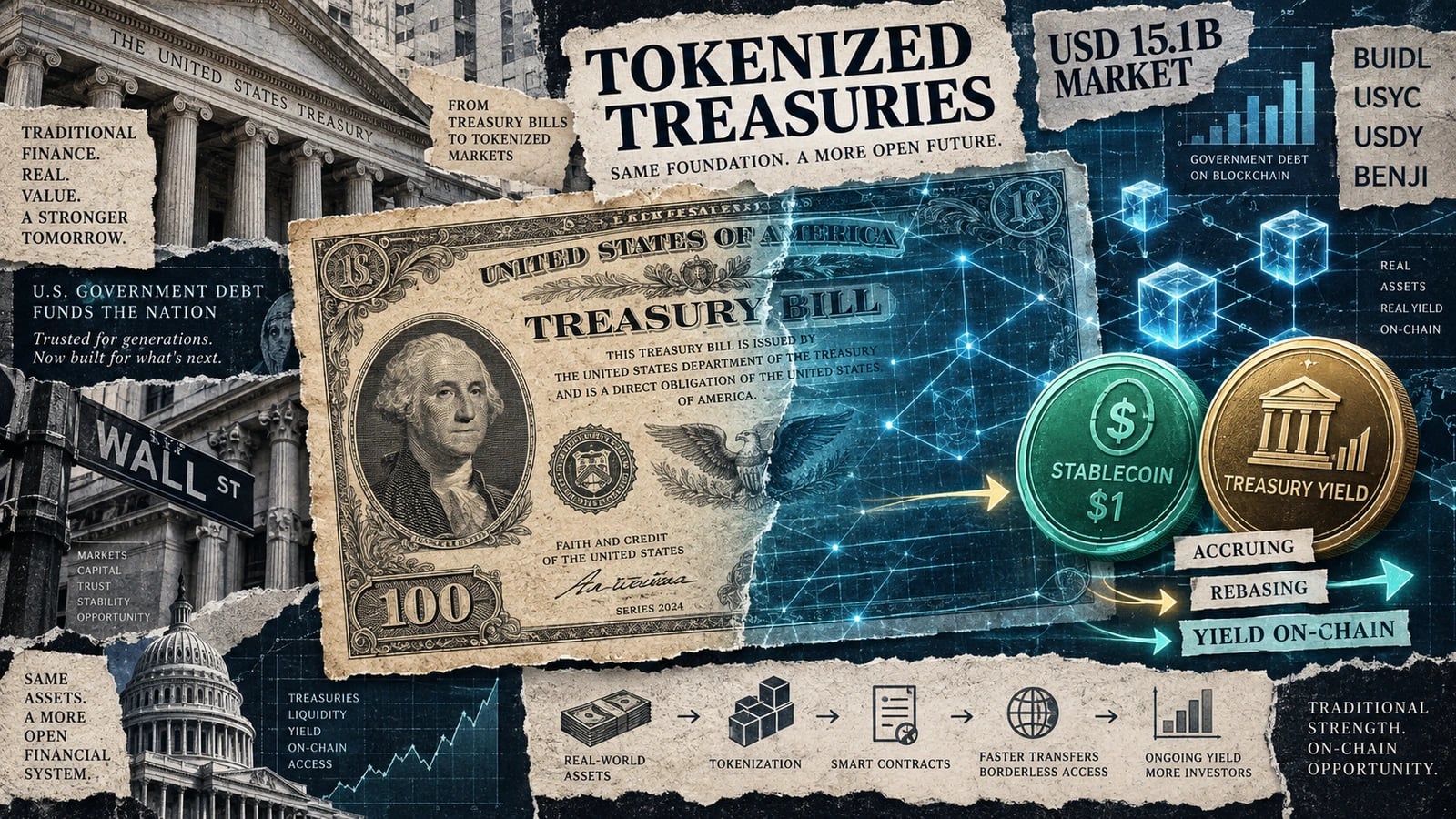
- Tokenized Treasuries are blockchain-based investment products whose value or yield is linked mainly to short-term U.S. government securities. Depending on the product, the token may represent fund shares, debt instruments, or interests in portfolios holding Treasury bills, repos, cash, or Treasury-focused funds. The market had grown to about USD 15.1 billion by the end of August 2026, led by products such as BlackRock's BUIDL, Circle's USYC, Ondo USDY, and Franklin Templeton's iBENJI.
- Their main advantage is not a higher Treasury yield, but potentially faster transfers, 24/7 onchain functionality, programmable settlement, and easier collateral movement. However, tokenized Treasuries still carry product-specific risks involving liquidity, smart contracts, custody, legal structure, regulation, and investor eligibility. They are also not the same as stablecoins, and the exact yield, redemption process, and access rules vary significantly between products.
Tokenized Treasuries are blockchain-based representations of investment products whose value or yield is primarily linked to short-term U.S. government securities.
The exact structure varies. Some tokens represent shares in regulated money market funds. Others represent interests in private funds, offshore funds, or debt instruments backed by portfolios that may include Treasury bills, repurchase agreements, bank deposits, or other Treasury-focused funds.
What they share is the use of blockchain infrastructure to represent ownership or economic exposure and, in some cases, make transfers, subscriptions, redemptions, and collateral movements faster or available outside traditional market hours.
As of August 31, 2026, the tokenized U.S. Treasury market was worth roughly USD 15.1 billion. BlackRock's BUIDL and Circle's USYC were each around USD 2.8 billion, while Ondo's USDY was around USD 2.1 billion and Franklin Templeton's iBENJI around USD 1.7 billion, based on a market snapshot reported by CoinDesk using Token Terminal data.
Large financial institutions are also moving beyond experiments. In December 2025, the Depository Trust Company, a DTCC subsidiary, received an SEC no-action letter authorizing a defined tokenization service for certain DTC-custodied assets on pre-approved blockchains for three years. Eligible assets include U.S. Treasury bills, notes and bonds, major-index ETFs and Russell 1000 securities.
How a Treasury-Linked Asset Becomes a Token
There is no single structure used by every tokenized Treasury product.
A fund may buy short-term Treasuries, Treasury-focused money market funds, repurchase agreements or similar cash-management assets. Ownership interests in that fund can then be represented by blockchain tokens.
In other structures, the token may represent a debt instrument whose returns are linked to a portfolio containing Treasury securities.
That distinction matters because buying a tokenized Treasury product does not necessarily mean owning an individual Treasury bill directly.
The legal claim, redemption process, investor eligibility, custody arrangements and rights attached to the token depend on the specific product.
Tokenized Treasuries vs. Stablecoins
Tokenized Treasury products and stablecoins can both exist on blockchain networks, but they serve different purposes.
A conventional dollar stablecoin such as USDC is generally designed to maintain a value close to USD 1 and function as a liquid digital dollar.
A tokenized Treasury product is generally designed to provide exposure to yield generated by short-term government securities or related cash-management assets.
How that yield reaches investors varies.
Some products increase their redemption price over time. Others maintain a relatively stable per-token value and distribute or rebase additional units. Fund-based products can also distribute income according to their own fund structure.
This means it is inaccurate to assume that every tokenized Treasury token simply rises in price as interest accrues.
Accruing and Rebasing Tokens
Ondo's OUSG provides a useful example of the distinction.
OUSG is an accumulating token. Its yield is reflected through an increasing redemption value.
Ondo also offers rOUSG, a rebasing version designed to maintain a USD 1 mint and redemption price while distributing yield through increases in the holder's token balance.
The economic goal may be similar, but the accounting experience is different.
An accruing token keeps the token balance relatively constant while its value increases. A rebasing token can maintain a stable unit value while the number of tokens held increases.
The structure can also affect accounting, reporting and potentially taxation. Those consequences depend on the product's legal structure and the investor's jurisdiction rather than simply on whether a token accrues or rebases.
What the Tokens Actually Represent
The legal wrapper is at least as important as the blockchain.
Franklin Templeton BENJI
Franklin Templeton's Franklin OnChain U.S. Government Money Fund, or FOBXX, is a U.S.-registered government money market fund. Its shares are represented through the BENJI token, and the fund uses public blockchain infrastructure as part of its official shareholder recordkeeping system.
Access requirements and minimum investments can vary by network, account type and distribution channel, so BENJI should not be described using one universal investment minimum.
BlackRock BUIDL
BlackRock's USD Institutional Digital Liquidity Fund, known as BUIDL, is structured for eligible institutional investors rather than broad retail distribution.
At launch, the fund used an initial investment minimum of USD 5 million and issued shares under private-placement exemptions. Securitize provides tokenization and transfer-agent infrastructure.
BUIDL invests in assets including cash, U.S. Treasury bills and repurchase agreements.
Circle USYC
USYC represents shares in the Hashnote International Short Duration Fund, a Cayman Islands mutual fund. Its portfolio includes short-term U.S. government securities and reverse-repurchase transactions.
Circle currently states that USYC is available only to non-U.S. persons, subject to additional eligibility restrictions. Yield accrues through a rising token price.
Ondo USDY
USDY is not a direct Treasury security or a conventional stablecoin.
Ondo describes it as a yield-bearing token backed by assets including short-term U.S. Treasuries and bank deposits. It is currently available to eligible non-U.S. individuals and institutions under a Regulation S structure.
Ondo OUSG
OUSG is designed for qualified investors seeking exposure to short-term U.S. Treasuries and Treasury-focused funds.
Ondo currently says most of the portfolio is invested in BlackRock's BUIDL, with additional liquidity held through other assets. OUSG is restricted to accredited investors who also meet qualified-purchaser requirements.
These examples show why the phrase tokenized Treasury describes a category rather than one standardized financial product.
How Big Is the Tokenized Treasury Market?
As of August 31, 2026, the category stood near USD 15.1 billion.
A snapshot of several major products at that date looked roughly like this:
| Product | Provider | Approx. Size, Aug. 31, 2026 | General Structure / Access |
|---|---|---|---|
| BUIDL | BlackRock / Securitize | ~USD 2.8B | Private institutional fund |
| USYC | Circle / Hashnote | ~USD 2.8B | Tokenized offshore money market fund; non-U.S. persons |
| USDY | Ondo Finance | ~USD 2.1B | Treasury-backed yield-bearing note; non-U.S. persons |
| iBENJI | Franklin Templeton | ~USD 1.7B | Tokenized fund product |
These are point-in-time market figures from August 31, 2026. Tokenized-asset values can change quickly.
The concentration at the top also shows that the market remains relatively young. A handful of large products account for a substantial percentage of total tokenized Treasury value.
Why Financial Institutions Are Moving Onchain
Tokenization does not automatically create a higher Treasury yield.
The more important potential advantages involve settlement, programmability, collateral use and interoperability.
Faster and More Flexible Settlement
Traditional U.S. securities infrastructure generally operates around established market and banking schedules. Many securities settle on T+1, while some money market fund transactions can already settle on the same day.
That means the advantage of tokenization should not be simplified to "days versus minutes."
Instead, certain tokenized products can allow subscriptions, redemptions or transfers outside conventional market hours and can interact directly with blockchain-based financial infrastructure.
USYC, for example, supports near-instant subscriptions and redemptions within available instant-redemption capacity. Larger redemptions can settle on T+0 or T+1.
Ondo's OUSG also supports 24/7 stablecoin-based mints and redemptions for eligible investors.
The practical benefit therefore depends on the product rather than on tokenization alone.
DTCC Moves Tokenization Into Production
DTCC provides a clearer example of institutional adoption.
After DTC received its SEC no-action letter in December 2025, DTCC continued developing a tokenization service for eligible DTC-custodied securities.
On July 15, 2026, DTCC conducted live production transactions involving about 40 firms. The event included U.S. Treasury repo transactions, Treasury and equity delivery-versus-payment transactions, collateral pledges and cross-chain transfers.
The activity used DTC-custodied tokenized assets and infrastructure including the Canton ecosystem and LFDT Besu.
DTCC expects its broader Tokenization Service to launch in October 2026.
That is more significant than a laboratory demonstration because established financial-market infrastructure is now testing tokenized assets in live production workflows.
Why Collateral Is a Major Use Case
Collateral mobility may become one of tokenization's most important applications.
Financial institutions constantly move Treasuries and other high-quality securities between custodians, clearing systems and counterparties to satisfy margin and collateral requirements.
Blockchain-based representations can potentially make those movements more programmable and easier to integrate across systems.
The CFTC addressed this issue in December 2025 through staff guidance on tokenized collateral in futures and swaps markets.
The guidance covers tokenized representations of assets such as U.S. Treasury securities and money market fund shares and emphasizes existing requirements around custody, liquidity, credit quality, legal enforceability and risk management.
The key principle is technology neutrality: putting an asset on a blockchain does not eliminate the financial and regulatory requirements attached to the underlying exposure.
A Bridge Between Crypto Cash and Treasury Yield
Tokenized Treasury products are also useful for institutions already operating onchain.
A stablecoin such as USDC held passively in a wallet or smart contract does not itself automatically pay the holder Treasury yield.
Eligible institutions can instead move some cash into yield-bearing products such as tokenized Treasury funds, subject to each product's access rules, liquidity terms and risks.
That allows capital to remain within blockchain-based workflows while gaining exposure to short-term government rates.
This is one reason tokenized Treasuries have become increasingly important as collateral across digital-asset markets.
Research published by the National Bureau of Economic Research in 2026 also found evidence that tokenized Treasuries can attract flows during periods of cross-asset stress, functioning in some circumstances as digital safe-haven assets.
The researchers also highlighted potential fragilities created by the interaction between onchain financial systems and offchain reserve structures.
The U.S. Regulatory Picture in 2026
The regulatory environment has become clearer, but it is still evolving.
Tokenized Securities Remain Securities
On January 28, 2026, staff from the SEC's Divisions of Corporation Finance, Investment Management, and Trading and Markets published a joint statement explaining different structures used for tokenized securities.
The statement distinguishes between securities tokenized by or on behalf of their issuer and tokenized representations created by unaffiliated third parties.
The broader principle is straightforward: using blockchain technology does not by itself remove a financial instrument from existing federal securities laws.
Banks Receive Capital-Treatment Clarification
On March 5, 2026, the Federal Reserve, FDIC and Office of the Comptroller of the Currency jointly clarified the capital treatment of eligible tokenized securities held by banking organizations.
The agencies said that an eligible tokenized security should generally receive the same capital treatment as the equivalent non-tokenized security because the capital framework is technology neutral.
The SEC's September Innovation Exemption
The regulatory picture changed again on September 17, 2026.
The SEC granted temporary, conditional exemptive relief allowing qualifying Tokenized Securities Venues to facilitate limited onchain trading of tokenized National Market System stocks through permissioned automated market makers and liquidity pools.
The action is important for the broader tokenization industry, but its scope should not be overstated.
The Innovation Exemption applies to tokenized NMS stocks, not to every tokenized security and not specifically to tokenized Treasury funds.
It is therefore evidence of the SEC experimenting with onchain market structures rather than a blanket approval framework for tokenized Treasuries.
The SEC is also seeking public comment as it considers longer-term rules.
Risks and Limitations
Tokenizing a Treasury-related investment does not eliminate risk.
Underlying Asset Risk
U.S. Treasury securities are generally regarded as having very low credit risk, but their market values can still move as interest rates change.
Products holding repos, bank deposits, other funds or additional assets may introduce risks beyond direct Treasury exposure.
Smart Contract and Blockchain Risk
Tokenized products depend on software and blockchain infrastructure.
Smart-contract bugs, network congestion, chain outages, bridge vulnerabilities or compromised wallet infrastructure can disrupt access or transfers even when the underlying securities remain intact.
Using the token inside DeFi protocols can introduce another layer of smart-contract and counterparty risk.
Custody and Legal-Structure Risk
The underlying financial assets are generally held through custodians, funds or other legal entities.
Investors therefore need to understand what the token legally represents, who holds the assets, how ownership is recorded and what happens if an issuer, administrator or technology provider fails.
Liquidity Risk
A token being transferable onchain does not guarantee a deep secondary market.
Some products depend primarily on issuer subscriptions and redemptions, and liquidity conditions can change during periods of stress.
Near-instant redemption may also be subject to limits, with larger transactions reverting to T+0, T+1 or other settlement processes.
Regulatory and Access Risk
Investor access differs dramatically across products.
Some offerings are limited to qualified purchasers or accredited investors. Others exclude U.S. persons entirely. Registered fund products can have different requirements depending on the distribution channel or blockchain network.
A token visible in a wallet is therefore not necessarily freely purchasable by every investor.
Are Tokenized Treasuries Replacing Traditional Treasuries?
Not yet.
The roughly USD 15.1 billion market figure cited earlier is a snapshot as of August 31, 2026, and remains tiny compared with the conventional U.S. Treasury market.
The more immediate development is not the replacement of Treasury securities. It is the creation of new infrastructure around how Treasury-linked assets can be owned, transferred, redeemed and used as collateral.
Traditional custody and blockchain infrastructure are also beginning to converge rather than operate as completely separate systems.
DTCC's work is a good example. The underlying assets remain within established market infrastructure, while blockchain representations add a new way to transfer or use ownership rights.
That hybrid model may be more important than the idea of replacing traditional finance entirely.
Disclaimer: This article is for informational and educational purposes only and is not personalized financial, investment, tax, or legal advice. Eligibility, regulation, tax treatment and product terms can vary by jurisdiction and may change. Review official product documentation and consult a qualified professional where appropriate.
Frequently Asked Questions
Are tokenized Treasuries basically stablecoins with yield?
No. The similarities stop at the fact that both can operate on blockchain networks.
Stablecoins are usually designed to function as digital cash and maintain a relatively stable value. Tokenized Treasury products provide exposure to Treasury-related yield through fund shares, notes or other investment structures.
Depending on the product, income may appear through a rising token value, distributions or rebasing.
Will a tokenized Treasury always match the yield on a Treasury bill?
Not necessarily.
The underlying portfolio may include Treasury bills, repos, cash, bank deposits or Treasury-focused funds. Management fees, fund expenses, liquidity reserves and product structure can all cause the investor's net return to differ from the yield on a Treasury bill bought directly.
Who can actually buy these products?
Eligibility varies significantly.
BlackRock BUIDL and Ondo OUSG have strict investor requirements. Ondo USDY and Circle USYC are currently restricted from U.S. persons.
Franklin Templeton's U.S.-registered BENJI structure is more accessible, although availability and minimums depend on the distribution channel, account type and blockchain network.
What if the blockchain used by a product goes offline?
A blockchain outage could temporarily prevent transfers or access to a token even while the underlying financial assets remain held by the fund or custodian.
Recovery options depend on the product's legal ownership records, administrator, smart-contract design and contingency procedures.
That is one reason the legal structure matters just as much as the blockchain itself.
From the Desk
All Crypto →More in Crypto
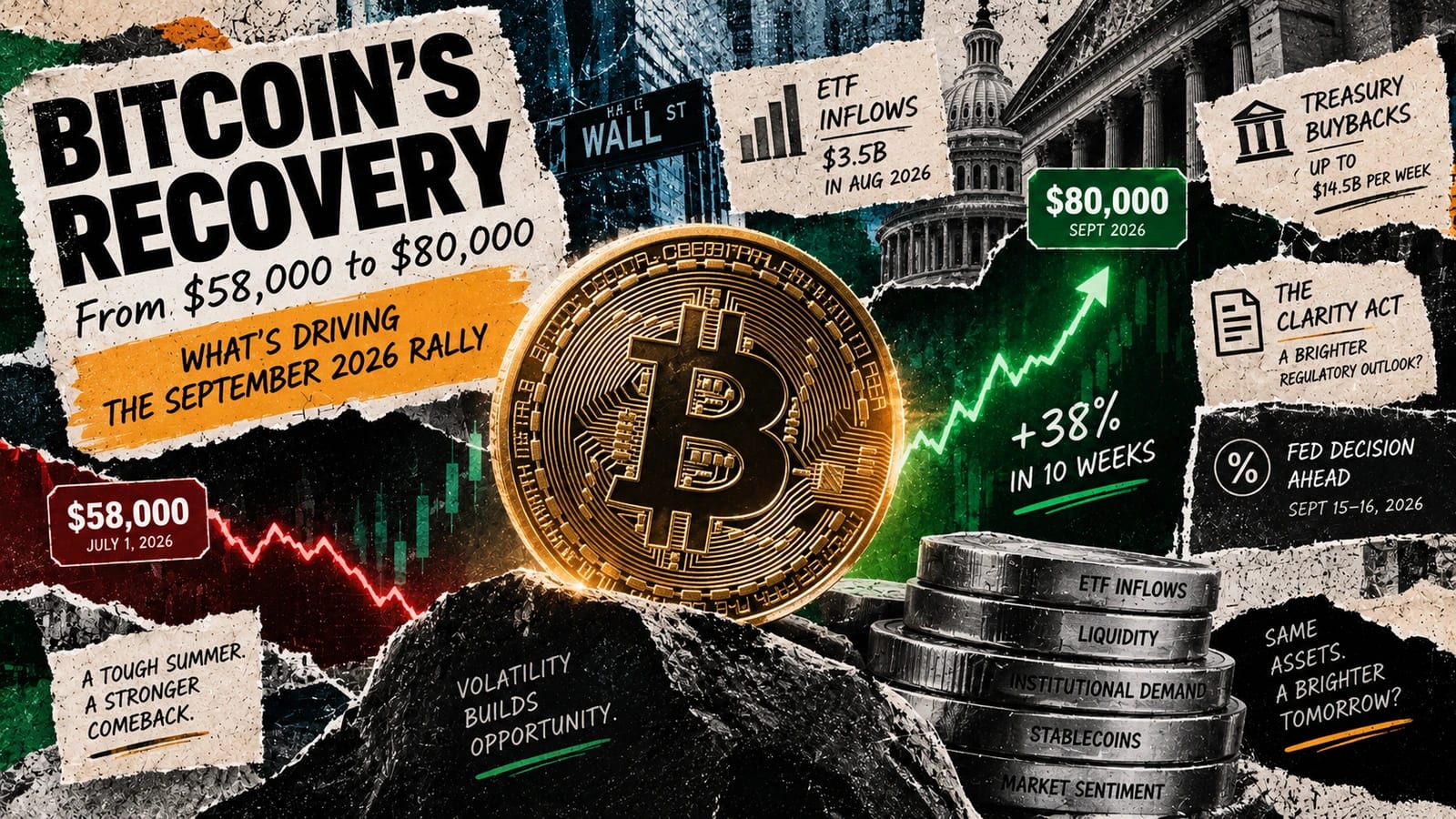
Bitcoin Recovery: From USD 58,000 to USD 80,000 in September 2026
Bitcoin recovery saw a rise from USD 58,000 to USD 80,000 by mid-September 2026, driven by a short squeeze and ETF inflows. What lies ahead?
Fresh Reporting
Browse All Stories →Latest from The Ledger
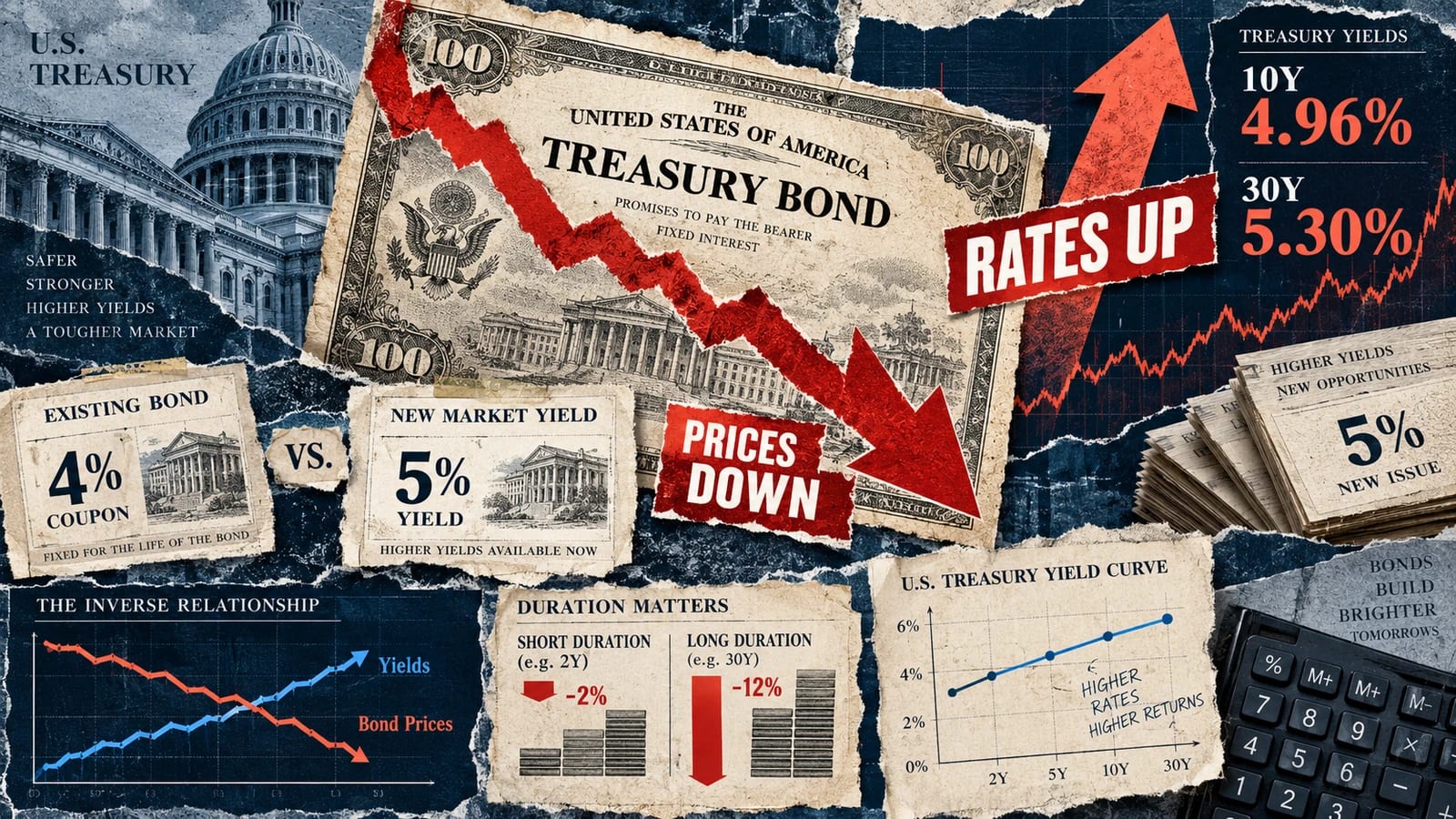
Why Bond Prices Fall When Interest Rates Rise: A Simple Guide to Bond Yields
Bond prices and interest rates generally move in opposite directions. This guide explains why, using clear bond-pricing examples, duration and yield concepts, and the 2026 interest-rate environment.


Leave a Comment
Your email address will not be published. Required fields are marked *