••
What Is AI Inference? Why the Next AI Chip Battle Is Moving Beyond Training
AI inference is running a trained model to generate outputs on new data. It now accounts for 80% to 90% of AI compute costs and is becoming the main battleground for chipmakers like NVIDIA, AMD, and OpenAI.
Share Article:
Quick Take
- AI inference is the process of running a trained model to generate outputs, and it is becoming a larger share of AI infrastructure spending as more products move from development into everyday use. Gartner expects inference workloads to account for about 55% of AI-optimized IaaS spending in 2026, putting more pressure on chipmakers and cloud providers to improve latency, throughput, memory efficiency, and cost.
- That shift is widening the AI hardware market beyond training-focused GPUs. NVIDIA, AMD, OpenAI, Google, AWS, and specialized accelerator companies are all targeting inference with different architectures, while techniques such as quantization, batching, caching, and speculative decoding help reduce serving costs. The result is a new competitive phase where running models efficiently can matter as much as training them.
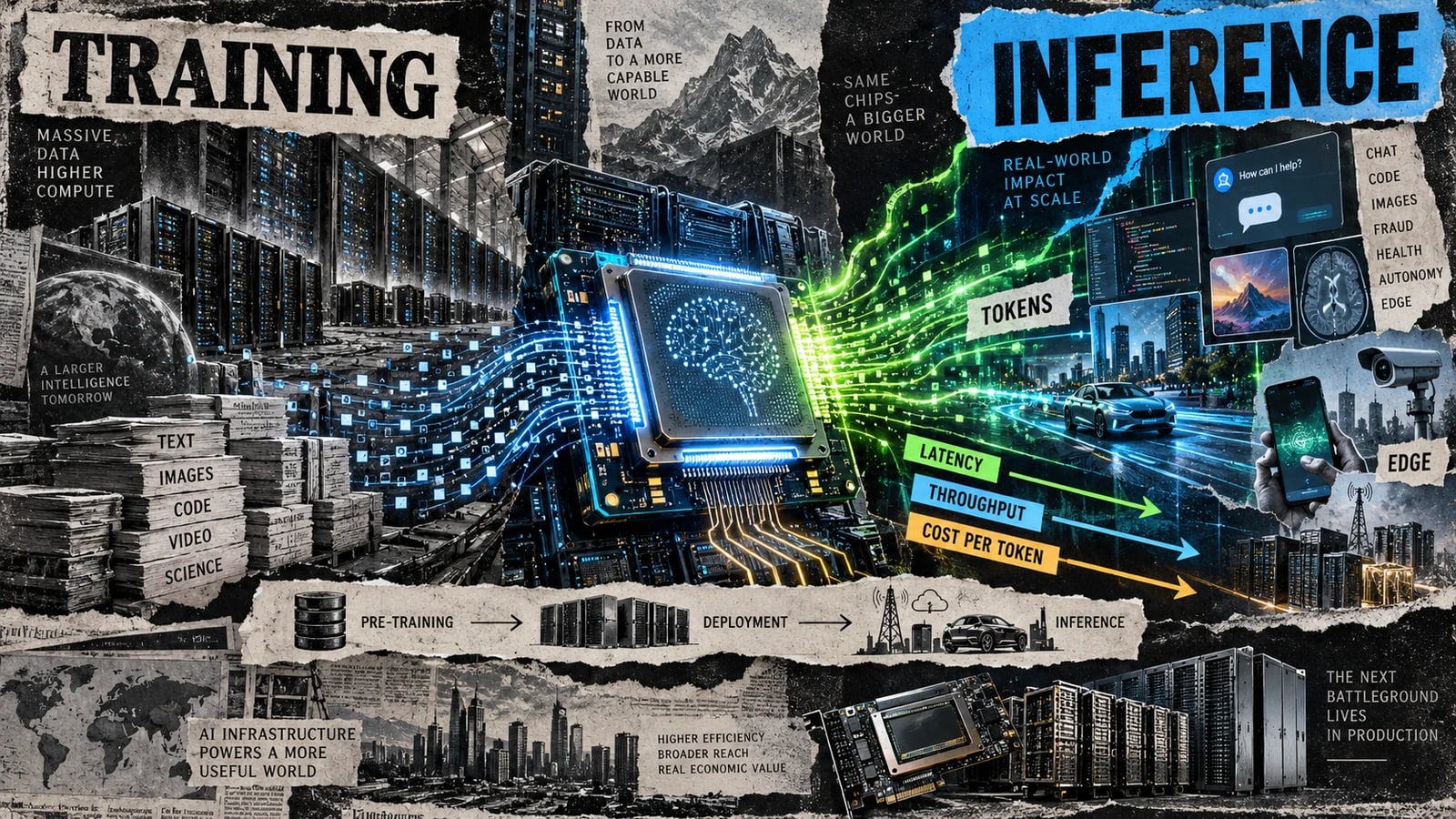
AI inference is the process of running a trained model to generate outputs from new inputs. It is what happens when you ask ChatGPT a question, use a coding assistant, generate an image, or run an AI-powered fraud-detection system. Training builds the model; inference is where that model gets used.
For years, most attention in AI hardware focused on training increasingly large models. That balance is shifting. Gartner forecasts that within AI-optimized infrastructure-as-a-service spending, inference workloads will account for about USD 23.3 billion in 2026, compared with roughly USD 19 billion for training. Inference is becoming a larger part of production AI spending and a major competitive target for chipmakers and cloud providers.
What Happens During AI Inference
During training, a model adjusts its parameters as it learns patterns from data. In standard inference, those trained parameters remain fixed while the model processes an input and generates an output.
That distinction matters. A model answering a question does not normally rewrite its underlying weights based on that individual request. Applications can still store conversation history, retrieve external information, or maintain memory outside the model, but those features are separate from the base inference process.
| Stage | Main Purpose | Typical Data | Main Hardware Priorities | Frequency |
|---|---|---|---|---|
| Training | Learn or update model parameters | Large training datasets, often using self-supervised or labeled data | High parallel compute, memory capacity, interconnect bandwidth | Periodic |
| Inference | Generate outputs from a trained model | User prompts, sensor data, documents, images, or other production inputs | Latency, throughput, memory bandwidth, efficiency | Continuous in production |
The bottlenecks also differ by workload.
Large-language-model inference is not universally memory-bound. Prompt processing, often called prefill, can be highly compute-intensive because many input tokens are processed in parallel. The decode stage, where tokens are generated sequentially, is often more sensitive to memory bandwidth, latency, and cache behavior.
That difference is one reason hardware optimized for training is not automatically the most efficient option for every inference workload.
The Model Lifecycle
Before a model begins serving users, it typically passes through several stages.
Pre-training is where a model learns broad statistical patterns from large datasets. A forward pass produces predictions, a loss function measures error, and optimization updates the model's parameters through backpropagation.
Post-training can include techniques such as supervised fine-tuning, reinforcement learning, preference optimization, or other methods designed to improve how the model behaves for particular tasks.
Deployment optimization prepares the model for production. Depending on the system, this can include quantization, compilation, model partitioning, batching strategies, caching, or other techniques intended to reduce latency and infrastructure costs.
Inference begins when the resulting model is used to process production requests.
Why Inference Is Becoming More Important
Three forces are pushing more AI infrastructure investment toward inference.
The first is usage volume. Training may happen periodically, but inference happens every time someone uses an AI service. A widely adopted model can process millions or billions of requests long after its original training run has finished.
Gartner forecasts that inference will represent about 55% of AI-optimized IaaS spending in 2026 and approximately 59% in 2027. That does not mean inference always accounts for the same share of every model's total cost, but it illustrates how production workloads are taking a growing share of AI infrastructure spending.
The second force is agentic AI. Systems that plan tasks, call tools, write and execute code, search databases, and inspect their own intermediate results can generate far more inference activity than a simple one-question, one-answer chatbot.
A single agentic task may require repeated model calls before the system produces a final result. That increases the importance of throughput, latency, memory efficiency, and cost per generated token.
The third force is market growth. Fortune Business Insights estimates that the global AI inference market was worth about USD 103.73 billion in 2025 and could reach USD 117.80 billion in 2026.
Forecasts vary widely because research firms define inference infrastructure and services differently, but the direction is clear: companies are spending heavily on hardware and software designed to run AI models efficiently after training.
How the AI Chip Battle Is Changing
NVIDIA remains the dominant supplier of AI accelerators, but inference creates openings for architectures optimized around latency, memory movement, and token generation.
That has encouraged GPU vendors, cloud providers, and specialized chip companies to pursue different designs.
NVIDIA and Groq
In December 2025, NVIDIA entered a non-exclusive technology licensing agreement with Groq covering inference technology. Groq remained an independent company, while founder Jonathan Ross, president Sunny Madra, and other team members joined NVIDIA.
The distinction matters: NVIDIA did not simply acquire Groq as a company.
NVIDIA has since integrated Groq technology into its broader inference strategy through the Groq 3 LPX platform.
A Groq 3 LPX rack contains 256 LPUs and 128 GB of total on-chip SRAM. NVIDIA lists roughly 40 PB/s of aggregate on-chip SRAM bandwidth across the rack, while each LPU provides about 150 TB/s of SRAM bandwidth.
The system is designed to work alongside NVIDIA's Vera Rubin platform rather than replace GPUs entirely.
In NVIDIA's disaggregated inference architecture, Vera Rubin handles compute-intensive work including prefill and attention operations, while Groq LPX hardware can accelerate latency-sensitive feed-forward and mixture-of-experts portions of token generation.
NVIDIA says the combination can deliver up to 35 times higher inference throughput per megawatt than previous-generation configurations under its tested conditions. That is a vendor benchmark rather than a universal performance result, so actual gains depend on the model and workload.
Artificial Analysis testing cited by NVIDIA also showed Groq 3 LPX exceeding 3,000 output tokens per second on a large-model workload with a long context window, illustrating the type of low-latency inference the architecture is designed to target.
AMD's Rack-Scale Approach
AMD is pursuing inference and training through its Instinct accelerator lineup.
The Instinct MI455X powers AMD's Helios rack-scale platform. A Helios rack combines 72 liquid-cooled MI455X GPUs with EPYC CPUs and Pensando networking.
AMD says the system can deliver up to 2.9 exaFLOPS of FP4 performance and includes roughly 31 TB of HBM4 memory across the rack.
OpenAI has said deployments using AMD's Helios platform are expected to begin in the fourth quarter of 2026, with broader expansion planned through 2027.
The strategy differs from a highly specialized inference accelerator. AMD is positioning Helios as a rack-scale platform capable of supporting multiple AI workloads while competing on memory capacity, compute density, networking, and overall system efficiency.
OpenAI's Jalapeño Chip
OpenAI is also developing custom inference silicon.
Its Jalapeño chip was developed with Broadcom and manufactured using TSMC's 3-nanometer process. The project is designed around inference workloads used by OpenAI's systems.
OpenAI's first published benchmark results show why custom silicon is attractive.
In an InferenceX benchmark running DeepSeek R1 670B, OpenAI reported that Jalapeño achieved about 3.6 times lower end-to-end latency than the compared NVIDIA GB300 configuration.
That result is workload-specific and should not be interpreted as Jalapeño being universally 3.6 times faster than GB300 across all AI models.
Initial Jalapeño deployment is expected to begin at relatively small scale before broader deployment expands.
The wider inference market also includes Google's TPUs, Amazon's Inferentia chips, Microsoft's custom AI silicon, Qualcomm accelerators, and other specialized designs.
The result is a more varied hardware market than the early training boom suggested.
Why Inference Economics Matter
Inference creates a recurring cost.
Training expenses are concentrated around model development and updates. Inference costs continue for as long as users, applications, and automated agents keep sending requests.
That changes the economics of AI software.
A successful traditional web application can often serve an additional user at relatively low incremental cost. Generative AI applications may consume additional accelerator time, memory bandwidth, networking, and energy every time usage increases.
This is why cost per token, requests per second, latency, utilization, and energy efficiency have become important competitive metrics.
Cloud and hardware providers are responding with infrastructure designed specifically to improve inference economics.
Google says TPU v5e can deliver up to roughly 2.5 times greater inference performance per dollar than TPU v4 on tested workloads.
Amazon's first-generation Inf1 instances were marketed as offering up to 70% lower cost per inference than comparable EC2 GPU instances. For the newer Inferentia2 architecture, AWS instead highlights up to four times higher throughput and up to 10 times lower latency compared with first-generation Inferentia.
Those numbers come from vendor benchmarks and should be interpreted within the specific workloads and configurations tested.
The broader point is that AI infrastructure competition is increasingly about more than peak compute. Providers are competing on how cheaply and quickly they can turn trained models into production responses.
Optimization Techniques That Reduce Inference Costs
Hardware is only part of the equation. Software techniques can substantially change how much compute an inference workload requires.
Quantization
Quantization stores or computes model values using lower-precision numerical formats.
Moving from 16-bit representations to 8-bit, 4-bit, or other lower-precision formats can reduce memory requirements and improve efficiency on compatible hardware.
The trade-off varies by model. Some models tolerate aggressive quantization with little visible degradation, while others lose accuracy on reasoning, mathematical, or specialized tasks.
QLoRA demonstrated that a frozen 4-bit quantized base model could be fine-tuned efficiently while maintaining strong task performance. It should not, however, be interpreted as proving a universal percentage reduction in inference cost or a fixed percentage of retained model quality.
Knowledge Distillation
Knowledge distillation trains a smaller model to reproduce some of the behavior of a larger model.
A well-designed distilled model can be cheaper and faster to serve, particularly when an application does not require the full capability of a frontier-scale model.
The trade-off is that smaller models may struggle more on unusual, highly complex, or long-horizon tasks.
Pruning
Pruning removes model weights or structures that contribute relatively little to outputs.
The practical performance benefit depends heavily on how the resulting sparsity maps to the target hardware. Removing parameters does not automatically make inference faster if the hardware cannot efficiently exploit the sparse representation.
Serving-Level Optimization
Serving systems can also improve efficiency without modifying the model itself.
Dynamic batching combines multiple requests so accelerators spend less time idle.
Speculative decoding uses a smaller or faster model to propose tokens that a larger model can verify, potentially reducing generation latency when the technique works well.
Caching can avoid recomputing repeated prompt components or intermediate results.
Modern inference platforms increasingly combine several of these methods.
What Edge Inference Changes
Inference does not have to happen in a data center.
Edge inference runs AI models on devices such as smartphones, cameras, industrial equipment, vehicles, and local servers instead of sending every request to a remote cloud.
The advantages can include lower latency, reduced bandwidth usage, and stronger control over sensitive data.
An autonomous system may need to react faster than a cloud round trip allows. A factory camera can inspect products locally without continuously uploading video. A medical device may process sensitive information on-site instead of transmitting raw data to an external service.
Market estimates for edge AI vary sharply because research firms define edge AI, edge inference, hardware, software, and services differently. That makes headline market-size figures difficult to compare directly.
The underlying engineering challenge is clearer: edge devices have tighter limits on memory, power consumption, cooling, and compute capacity than data-center accelerators.
Specialized hardware is addressing some of those constraints.
Axelera AI's Europa accelerator, for example, is rated at up to 629 TOPS with a 45-watt thermal design power and targets workloads including computer vision, robotics, edge servers, and automotive systems.
Healthcare companies are also experimenting with local inference.
At NVIDIA GTC 2026, Innodisk demonstrated an APEX-X200 edge AI platform running a multimodal medical vision-language model locally. The demonstration analyzed X-ray and CT images, generated draft reports, and produced patient-facing explanations without sending the workload to a cloud service.
It should be viewed as a technology demonstration rather than evidence of clinical validation or regulatory approval.
Many real deployments are likely to remain hybrid. Latency-sensitive or privacy-sensitive tasks can run locally, while larger models and computationally intensive work remain in centralized infrastructure.
Why Inference Efficiency Is Becoming a Competitive Advantage
The first wave of generative AI infrastructure spending centered on the ability to train increasingly capable models. Production deployment adds a different constraint: those models have to respond quickly and economically at large scale.
That shifts attention toward cost per token, memory bandwidth, latency, power consumption, utilization, and software efficiency. A faster accelerator offers limited business value if the surrounding system cannot keep it busy or if serving costs remain too high.
The market is therefore broadening beyond general-purpose GPUs. Specialized inference accelerators, cloud-provider silicon, custom ASICs, rack-scale systems, and edge processors are competing alongside GPUs for specific workloads.
Training capability will remain important. But as AI systems move into everyday software and automated workflows, the ability to serve those models efficiently is becoming a separate engineering and economic advantage.
Frequently Asked Questions
What is the difference between AI training and inference?
Training changes a model by updating its parameters from data. Inference takes those learned parameters and uses them to process new prompts, images, sensor readings, documents, or other inputs.
Under standard inference, the model's base weights remain unchanged.
Why is AI inference becoming more important?
Every production request consumes inference resources. As AI products gain users and agentic systems make repeated model calls, serving capacity becomes a recurring infrastructure requirement rather than a one-time development expense.
Gartner expects inference to account for a majority of AI-optimized IaaS spending in 2026.
Is AI inference always memory-bound?
No. The bottleneck changes with the workload.
Prompt prefill can place more pressure on compute, while sequential token generation is often more sensitive to memory bandwidth and latency. Model size, batch size, context length, hardware, and serving architecture all affect which constraint dominates.
What hardware can run AI inference?
GPUs remain common, but production systems increasingly use a wider mix of hardware, including TPUs, custom ASICs, inference-focused accelerators, and edge AI processors.
The best fit depends on model size, latency requirements, throughput, power limits, software support, and total serving cost.
Can inference costs be reduced without changing hardware?
Often, yes. Quantization and distillation can reduce model requirements, while batching, caching, and speculative decoding can improve the efficiency of the serving layer.
The gains vary enough that real-world benchmarking is usually more useful than assuming one optimization will work equally well for every model.
From the Desk
All Technology →More in Technology

IDScan Data Breach 2026: What the 153 Million Record Claim Means for Businesses
A dark-web service claimed access to more than 153 million driver's license records apparently linked to IDScan.net. IDScan has confirmed unauthorized access, but the final scope has not been publicly verified.

Fresh Reporting
Browse All Stories →Latest from The Ledger

Fed Rate vs Mortgage Rate: Why Mortgage Rates Don't Move Exactly With the Fed
The Fed raised rates on September 16, 2026, but mortgage rates had already priced in the move. Here's why mortgage rates track the 10-year Treasury yield and MBS spreads, not the fed funds rate.





Leave a Comment
Your email address will not be published. Required fields are marked *