••
Why Bond Prices Fall When Interest Rates Rise: A Simple Guide to Bond Yields
Bond prices and interest rates generally move in opposite directions. This guide explains why, using clear bond-pricing examples, duration and yield concepts, and the 2026 interest-rate environment.
Share Article:
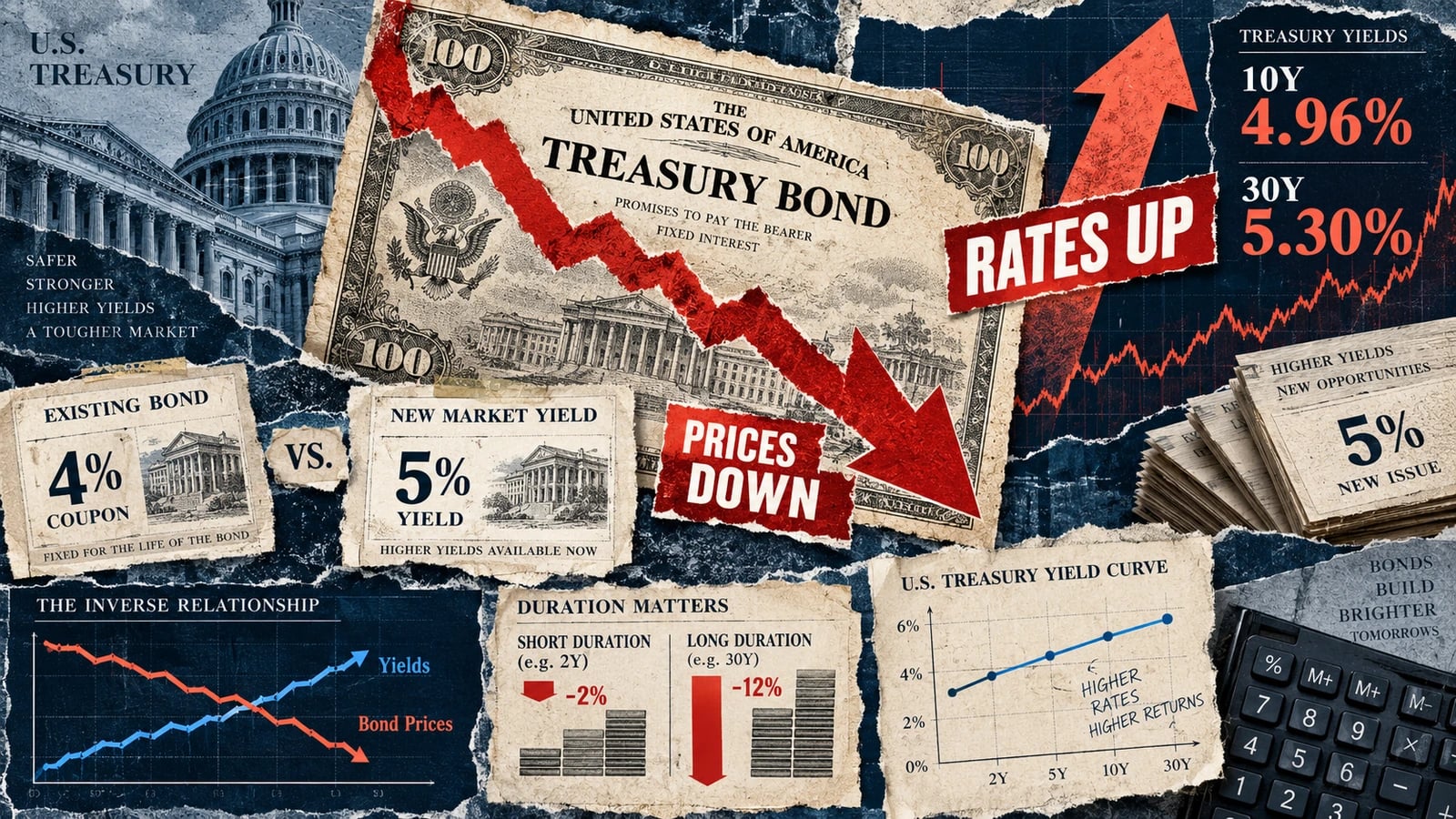
Bond prices and interest rates move in opposite directions. When rates rise, existing fixed-rate bond prices generally fall. When rates fall, those bond prices generally rise. This inverse relationship is one of the most important concepts for anyone who owns bonds or bond funds.
The 10-year Treasury yield stood at 4.96% on September 11, 2026, up from 4.01% a year earlier. That increase in market yields put downward pressure on the prices of existing lower-yielding bonds.
The Fixed Coupon Problem
A bond is essentially a loan. With a plain fixed-rate bond, the issuer promises to pay a set coupon on a schedule and return the principal at maturity.
Once that bond is issued, its coupon rate does not change.
That fixed payment becomes less attractive when newly issued bonds begin offering higher yields.
Suppose an investor buys a bond with a 4% coupon when prevailing rates are also 4%. The bond pays USD 40 per year on a USD 1,000 face value.
Now suppose newly issued bonds of similar maturity and credit quality offer 5%.
The older bond still pays only USD 40 per year. A buyer would have little reason to pay the full USD 1,000 for it when a comparable new bond offers USD 50 annually.
The older bond's market price therefore falls until its expected return becomes competitive with prevailing rates.
The coupon did not change. The market price did.
A Concrete Example
Consider a fixed-rate bond with:
- USD 1,000 face value
- 4% annual coupon
- Five years remaining until maturity
- Annual coupon payments
It pays USD 40 each year and returns USD 1,000 at maturity.
If market yields rise to 5%, the value of those fixed USD 40 payments falls relative to newly issued bonds.
The older bond's price would decline to roughly USD 956.70.
At that price, the combination of annual coupon payments and the eventual return of USD 1,000 at maturity produces a yield to maturity of approximately 5%, assuming the issuer makes all promised payments.
The bond's market price has fallen by about 4.3%, even though its coupon remains unchanged.
Now reverse the example.
If comparable market yields fall to 3%, the same 4% coupon becomes more attractive. The bond's price rises to roughly USD 1,045.80 because buyers are willing to pay a premium for its above-market coupon.
Duration: Measuring a Bond's Rate Sensitivity
Duration helps estimate how sensitive a bond's price is to changes in market yields.
Two related measures are commonly discussed.
Macaulay duration measures the weighted average time it takes to receive a bond's cash flows.
Modified duration estimates how much a bond's price may change when its yield changes.
For example, a modified duration of 5 suggests that a bond's price could decline by roughly 5% if its yield rises by one percentage point, assuming other factors remain unchanged.
That is an approximation, not an exact prediction. Bond prices have convexity, which means price gains and losses are not perfectly symmetrical when yields move significantly.
Duration is also different from maturity.
A five-year coupon-paying bond generally has a Macaulay duration below five years because some cash flows arrive before maturity. A zero-coupon bond pays no intermediate coupon, so its Macaulay duration equals its maturity.
Modified duration is slightly lower than Macaulay duration because it adjusts for the bond's yield.
The broader principle remains simple: the longer the duration, the greater the bond's sensitivity to changes in interest rates.
| Bond Type | Approx. Modified Duration | Approx. Price Change if Yield Rises 1% | Approx. Price Change if Yield Falls 1% |
|---|---|---|---|
| 2-year Treasury | ~1.9 years | -1.9% | +1.9% |
| 5-year Treasury | ~4.6 years | -4.6% | +4.6% |
| 10-year Treasury | ~8.5 years | -8.5% | +8.5% |
| 30-year Treasury | ~16 years | -16% | +16% |
These figures are illustrative. Actual duration depends on coupon rate, yield, remaining maturity, and other bond characteristics. Convexity also affects actual price changes.
Why Duration Matters for Bond Funds
A bond fund owns a portfolio of bonds rather than a single security.
Its average duration gives investors a rough measure of how sensitive the portfolio may be to changes in market yields.
A fund with a modified duration near six might decline by roughly 6% if yields across its relevant market rose by one percentage point, all else equal.
A fund with a duration near two would generally show much less price sensitivity.
Short-duration funds therefore tend to have lower interest-rate sensitivity than long-duration funds.
That does not necessarily mean short-duration funds always offer lower yields. The yield available at different maturities depends on the shape of the yield curve, credit risk, and the types of securities held.
When the yield curve is inverted, short-term bonds can even yield more than longer-term securities.
The Income Cushion
Price changes are only part of a bond investor's total return.
Bonds also generate interest income, and higher starting yields can provide a larger cushion against future price declines.
Deutsche Bank calculations cited by Marlborough Group illustrate the point. A 10-year Treasury yielding roughly 4.85% would need its yield to rise to around 5.5% over one year, or about 6.4% over two years, before the combination of price losses and coupon income pushed total returns below zero under those assumptions.
That does not mean losses are impossible. It shows why starting yield matters.
The Bloomberg U.S. Aggregate Bond Index was down roughly 1.6% on a total-return basis through mid-September 2026, according to Dow Jones Market Data, as Treasury yields moved higher.
Interest income offset part of the decline in bond prices.
Higher starting yields can improve the income available to new buyers and provide a larger cushion against future rate increases. Realized returns still depend on subsequent changes in yields, credit conditions, and how long the investment is held.
What 2026 Has Looked Like
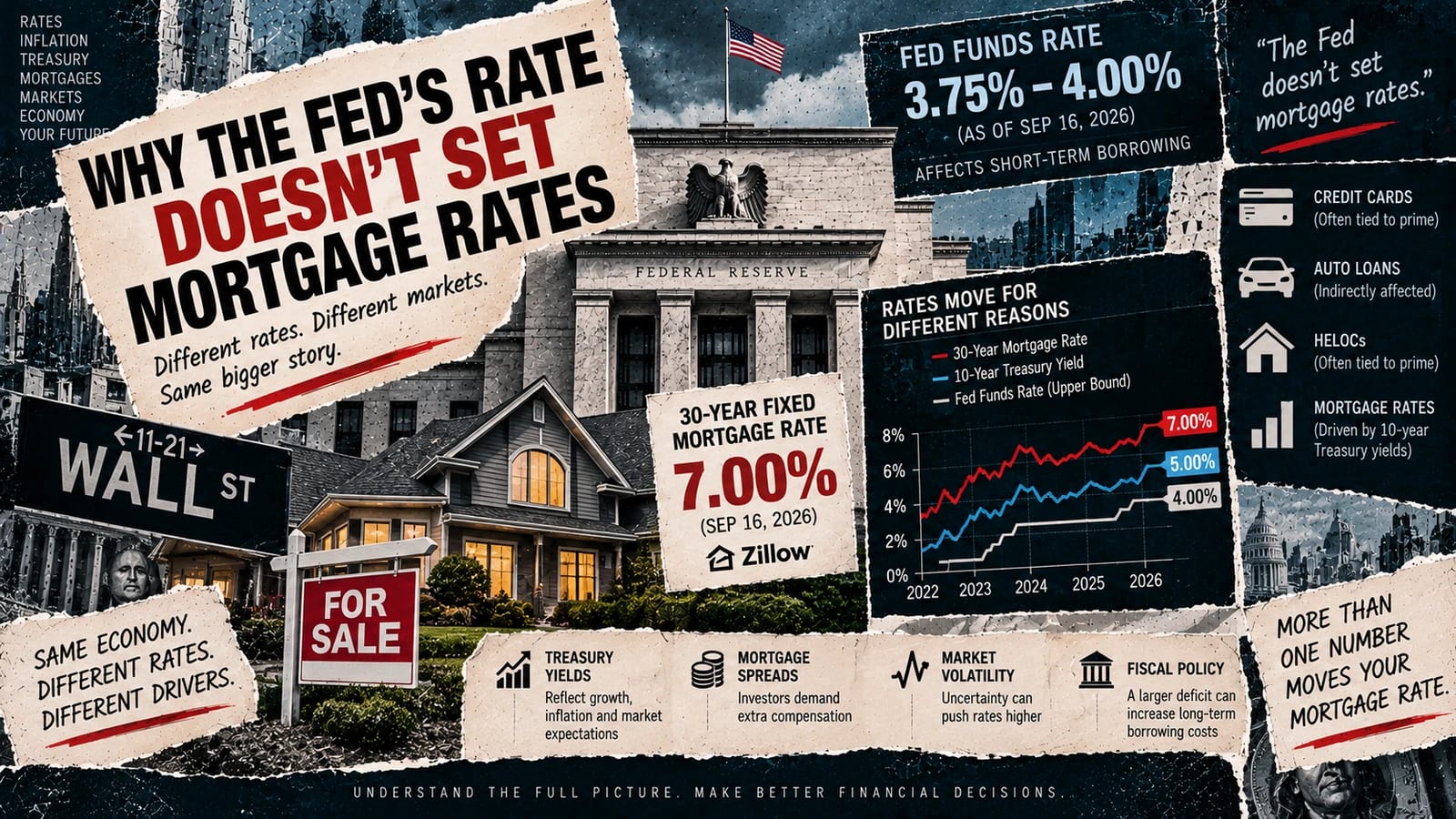
The Federal Reserve raised its benchmark target range to 3.75%–4.00% on September 16, 2026, its first rate increase since 2023.
After the announcement, the 2-year Treasury yield rose to around 4.73%, while the 10-year Treasury yield briefly moved back above 5%.
Bond markets had already been repricing before the Fed acted.
Earlier in 2026, investors were still expecting additional monetary-policy easing. By late July, expectations had shifted sharply toward tighter policy as inflation remained persistent and economic growth proved more resilient than many forecasts had assumed.
By the time the September hike arrived, a significant amount of the expected tightening had already been reflected in Treasury yields and bond prices.
Shorter-term yields reacted particularly strongly because they are more directly influenced by expectations for Federal Reserve policy.
Longer-term yields respond to a broader set of forces, including expected inflation, economic growth, fiscal policy, Treasury issuance, and the market's view of future short-term rates.
What the Yield Curve Can Tell Investors
The shape of the Treasury yield curve can matter as much as the level of any individual yield.
DBS Group Research noted that longer-term yields had risen by less than shorter-term yields during part of the 2026 repricing, contributing to a flatter curve.
One reason is that longer-term inflation expectations remained more contained than the immediate inflation pressures affecting short-term Fed expectations.
If long-term inflation expectations rise materially, investors may demand higher yields on longer-dated bonds. That would put additional downward pressure on long-duration bond prices.
The 30-year Treasury yield climbed above 5.3% in September 2026, reaching levels not seen since before the 2008 financial crisis.
Long-term Treasury prices were therefore particularly sensitive to the year's increase in yields.
Heavy government borrowing, inflation uncertainty, and changing expectations about fiscal policy have all contributed to volatility at the long end of the Treasury market.
What Rising Rates Mean for Bond Investors
The inverse relationship between prices and yields does not mean rising rates are universally bad for bond investors.
Existing bonds with low coupons can lose market value when yields rise.
At the same time, newly issued bonds become available at higher yields, and maturing principal or coupon payments can potentially be reinvested at those higher rates.
The effect therefore depends partly on the investor's time horizon.
Someone who needs to sell a long-duration bond shortly after rates rise may face a significant market-price loss.
An investor with a longer horizon may benefit from receiving income and eventually reinvesting cash flows at higher yields.
For bond funds, the portfolio continually replaces maturing securities and receives coupon payments, allowing higher market yields gradually to feed into portfolio income.
That is why a period of rising rates can be painful initially but may improve the income potential of a bond portfolio over time.
Disclaimer: This article is for informational and educational purposes only and is not personalized financial, investment, tax, or legal advice. Consult a licensed professional for advice specific to your situation.
Frequently Asked Questions
Does a bond's coupon change when interest rates rise?
For a standard fixed-rate bond, the coupon stays the same after issuance. Market interest-rate changes are instead reflected mainly through the bond's trading price and yield.
Floating-rate securities work differently because their payments can reset according to a benchmark rate.
What is the difference between bond price and bond yield?
Think of price as what an investor pays today and yield as the return implied by that price and the bond's future cash flows.
Because a fixed-rate bond continues paying the same coupon, a lower market price produces a higher yield. A higher price produces a lower yield.
Why do long-term bonds usually move more than short-term bonds?
The key reason is duration.
Longer-term bonds generally expose investors to fixed cash flows for more years. When market yields rise, those older payments become less attractive for a longer period, so a larger price adjustment may be required.
Shorter-duration securities return principal sooner and therefore tend to react less sharply to the same change in yields.
Can an individual bondholder avoid realizing a price loss?
Holding an individual fixed-rate bond until maturity can generally prevent an interim market-price decline from becoming a realized loss, provided the issuer makes all promised payments and the bond is not called early.
That does not eliminate default risk, inflation risk, call risk, or the opportunity cost of remaining invested in a below-market coupon.
Are bond funds riskier than individual bonds?
There is no universal answer because the two structures expose investors to risk differently.
A traditional bond fund continuously owns a portfolio of securities rather than returning one fixed face value on a single maturity date. Its sensitivity to interest rates depends heavily on portfolio duration and the credit quality of its holdings.
An individual bond has a defined maturity date if it is not called and the issuer does not default. Target-maturity bond funds are another variation because they are designed around a specified maturity year.
From the Desk
All Markets →More in Markets
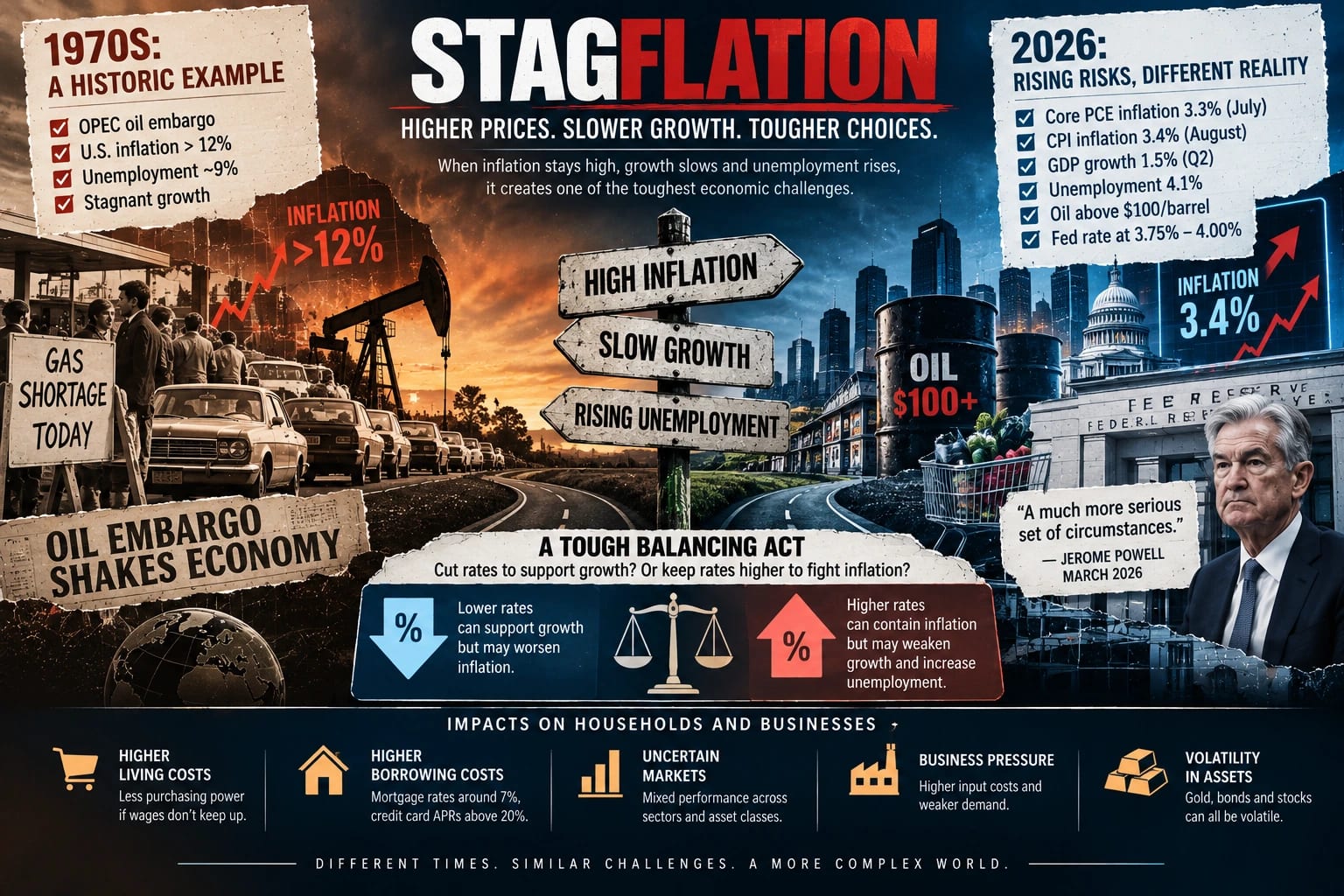
Stagflation Explained: Why High Inflation and Slow Growth Can Hit at the Same Time
Stagflation combines persistent inflation with weak economic growth and a softer labor market. This guide explains why it happens, how current 2026 conditions compare with the 1970s, and why stagflation creates a difficult policy trade-off for the Federal Reserve.
Fresh Reporting
Browse All Stories →Latest from The Ledger
Stagflation Explained: Why High Inflation and Slow Growth Can Hit at the Same Time
Stagflation combines persistent inflation with weak economic growth and a softer labor market. This guide explains why it happens, how current 2026 conditions compare with the 1970s, and why stagflation creates a difficult policy trade-off for the Federal Reserve.


Leave a Comment
Your email address will not be published. Required fields are marked *