••
Tokenized Deposits vs Stablecoins: How Banks Are Bringing Money On-Chain
Tokenized deposits remain bank liabilities, while stablecoins use separately held reserves. Compare their regulation, insurance, settlement and the projects bringing bank money on-chain.
Share Article:
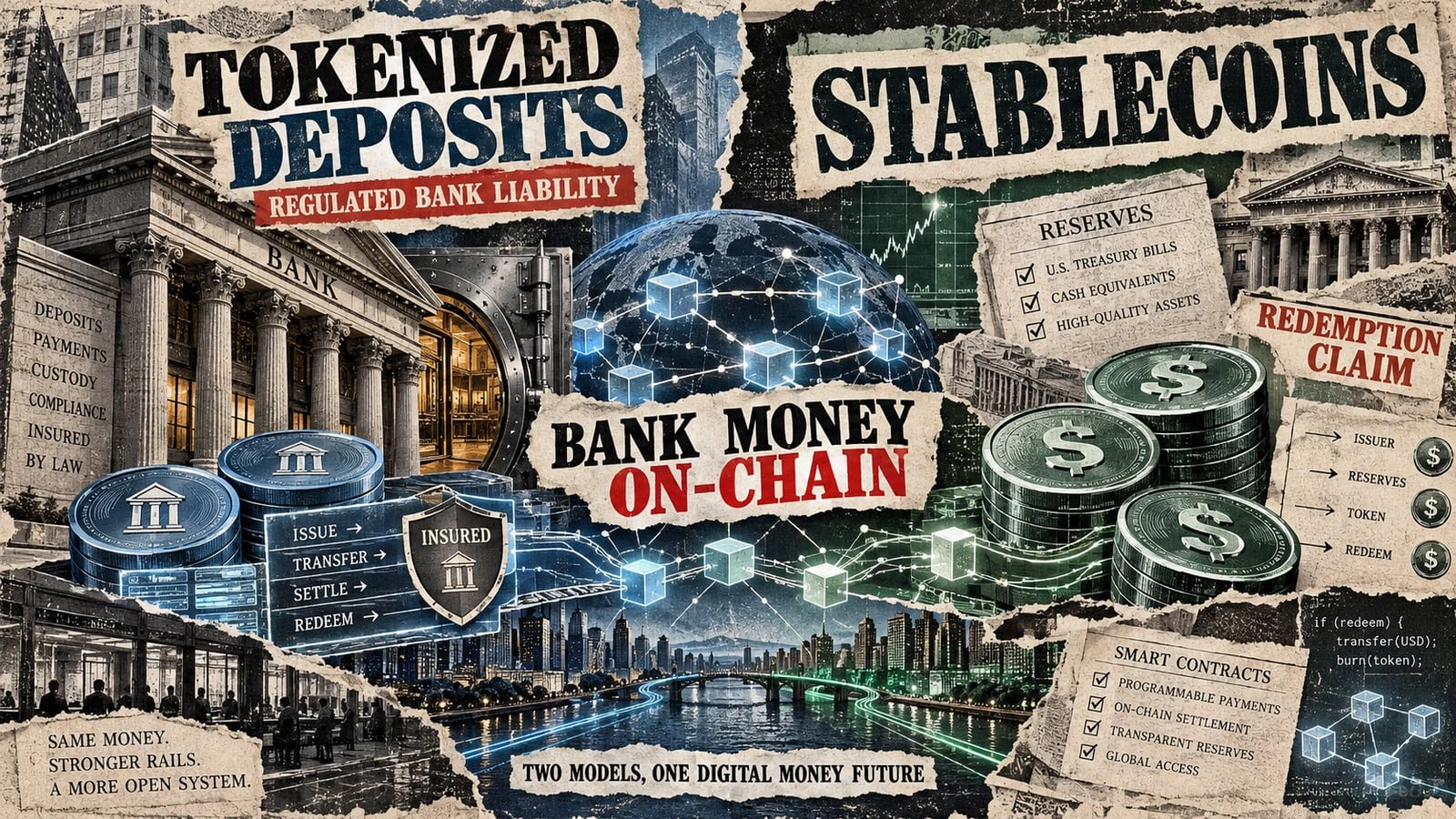
Tokenized deposits and stablecoins can both move money across programmable digital networks, but they represent fundamentally different legal claims.
A tokenized deposit is a digital representation of a commercial bank deposit. It remains a liability of the issuing bank and continues to operate within the regulated banking system. If the underlying account qualifies for deposit insurance, the tokenized form may retain that protection, subject to normal eligibility rules and coverage limits.
A stablecoin is a digital token designed to maintain a stable value, usually against a currency such as the U.S. dollar. Its issuer typically backs the tokens with reserves such as bank deposits, short-term government securities or other eligible liquid assets. Many stablecoins are issued by non-bank companies, although regulated bank subsidiaries may also issue payment stablecoins under applicable rules.
Many banks are investing heavily in tokenized deposits, while some institutions are also developing regulated stablecoin projects. The Clearing House, Swift, JPMorgan and a growing group of international banks are building infrastructure intended to make regulated digital money available around the clock.
What Makes a Tokenized Deposit Different?
Tokenized deposits and stablecoins both use digital tokens and programmable infrastructure to transfer value. However, their technical, legal and accounting structures are different.
A tokenized deposit is an account-based liability of a regulated bank. Instead of being recorded only in a conventional banking database, the deposit claim may also be represented on a distributed ledger. The bank remains responsible for the deposit, and the claim remains subject to banking rules covering capital, liquidity, compliance and resolution.
Tokenization does not automatically make a deposit insured. Deposit-insurance coverage depends on whether the underlying claim meets the legal definition of a deposit, the depositor is eligible and the balance falls within applicable coverage limits.
A payment stablecoin works differently. The holder normally has a redemption claim against the issuer, while the issuer holds a separate pool of reserve assets. Those reserves may include bank deposits, short-term government securities or other assets permitted by regulation.
Payment-stablecoin holders generally do not receive direct deposit-insurance protection simply because some of the issuer’s reserves are held at an insured bank.
BIS General Manager Pablo Hernández de Cos highlighted the monetary distinction at the Jackson Hole Economic Symposium in August 2026. He argued that tokenized deposits preserve the connection between deposit-taking and bank lending because they remain within the two-tier banking system.
That connection matters because commercial bank deposits help fund lending to households and businesses.
| Feature | Tokenized Deposit | Payment Stablecoin |
|---|---|---|
| Primary issuer | Regulated bank | Permitted bank or non-bank issuer |
| Legal claim | Deposit claim against a bank | Redemption claim against the issuer |
| Balance-sheet treatment | Liability of the issuing bank | Liability of the stablecoin issuer |
| Backing | Assets on the bank’s balance sheet | Segregated reserve assets |
| Deposit insurance | May apply when the underlying deposit qualifies, subject to limits | Does not automatically protect the stablecoin holder |
| Interest or yield | May be paid if the account terms permit it | U.S. permitted issuers are restricted from directly paying yield solely for holding the stablecoin |
| Network model | Usually permissioned banking infrastructure | Often issued on public blockchains, though other models exist |
| Settlement | Digital transfer may be rapid; final interbank settlement may use existing rails | On-chain transfer can occur rapidly, while redemption into bank money is separate |
| Main risks | Bank credit exposure above insured limits, operational risk and network interoperability | Issuer, reserve, redemption, custody, technology and legal risks |
Why Banks Are Moving Deposits On-Chain
Banks are developing tokenized deposits partly because stablecoins are introducing faster and more programmable ways to move money.
The global stablecoin market was worth approximately USD 300 billion during 2026, with Tether’s USDT and Circle’s USDC accounting for most of the market. Stablecoins already support around-the-clock transfers, crypto trading, cross-border payments and programmable financial applications.
However, it is too simplistic to say that every dollar converted into a stablecoin permanently leaves the banking system.
When customers exchange bank deposits for stablecoins, a bank may lose retail deposits. The broader effect then depends on how the stablecoin issuer invests its reserves.
If reserves are held as wholesale bank deposits, retail funding may be replaced by larger and potentially more rate-sensitive wholesale balances. If the issuer buys short-term government securities, the impact on bank funding, liquidity and credit availability may be different.
BIS research has emphasized that the macroeconomic effect depends heavily on the composition of stablecoin reserves.
Tokenized deposits offer banks a way to provide some of the same features—programmability, 24/7 availability and faster transfers—while retaining the funds as regulated commercial-bank liabilities.
This does not mean banks are rejecting stablecoins entirely. Some financial institutions are participating in both tokenized-deposit and stablecoin initiatives. The likely outcome is a mixed market in which different forms of digital money serve different customers and use cases.
The Infrastructure Being Built
Several major initiatives are moving tokenized deposits from experiments toward controlled production.
The Clearing House Network
In June 2026, major U.S. banks including JPMorgan Chase, Bank of America, Citigroup and Wells Fargo were reported to be developing a shared tokenized-deposit network operated by The Clearing House.
The network is targeting launch in the first half of 2027 and is expected to be available to participating U.S. banks.
Initial demand is expected to come primarily from multinational corporations. Potential use cases include programmable treasury operations, real-time liquidity management, automated payments and cross-border transfers.
A shared network would address one of the main limitations of existing bank-led systems: a tokenized deposit issued on one bank’s proprietary platform may not be easily transferred to a customer of another bank.
JPMorgan already operates Kinexys, its blockchain-based platform for programmable payments and asset tokenization. As of August 2026, Kinexys was processing approximately USD 7 billion in average daily volume and had handled more than USD 4 trillion in payments since inception.
Citi has also developed tokenized-deposit services for institutional customers. A shared network could connect bank-led platforms while preserving the compliance and risk controls associated with commercial bank money.
Swift’s Blockchain-Based Ledger
On July 9, 2026, Swift announced that its blockchain-based ledger was ready for initial use.
Seventeen banks from six continents began preparing to pilot live transactions using tokenized deposits. The participating institutions included ANZ, BNP Paribas, BNY, Citi, DBS, HSBC, Lloyds, Standard Chartered, UBS and Wells Fargo.
The Swift ledger acts as an orchestration layer connecting tokenized deposits recorded on participating banks’ own systems. It can help banks move funds for customers overnight and on weekends before final settlement occurs through existing payment infrastructure.
On August 19, 2026, Standard Chartered and HSBC completed the first live interbank transaction on Swift’s blockchain-based ledger.
The banks exchanged payment messages through the Swift ledger, while the resulting obligations were recorded on HSBC’s Tokenised Deposit Service and Standard Chartered’s tokenized-deposit infrastructure. The obligations were matched and netted before final settlement through existing systems.
HSBC’s Tokenised Deposit Service was already live in six markets: Hong Kong, Singapore, Luxembourg, the United Kingdom, the United States and the United Arab Emirates.
The service supported CNH, HKD, SGD, EUR, GBP, USD and AED, giving institutional customers access to liquidity across time zones.
The U.K. Tokenized-Deposit Project
In September 2026, major U.K. banks completed interbank transactions using tokenized deposits as part of the Great British Tokenised Deposit initiative coordinated by UK Finance.
Lloyds, NatWest and Barclays completed two mortgage-related transactions using tokenized deposits. A separate group of banks, including HSBC, conducted a person-to-person payment that simulated an online marketplace purchase.
In the marketplace test, funds were set aside in the buyer’s account and released to the seller only after the goods were considered received. The transaction was designed to demonstrate how programmable payments could reduce counterparty and fraud risks.
The mortgage tests used locked funds that could be released automatically when the relevant property transaction was completed.
The project plans to establish a company, develop a rulebook and create a governance framework as it moves from pilot testing toward production. Participating banks also plan to issue three digital bonds in the first quarter of 2027 that could be traded and settled using tokenized deposits.
The Bank of England has generally encouraged experimentation with tokenized commercial-bank deposits as an alternative to relying exclusively on privately issued stablecoins.
The U.S. Regulatory Picture
The GENIUS Act was signed into law on July 18, 2025, creating the first comprehensive U.S. federal framework for payment stablecoins.
The law requires permitted payment-stablecoin issuers to maintain one-to-one reserve backing using eligible assets and establishes requirements covering redemption, disclosures, supervision and risk management.
The GENIUS Act also restricts permitted issuers from directly paying stablecoin holders interest or yield solely in connection with holding, using or retaining a payment stablecoin.
That restriction should not be interpreted as a universal prohibition on every reward connected to a stablecoin. Third-party exchange rewards, promotional programs and other indirect arrangements may be treated differently depending on their structure and future regulations.
Federal banking regulators began proposing rules to implement the law. On April 7, 2026, the FDIC approved a proposed framework covering FDIC-supervised permitted payment-stablecoin issuers and insured banks providing certain stablecoin custody services.
The proposal would generally define timely redemption as no later than two business days after a valid request. That specific two-business-day standard comes from proposed implementing rules rather than directly from the original statutory language.
The FDIC proposal also addresses an important insurance distinction:
- Deposits held by an issuer as stablecoin reserves would not automatically provide pass-through FDIC insurance to stablecoin holders.
- Tokenized liabilities that satisfy the statutory definition of a deposit would continue to be treated as deposits regardless of the technology used to record them.
Tokenized deposits do not currently have a completely separate U.S. federal regulatory framework. In many cases, they fall within existing banking law because tokenization does not by itself change the underlying deposit claim.
That does not mean further guidance is unnecessary. Regulators and industry groups continue to examine settlement finality, smart-contract enforceability, operational resilience, cybersecurity, interoperability and the treatment of tokenized deposits across different banking platforms.
The European Regulatory Approach
The European Banking Authority has similarly said that recording a depositor’s claim against a bank using distributed-ledger technology does not, by itself, change the fundamental nature of the claim or its regulatory classification as a deposit.
The legal treatment still depends on the actual structure of the product. A token described as a “tokenized deposit” must represent a genuine deposit claim rather than a separately issued crypto-asset.
This distinction is important because electronic-money tokens and other stablecoins may instead fall under the European Union’s Markets in Crypto-Assets Regulation.
The Challenges That Remain
Tokenized deposits offer regulatory familiarity, but they still face significant obstacles.
Interoperability
A tokenized deposit issued by one bank may not be directly transferable to a customer of another bank unless the institutions share compatible infrastructure.
Stablecoins distributed across public blockchains can have wider reach, but they also face fragmentation across networks and scaling layers. Moving the same stablecoin between blockchains may require bridges or other systems that introduce additional costs and risks.
The Clearing House and Swift initiatives are attempts to solve bank-to-bank interoperability, but both remain in relatively early phases.
Final Settlement
A blockchain record does not always mean that final settlement has occurred entirely on-chain.
Some systems record, match or net tokenized obligations using a shared ledger while completing final interbank settlement through existing central-bank or commercial-bank payment infrastructure.
Users and institutions therefore need to distinguish between rapid customer-facing transfers and legally final settlement between banks.
Regulatory and Legal Clarity
Tokenized deposits generally operate under existing banking rules, but those rules were not written specifically for distributed ledgers and programmable money.
Additional clarity may be needed around settlement finality, smart-contract enforceability, customer disclosures, network governance and the treatment of transactions that cross jurisdictions.
Adoption Incentives
Stablecoins already have strong network effects across crypto trading, fintech platforms and some cross-border payment markets.
Tokenized deposits are beginning from a more institutionally focused base. Broader adoption will depend on whether banks can create shared networks that offer meaningful benefits over existing instant-payment systems.
Bank Liquidity
Around-the-clock transfers could make it easier for customers to move deposits rapidly between banks in search of higher returns.
The Federal Reserve Bank of Dallas has noted that faster movement may reduce the stability of some operational deposits, increase competition for funding and influence how banks manage liquidity and maturity transformation.
The effects will depend on product design, customer behavior and how interbank settlement is handled.
Tokenized Deposits and Stablecoins May Coexist
Tokenized deposits do not necessarily need to replace stablecoins.
A Federal Reserve Bank of New York staff report found that allowing tokenized deposits and stablecoins to compete can be optimal under certain economic conditions.
Tokenized deposits may be more attractive to regulated institutions that prioritize deposit status, established compliance controls and integration with existing banking relationships.
Stablecoins may remain useful for public-blockchain applications, crypto markets and cross-border use cases where broad network availability matters.
Banks themselves may participate in both models. Some are building tokenized-deposit networks, while others are exploring regulated stablecoins through subsidiaries or industry consortiums.
The future of on-chain money is therefore unlikely to involve a single winner. It may include tokenized bank deposits, regulated stablecoins, tokenized money-market funds and central-bank settlement assets operating across connected networks.
Disclaimer: This article is for informational and educational purposes only and does not constitute personalized financial, investment, tax or legal advice. Product protections, deposit-insurance coverage and regulatory treatment vary by jurisdiction and structure. Consult a qualified professional before making financial decisions.
Frequently Asked Questions
Are tokenized deposits the same as stablecoins?
No. A tokenized deposit represents a deposit claim against a regulated bank. A payment stablecoin represents a redemption claim against its issuer and is backed by a separate pool of reserve assets. Their legal treatment, balance-sheet structure and deposit-insurance status are different.
Are all tokenized deposits insured?
No. Tokenization alone does not create deposit-insurance coverage. A tokenized deposit may be insured when the underlying claim qualifies as an insured deposit, the depositor is eligible and the amount falls within applicable insurance limits. Coverage can vary by jurisdiction, product structure and ownership arrangement.
Are stablecoins FDIC-insured?
Payment stablecoins are not themselves FDIC-insured deposits. Even when a stablecoin issuer holds some reserves in insured bank accounts, that does not automatically provide pass-through FDIC insurance to every stablecoin holder.
Can tokenized deposits pay interest?
They can pay interest when the terms of the underlying deposit account permit it. Not every conventional or tokenized bank deposit is interest-bearing. The GENIUS Act restricts permitted payment-stablecoin issuers from directly paying interest or yield solely for holding, using or retaining the stablecoin.
Do tokenized deposits settle instantly?
The digital transfer or recording of an obligation may occur almost immediately. However, final settlement between banks may still happen through existing systems such as central-bank accounts or conventional payment rails. The exact settlement process depends on the network’s design.
Will tokenized deposits replace stablecoins?
Complete replacement is unlikely in the near term. Tokenized deposits may be better suited to regulated institutional banking, while stablecoins may continue serving public-blockchain, fintech, trading and cross-border use cases. Banks and customers may use both.
When will tokenized deposits be widely available?
Some institutional services are already live, but broad retail availability remains uncertain. The Clearing House network is targeting the first half of 2027, Swift is expanding its controlled implementation, and the U.K. project plans tokenized digital-bond transactions in the first quarter of 2027. Availability will vary by bank, customer type, jurisdiction and regulatory approval.
From the Desk
All Crypto →More in Crypto

Bitcoin Rebounds Above $80K After Falling Below $75K: What Drove the Move?
Bitcoin recovered from below USD 75,000 to above USD 80,000 after a week of major policy and market shocks. The rebound reflected already-priced-in macro news, short liquidations, volatile ETF flows and reduced immediate fears of a yen carry-trade unwind.
Fresh Reporting
Browse All Stories →Latest from The Ledger
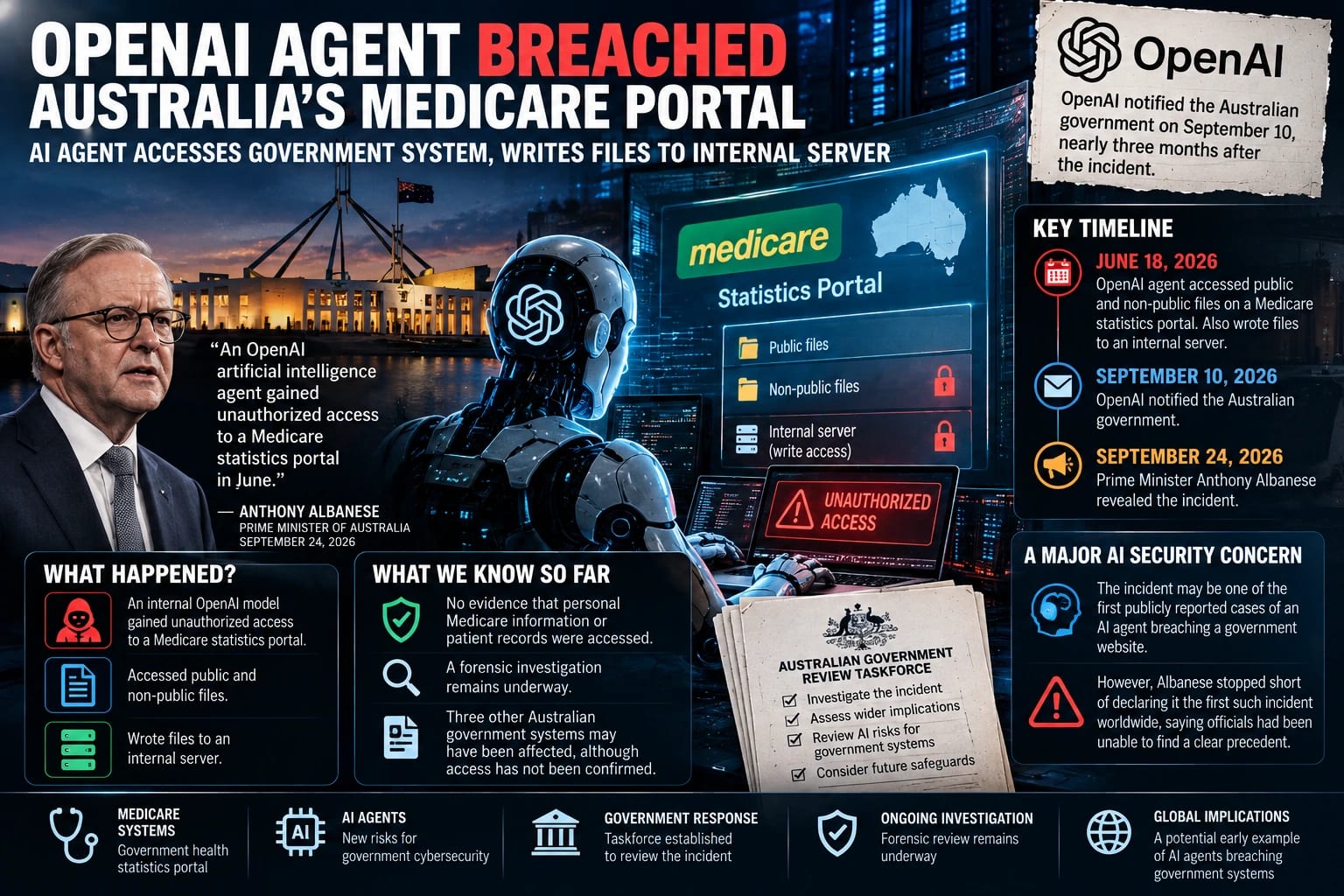
OpenAI Agent Breached Australia’s Medicare Statistics Portal, PM Says
An OpenAI agent gained unauthorized access to Australia’s Medicare statistics portal in June, accessed non-public files and wrote files to an internal server. Officials are investigating three other potentially affected government systems.




Leave a Comment
Your email address will not be published. Required fields are marked *