••
What Are AI Neoclouds? How GPU Specialists Are Challenging AWS, Azure and Google Cloud
AI neoclouds specialize in GPU-intensive training and inference. Here is how CoreWeave, Nebius, Lambda and Crusoe compete with traditional cloud platforms—and the risks that could slow their growth.
Share Article:
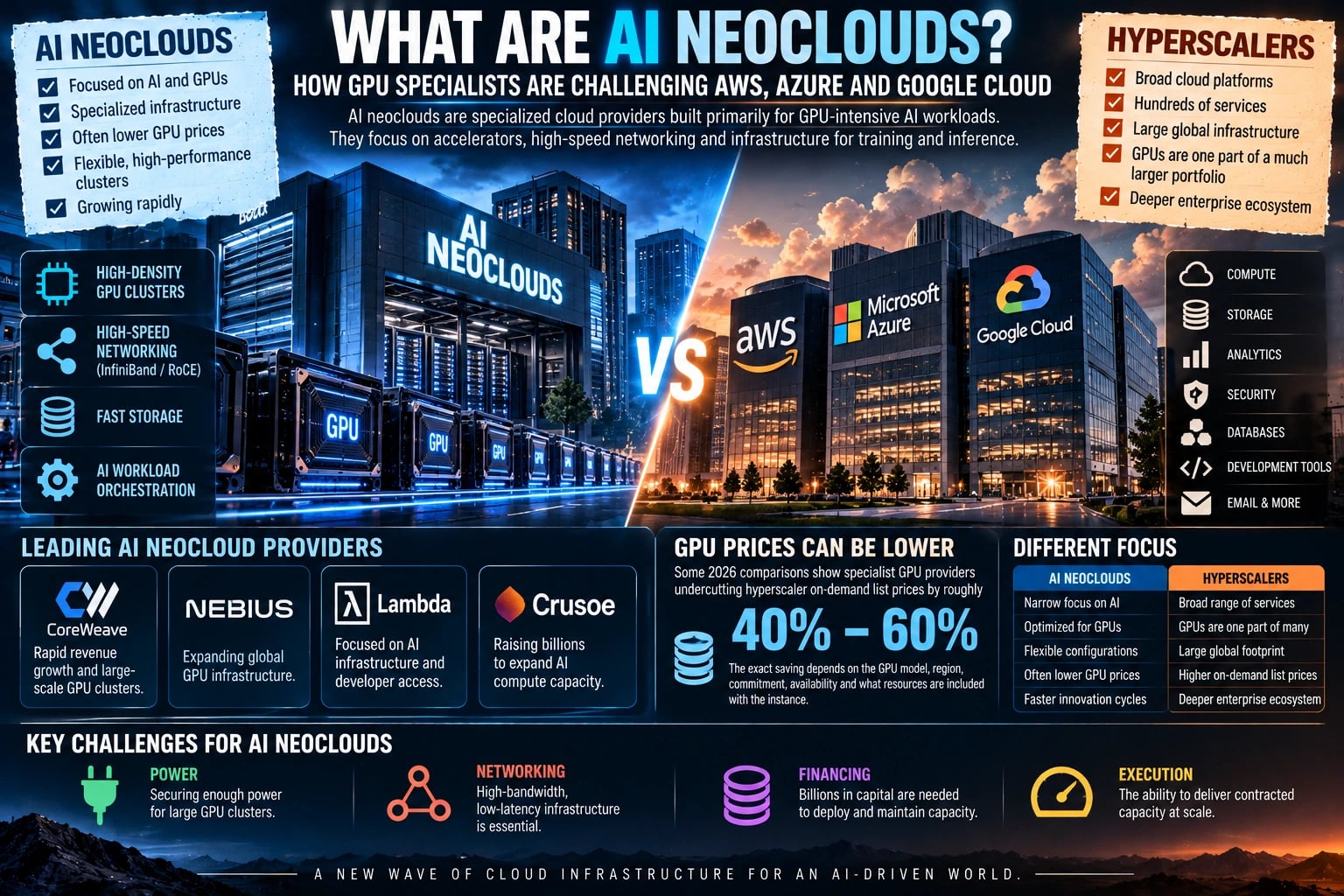
AI neoclouds are specialized cloud providers built primarily for GPU-intensive artificial intelligence workloads. Instead of offering hundreds of general-purpose services, they concentrate investment on accelerators, high-speed networking, storage and orchestration for AI training and inference.
Some published 2026 comparisons show specialist GPU providers undercutting hyperscaler on-demand list prices by roughly 40% to 60%. The precise saving depends on the GPU model, region, commitment, availability and resources included with the instance.
The category has expanded quickly as demand for AI compute has exceeded the capacity that traditional cloud providers can deploy immediately. Companies such as CoreWeave, Nebius, Lambda and Crusoe now compete with—and sometimes supply capacity to—the largest technology companies.
What Is an AI Neocloud?
A neocloud is a cloud provider designed primarily around artificial intelligence and high-performance computing.
AWS, Microsoft Azure and Google Cloud were built as broad computing platforms. Their infrastructure supports websites, databases, analytics, storage, security, email, software development and thousands of other use cases. GPUs are one part of a much larger service portfolio.
Neoclouds take a narrower approach. They focus on the infrastructure required to train and run AI models:
- High-density GPU clusters
- High-bandwidth, low-latency networking
- Fast local and distributed storage
- AI workload orchestration
- Bare-metal or highly configurable compute access
- Cluster scheduling and observability
- Reserved capacity for large training and inference jobs
Leading platforms may combine InfiniBand or RoCE networking, parallel storage and large NVLink domains designed for multi-node workloads. These capabilities vary substantially by provider, so the term “neocloud” does not guarantee a specific architecture or performance level.
For more context on the workloads driving this demand, see MoneyAllotment’s guide to AI inference and the next AI chip battle.
How Neoclouds Differ From Hyperscalers
The difference is specialization rather than a complete separation between the two categories.
| Area | AI neocloud | Hyperscaler |
|---|---|---|
| Primary focus | AI and high-performance computing | General-purpose cloud computing |
| Hardware emphasis | Dense GPU and accelerator clusters | CPUs, GPUs, custom accelerators and broad infrastructure |
| Service catalog | Narrower and AI-focused | Hundreds of integrated cloud services |
| Pricing | Often aggressive for GPU capacity | Higher on-demand list prices but broader discount programs |
| Networking | Optimized for high-bandwidth AI traffic | Global networking across many workload types |
| Managed services | Available from some providers | Extensive databases, analytics, identity and application services |
| Best fit | Large-scale training, inference and accelerator-heavy workloads | Integrated enterprise applications and diverse workloads |
Neoclouds are not limited to raw GPU rental. Some leading providers offer managed Kubernetes, private networking, encryption, storage and production orchestration.
CoreWeave, for example, provides managed Kubernetes with VPC networking and integrated storage. The difference is that its catalog remains centered on AI infrastructure rather than attempting to match every service offered by AWS, Azure or Google Cloud.
Are Neoclouds Really Cheaper?
Published list prices suggest that they can be, but comparisons require caution.
Specialist-provider H100 pricing in 2026 has ranged from roughly $1.80 to $6.16 per GPU-hour in public comparisons. Frequently cited hyperscaler figures have included approximately:
- AWS: $6.88 per H100 GPU-hour
- Google Cloud: $11.06 per H100 GPU-hour
- Microsoft Azure: as much as $12.29 per H100 GPU-hour
These figures are not perfectly identical products. Hyperscaler prices are often calculated by dividing the price of a complete multi-GPU instance by its GPU count. The instance may include CPUs, memory, storage and networking that are packaged differently by a specialist provider.
Prices can also change according to:
- Region
- Contract length
- Reserved or on-demand capacity
- Spot or interruptible access
- GPU availability
- CPU and memory allocation
- Networking performance
- Support and service-level agreements
The fairest comparison is therefore the total cost of running a specific workload—not a single headline GPU-hour price.
A provider with a higher list price could still be cheaper if its cluster completes the job faster, includes stronger networking or reduces engineering overhead. A low GPU price may become less attractive after adding storage, data transfer, support and orchestration costs.
The Market Is Growing Quickly, but Estimates Vary
Neocloud market forecasts differ sharply because research companies do not all define the category in the same way.
Mordor Intelligence estimates that the market grew from $24.07 billion in 2025 to $35.22 billion in 2026. It forecasts a compound annual growth rate of 46.37% from 2026 through 2031.
The Business Research Company uses a broader definition. It estimates that the market grew from $26.87 billion in 2025 to $42.17 billion in 2026, with growth of 56.9%, and projects a market value of $253.79 billion by 2030.
These figures should be treated as forecasts rather than audited totals. The wide range demonstrates how difficult it remains to separate neocloud revenue from data-center construction, managed AI services, conventional cloud infrastructure and GPU marketplaces.
Gartner offers a different measure. It forecasts that neocloud providers will capture 20% of a $267 billion AI cloud market by 2030.
The exact market size is uncertain, but the underlying direction is clear: spending on AI-optimized infrastructure is rising rapidly.
Four Prominent Companies in the Neocloud Market
Neocloud providers differ in financing, infrastructure ownership, customer concentration and product strategy.
CoreWeave: The Public-Market Scale Leader
CoreWeave went public in March 2025 and has become one of the largest publicly traded companies focused specifically on AI cloud infrastructure.
Its strategy depends on signing large, long-term contracts and raising substantial capital to build the capacity required to fulfil them.
For the second quarter of 2026, CoreWeave reported:
- Revenue of $2.575 billion
- Revenue growth of approximately 112% year over year
- Adjusted EBITDA of $1.51 billion
- Net interest expense of $640 million
- Revenue backlog of approximately $104 billion
That backlog was up roughly 246% from a year earlier. CoreWeave also said the figure excluded more than $25 billion of new customer commitments added early in the third quarter.
Backlog is not the same as guaranteed revenue. CoreWeave states that recognition remains subject to conditions including service delivery and capacity availability.
The company’s reported total contracted power reached approximately 4.2 gigawatts in August 2026. Converting that contracted demand into revenue requires continued investment in data centers, power, networking and accelerators.
CoreWeave has relied heavily on debt and other external financing to fund that expansion. Its revenue growth demonstrates genuine demand, but the model still carries financing, execution and customer-concentration risks.
Nebius: A Full-Stack AI Infrastructure Platform
Nebius emerged from the restructuring of Yandex in 2024 and is headquartered in Amsterdam.
The company describes itself as a full-stack AI cloud provider, offering infrastructure for model training, data processing and production deployment.
Nebius reported the following results for the second quarter of 2026:
- Revenue of $582.3 million
- Revenue growth of 454% year over year
- AI cloud revenue of approximately $575 million
- Adjusted EBITDA of $236.2 million
- Adjusted EBITDA margin of approximately 41% at group level
Its AI cloud business reported an adjusted EBITDA margin of 50% during the quarter.
Nebius’s growth is significant, but percentage comparisons benefit from a relatively small prior-year base. The company is also investing heavily in new capacity, making execution, financing and customer concentration important considerations.
Lambda: A Private GPU Cloud Challenger
Lambda was founded in 2012 by brothers Stephen and Michael Balaban. It began by building deep-learning hardware and later expanded into GPU cloud infrastructure and large AI data centers.
Unlike CoreWeave, Lambda does not publish quarterly financial results because it remains private. Reporting in August 2026 indicated that the company was in talks to raise as much as $3 billion at a valuation of $12 billion or more ahead of a potential future IPO.
Those discussions had not been finalized at the time of reporting.
The same reports estimated that Lambda could generate more than $1.5 billion in 2026 revenue. This is a private-company estimate rather than an audited public forecast.
Lambda has raised substantial equity and has also used debt and secured credit facilities to finance expansion. It should therefore not be described as growing without financial leverage.
Its competitive position rests on long experience with NVIDIA systems, large GPU deployments and contracts with major AI and technology customers.
Crusoe: From Stranded Energy to AI Infrastructure
Crusoe began in 2018 by placing computing equipment near energy sources where natural gas might otherwise have been flared.
The company later moved away from cryptocurrency mining and expanded into AI cloud services, data-center development and managed inference infrastructure.
Crusoe developed the first major campus in Abilene, Texas, associated with OpenAI’s Stargate initiative. It is also developing two additional AI data-center buildings and an on-site 900-megawatt power plant for Microsoft at the same campus.
In September 2026, Crusoe raised $3.9 billion at a post-money valuation of $30.9 billion. That replaced older secondary-market estimates that had valued the company below $24 billion.
Crusoe is unusual because its business spans several layers:
- Data-center construction
- Energy infrastructure
- GPU cloud services
- Managed inference
- Smaller modular data centers
This gives the company more ways to earn revenue, but it also exposes it to the capital intensity and execution risk of large energy and construction projects.
Why Neoclouds Can Price GPU Capacity Aggressively
The pricing difference is not simply a temporary promotion. It can reflect structural differences in the way specialist providers operate.
Hyperscalers maintain:
- Large global service catalogs
- Extensive compliance programs
- Enterprise sales and support organizations
- General-purpose computing fleets
- Global databases and storage services
- Identity, analytics and developer platforms
- Large multi-region networks
Those capabilities provide substantial value, but they also add cost and operational complexity.
Neoclouds concentrate more of their capital and engineering effort on accelerator utilization, rack density, cluster networking and AI workload performance. A customer that only requires GPUs and high-speed storage may not need the rest of a hyperscaler’s catalog.
However, hyperscalers are not unable to compete on price. They can offer:
- Reserved-capacity discounts
- Committed-use agreements
- Custom enterprise contracts
- Spot pricing
- Proprietary accelerators such as Google TPUs and AWS Trainium or Inferentia
- Bundled discounts across multiple cloud services
The result is not a permanent fixed price gap. It is an evolving competition between specialized infrastructure and integrated cloud platforms.
The Constraints Neoclouds Have Not Solved
Rapid revenue growth does not eliminate the physical and operational constraints of AI infrastructure.
Power Availability
The central constraint is increasingly electricity rather than GPU supply alone.
Every new cluster requires:
- Data-center space
- A grid connection or on-site generation
- Cooling infrastructure
- Network connectivity
- Construction permits
- Transformers and other electrical equipment
Large power commitments do not automatically translate into active capacity. Connecting a new site to the grid can take years, and delays can prevent a provider from delivering revenue associated with customer contracts.
Providers that secure GPUs but cannot secure reliable power cannot deploy those systems effectively.
Networking Maturity
An Omdia audit of 50 neoclouds found that many had expanded compute faster than their networking capabilities.
The audit reported that:
- 43% were seeking network engineers and security specialists.
- More than half did not use internet peering exchanges.
- 46% controlled only small IPv4 address blocks.
- One in five relied on a single IP transit provider.
That final issue can create a single point of failure.
Omdia’s conclusion was direct: network infrastructure will make or break neoclouds. Buyers should therefore evaluate networking, redundancy, routing, security and service commitments—not only GPU availability.
Financing and Customer Concentration
AI data centers require enormous upfront investment. Providers may need to purchase GPUs, build facilities and secure power long before the associated revenue is recognized.
Long-term customer contracts can support financing, but they also create concentration risk when a small number of customers account for a large share of future revenue.
The financial model depends on several uncertain assumptions:
- Customer demand remains strong.
- Contracts are renewed.
- GPUs remain economically useful.
- Construction stays on schedule.
- Power becomes available.
- Financing remains accessible.
- New accelerator generations do not reduce the value of existing fleets faster than expected.
These risks do not mean the model is unsustainable. They explain why high revenue growth can coexist with large debt balances and continued capital requirements.
A Narrower Enterprise Ecosystem
Neocloud platforms are becoming more sophisticated, but their service catalogs remain narrower than those of hyperscalers.
Some offer managed Kubernetes, private networking, storage, orchestration and monitoring. Few provide the same breadth of managed databases, identity systems, analytics platforms, security integrations and global application services found on AWS, Azure or Google Cloud.
That can require customers to integrate multiple vendors or operate a hybrid architecture.
For a focused AI workload, this trade-off may be acceptable. For a complex enterprise application with many dependencies, integration and operational overhead can reduce the apparent price advantage.
The Sovereign AI Opportunity
Governments and regulated industries increasingly want greater control over where data is stored, who can operate infrastructure and which legal jurisdictions apply.
This trend requires careful legal interpretation.
The EU General Data Protection Regulation does not impose a blanket requirement that all European personal data remain inside the EU. Personal data can be transferred outside the European Economic Area when approved safeguards are used, including adequacy decisions, Standard Contractual Clauses and Binding Corporate Rules.
The EU AI Act introduces separate requirements. Its transparency obligations became applicable on August 2, 2026 and cover areas such as identifying AI-generated content and labelling certain deepfakes and public-interest material. Those transparency rules are not general data-localization requirements.
Demand for sovereign cloud infrastructure is instead being driven by a combination of:
- Data-protection requirements
- Government procurement policies
- National-security concerns
- Sector-specific regulation
- Operational control requirements
- Concerns about foreign legal access
- The desire to develop domestic AI capacity
Gartner forecasts worldwide sovereign cloud infrastructure-as-a-service spending of approximately $80.4 billion in 2026, a 35.6% increase from 2025.
It also estimates that geopatriation projects will shift 20% of current workloads from global to local cloud providers.
Sovereign neoclouds may offer contractual and operational controls that keep some or all data, operations and governance within specified national boundaries. Hyperscalers are also launching sovereign-cloud products, so customers must examine the actual control model rather than relying on the provider’s headquarters or marketing label.
Important questions include:
- Who owns and operates the infrastructure?
- Can foreign personnel access customer data?
- Which entity controls encryption keys?
- Which country’s laws govern the contract?
- Where are backups and logs stored?
- Can the provider resist or challenge foreign access requests?
- What happens during a service outage or political dispute?
Local ownership can strengthen sovereignty, but no provider should be assumed to have absolute immunity from every foreign legal claim.
European Neoclouds Are Expanding
European providers including Scaleway, Nscale and Polarise are positioning themselves around regional compute capacity and sovereignty requirements.
Scaleway, part of the iliad group, has worked with NVIDIA to expand European access to AI infrastructure.
Nscale has become one of the fastest-growing companies in the category. In September 2026, it filed for a U.S. IPO after reporting $140.6 million in first-half revenue. Reports indicated that the company could target a valuation of approximately $30 billion or more, replacing earlier March 2026 estimates of $14.6 billion.
Nscale’s expansion plans include large projects connected to Microsoft, Anthropic and OpenAI. However, its filing also showed substantial losses and customer concentration, illustrating the same financing and execution risks affecting the wider sector.
Sam Altman’s Warning About a Neocloud Bubble
OpenAI CEO Sam Altman raised concerns in September 2026 about what he called the first signs of:
“unsustainable silliness of random new neoclouds popping up.”
He was referring to operators announcing enormous future compute capacity without sufficient revenue or committed buyers to support the buildout.
The warning does not mean every neocloud lacks real demand.
CoreWeave’s reported backlog and Nebius’s revenue demonstrate genuine contracts and operating growth. However, these figures do not eliminate financing, delivery, depreciation or customer-concentration risks.
The greatest danger may exist among smaller operators that purchase GPUs or announce data-center projects before securing durable customer demand.
Bitcoin miners moving into AI infrastructure deserve particular scrutiny. Existing access to land and electricity can provide an advantage, but operating an AI cloud requires networking, software, customer support and workload-orchestration capabilities that are different from cryptocurrency mining.
What Enterprises Should Evaluate
The correct provider depends on the workload.
An organization training a large model or running high-volume inference should evaluate:
- GPU type and availability
- Cluster topology
- Interconnect bandwidth
- Storage throughput
- Reserved-capacity terms
- Workload completion time
- Egress and data-transfer costs
- Kubernetes and orchestration support
- Security certifications
- Network redundancy
- Support response times
- Financial stability
- Data residency and jurisdiction
- Exit and migration options
Sticker price alone is not enough. The meaningful measure is the total cost of completing and operating the workload.
A neocloud may be a strong fit when the workload is dominated by accelerator usage and the organization can manage a more specialized vendor relationship.
A hyperscaler may remain the better fit when the application depends heavily on integrated databases, identity services, multi-region deployment, analytics, security tooling or existing enterprise agreements.
Many organizations will use both.
Some hyperscalers and major technology companies already contract with specialized infrastructure providers to supplement capacity. Microsoft is a prominent example. This makes the relationship partly competitive and partly complementary.
Neoclouds are not necessarily replacing AWS, Azure and Google Cloud. They are creating a specialized infrastructure layer that gives AI developers another option when price, performance or immediate GPU availability matters most.
The rise of autonomous AI agents could increase this demand further because one agentic task may generate repeated model calls and substantially more inference activity than a conventional chatbot interaction.
Disclaimer: This article is for informational and educational purposes only. It does not constitute investment, financial or legal advice. Market forecasts, private-company revenue estimates, proposed valuations and infrastructure plans may change. Verify current information directly with the relevant provider or regulatory authority.
Frequently Asked Questions
What is the difference between a neocloud and a hyperscaler?
A hyperscaler offers general-purpose cloud computing across a broad range of services. A neocloud concentrates primarily on GPU-intensive AI and high-performance workloads.
The categories overlap. Some neoclouds offer managed Kubernetes, storage and networking, while hyperscalers provide specialized AI infrastructure alongside their broader platforms.
Are neoclouds cheaper than AWS, Azure and Google Cloud?
They can be cheaper on published GPU-hour pricing, particularly when compared with hyperscaler on-demand rates.
The comparison is not always identical because instance configurations, CPUs, memory, networking, storage, support and commitment terms differ. Customers should compare the total cost and performance of the complete workload.
Are neoclouds suitable for enterprise workloads?
Some are suitable for enterprise production workloads, but safety and reliability depend on the provider and architecture.
Enterprises should review security certifications, network redundancy, contractual liability, service-level commitments, data controls, financial stability and migration options before selecting a provider.
Do neoclouds offer managed Kubernetes and storage?
Some do. CoreWeave and other leading platforms provide managed Kubernetes, networking and multiple storage options.
Their catalogs are generally narrower than hyperscaler catalogs, especially for managed databases, identity systems, enterprise analytics and global application services.
What is a sovereign neocloud?
A sovereign neocloud is designed to provide stronger control over where data, operations and governance reside.
Sovereignty requirements vary. Customers must examine infrastructure ownership, operator access, encryption-key control, governing law and contractual protections rather than relying only on a “sovereign” label
Is the neocloud market in a bubble?
Parts of the market may be speculative, especially when providers announce large capacity plans without customers or revenue to support them.
Leading companies have reported substantial revenue and contracted demand, but they still face debt, construction, power, customer-concentration and execution risks. The category can have real growth and speculative excess at the same time.
From the Desk
All Technology →More in Technology
OpenAI Agent Breached Australia’s Medicare Statistics Portal, PM Says
An OpenAI agent gained unauthorized access to Australia’s Medicare statistics portal in June, accessed non-public files and wrote files to an internal server. Officials are investigating three other potentially affected government systems.
Fresh Reporting
Browse All Stories →Latest from The Ledger

Tokenized Deposits vs Stablecoins: How Banks Are Bringing Money On-Chain
Tokenized deposits remain bank liabilities, while stablecoins use separately held reserves. Compare their regulation, insurance, settlement and the projects bringing bank money on-chain.




Leave a Comment
Your email address will not be published. Required fields are marked *