••
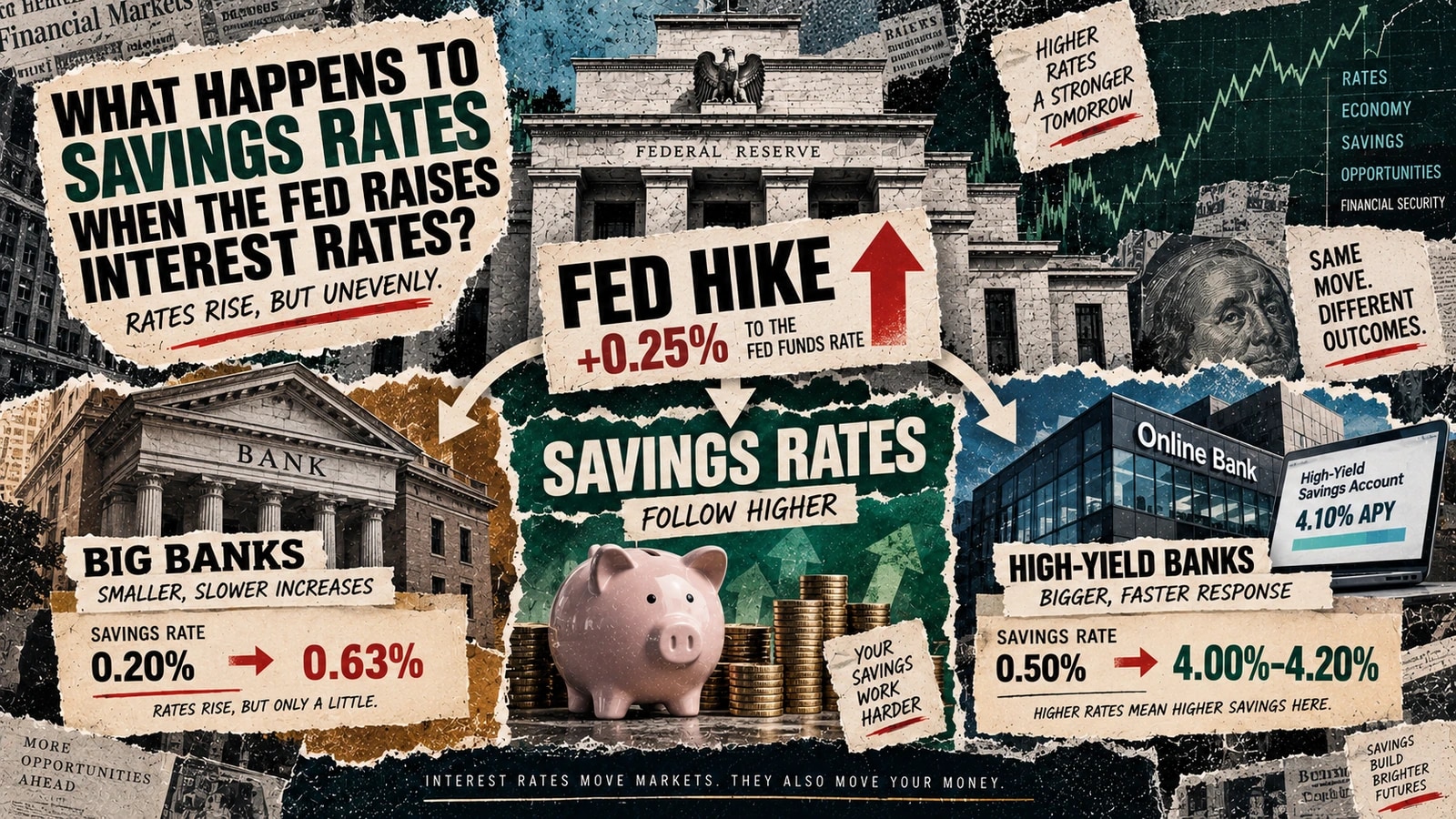
What Happens to Savings Rates When the Fed Raises Interest Rates?
A Fed rate hike does not automatically raise your savings APY. This guide explains deposit beta, why big banks lag, and how to capture higher yields when the Fed tightens.
Share Article:
When the Federal Reserve raises its benchmark interest rate, the immediate expectation for savers is straightforward: deposit accounts should start paying more. In practice, the relationship is looser, slower, and far more uneven. A Fed hike tends to put upward pressure on savings rates, but the size and timing of any increase depend heavily on the bank and account type.
Understanding that gap can make a meaningful difference in how much interest your cash earns. This article explains how Fed rate hikes reach savings accounts, why some banks pass along more than others, and what historical patterns reveal about timing.
The Fed Funds Rate and Your Savings APY Are Not the Same Number
The federal funds rate is the interest rate banks charge each other for overnight loans. The Federal Open Market Committee sets a target range for this rate as its primary tool for influencing inflation, employment, and overall economic activity. When the Fed raises that target, borrowing costs across the economy tend to rise, affecting mortgages, credit cards, auto loans, and business credit.
Your savings account's annual percentage yield is a different figure. It is set by your bank, not by the Fed, and reflects factors such as the bank's funding needs, loan demand, operating costs, and how aggressively it wants to attract deposits. Fed policy influences deposit rates, but it does not dictate them directly.
As of September 2026, the effective federal funds rate was around 3.63%, while some leading high-yield savings accounts were offering roughly 4.0% to 4.2% APY, depending on the provider and account requirements. Competitive banks can sometimes offer rates above the effective federal funds rate because they are actively competing for deposits rather than mechanically matching the Fed.
Why Banks Pass Along Only a Fraction of a Rate Hike
Economists often describe this transmission using the term deposit beta. It measures how much of a change in benchmark interest rates a bank passes through to depositors. A deposit beta of 100% would mean a savings rate moves in perfect lockstep with the Fed. In practice, pass-through is usually lower and varies considerably across institutions.
Research shows that online and traditional banks can respond very differently. NBER research found that following a 100-basis-point increase in the federal funds rate, deposit-rate increases at online banks were roughly 30 basis points larger than those at traditional banks.
That difference helps explain why national average savings rates can be misleading. Large traditional banks may make only limited changes to deposit rates, while institutions actively competing for deposits can respond more aggressively.
Deposit Rate Responses in Practice
| Bank Type | Typical Response to Fed Hikes | What Savers May See |
|---|---|---|
| Large traditional bank | Often limited | Little or no immediate APY change |
| Regional or community institution | Varies widely | Partial pass-through depending on funding needs |
| Online or high-yield bank | Often more responsive | Larger or faster APY adjustments |
Actual rate changes vary by institution, market conditions, funding needs, and competition for deposits.
Big Banks Have a Structural Advantage in Holding Rates Down
The gap between what the Fed pays banks and what banks pay depositors became a political issue after the 2022–2023 hiking cycle. A January 2025 letter from Senators Elizabeth Warren and Jack Reed highlighted that interest earned by JPMorgan Chase on reserves held at the Fed rose from 3.15% to 4.4%, while customers continued earning a negligible 0.01% on some savings accounts.
In their letter, Warren and Reed argued that the gap benefited large banks. The letter said U.S. banks had collectively earned roughly USD 1 trillion in profits, while JPMorgan reported USD 49.6 billion in profit in 2023.
Deposit rates have historically lagged the federal funds rate, but the lag can be substantially larger at major traditional banks than at institutions competing aggressively for deposits. For savers, that means remaining with a familiar bank does not necessarily produce a competitive deposit rate.
The 2022–2023 Cycle: What Actually Happened to Savings Rates
The most recent full hiking cycle offers a useful case study. From March 2022 to July 2023, the Fed raised its benchmark rate 11 times, moving it from near zero to a range of 5.25%–5.50%. It was one of the fastest tightening campaigns in decades.
National average savings rates rose, but from a very low base. Between March 2022 and May 2024, the national average savings rate climbed from 0.06% to 0.45%, while one-year CD rates increased from 0.15% to 1.80%, according to a NerdWallet analysis published by Nasdaq. Those increases were modest relative to the scale of the Fed's rate moves.
Competitive accounts told a different story. High-yield savings rates at online banks were around 1% to 1.25% APY in June 2022. By June 2024, top savings rates were around 5% APY, and some one-year CDs exceeded 5%. Some of the most competitive promotional CDs reached around 6% APY during parts of 2023.
The period showed how dramatically the gap between average and competitive deposit rates can widen. Savers who stayed in very low-yield traditional accounts captured little of the benefit, while customers using competitive savings products had access to much higher rates.
Why Online Banks Often Pass Through More
Online-only banks typically operate without large branch networks, which can reduce overhead and make it easier to compete with higher deposit rates.
There is also a funding incentive. Many online banks rely heavily on deposits to support lending and use attractive rates to bring in new customers. When benchmark rates rise, these institutions may adjust rates faster or more aggressively. Traditional banks with large, stable deposit bases can face less pressure to compete on APY.
This is not a universal rule. Some regional banks and credit unions also offer highly competitive rates. What matters most is whether the institution is actively competing for deposits.
What a Fed Hike Means for Different Savings Products
Not all deposit accounts respond to Fed changes in the same way.
High-yield savings accounts tend to be among the most responsive. Their rates are variable, and competitive institutions may adjust them when benchmark rates move. They offer liquidity, but the APY can fall if market rates decline.
Certificates of deposit lock in a rate for a fixed term. During a rising-rate environment, CD rates often increase as well, although the timing varies. Once a CD is opened, its fixed rate generally remains in place for the term. The trade-off is reduced liquidity, and early withdrawal penalties may apply.
Traditional savings accounts at large banks may pay rates that change very little even when Fed policy shifts substantially. A January 2025 letter from Senators Warren and Reed said some major banks had left savings rates largely unchanged despite the earlier Fed hiking cycle.
Money market accounts can offer rates above standard savings accounts, although terms vary. Some accounts also have minimum balance requirements or different transaction features.
A Simple Calculation
Suppose the Fed raises rates by 0.25 percentage points, or 25 basis points. If a hypothetical high-yield savings account passes through half of that increase, its APY would rise by about 0.125 percentage points.
On a USD 10,000 balance, that would add roughly USD 12.50 in annual interest before compounding, assuming the balance remained unchanged. An account that did not adjust its rate would provide no additional interest from the Fed move.
Over a full hiking cycle, differences in APYs can amount to hundreds of dollars per year on a USD 10,000 balance and substantially more on larger balances.
Practical Steps for Savers When the Fed Hikes
The Fed's decisions are outside your control. Your choice of account is not.
- Compare APYs across institutions. The gap between national averages and competitive rates can become wide during changing interest-rate environments.
- Understand the difference between average and competitive rates. A national average tells you what accounts broadly pay, not necessarily what the most competitive accounts offer.
- Consider the trade-off between liquidity and rate certainty. If you have funds you will not need for a fixed period, a CD can provide rate certainty that a variable savings account cannot.
- Check whether your bank has historically adjusted deposit rates. Past behavior can provide useful context, although it does not guarantee future rate changes.
- Do not assume a Fed hike automatically improves your APY. Deposit-rate transmission is partial and varies by bank.
- Verify deposit insurance before moving money. Check whether a bank is FDIC-insured or a credit union is federally insured through the NCUA, and make sure you understand applicable coverage limits.
Disclaimer: This article is for informational and educational purposes only and is not personalized financial, investment, tax, or legal advice. Consult a licensed professional for advice specific to your situation.
Frequently Asked Questions
Does a Fed rate hike automatically raise my savings account rate?
No. The Fed sets a target range for the federal funds rate, not consumer deposit rates. Individual banks and credit unions decide whether and how much to adjust their savings APYs.
How long does it take for a Fed hike to show up in savings rates?
Timing varies by institution. Competitive banks may adjust relatively quickly, while others may respond slowly or make little change at all. There is no fixed period in which a bank must raise a savings rate after a Fed hike.
Are CD rates better than savings rates when the Fed is hiking?
CD rates often rise during higher-rate environments and allow customers to lock in a fixed yield for a defined period. High-yield savings accounts offer greater liquidity, but their rates are variable. The better option depends on how soon you may need the money and the terms available when you open the account.
Why do online banks often pay more than big banks?
Online banks may have lower operating costs and often compete aggressively for deposits. Traditional banks with large existing deposit bases may have less incentive to offer market-leading savings rates.
From the Desk
All Personal Finance →More in Personal Finance
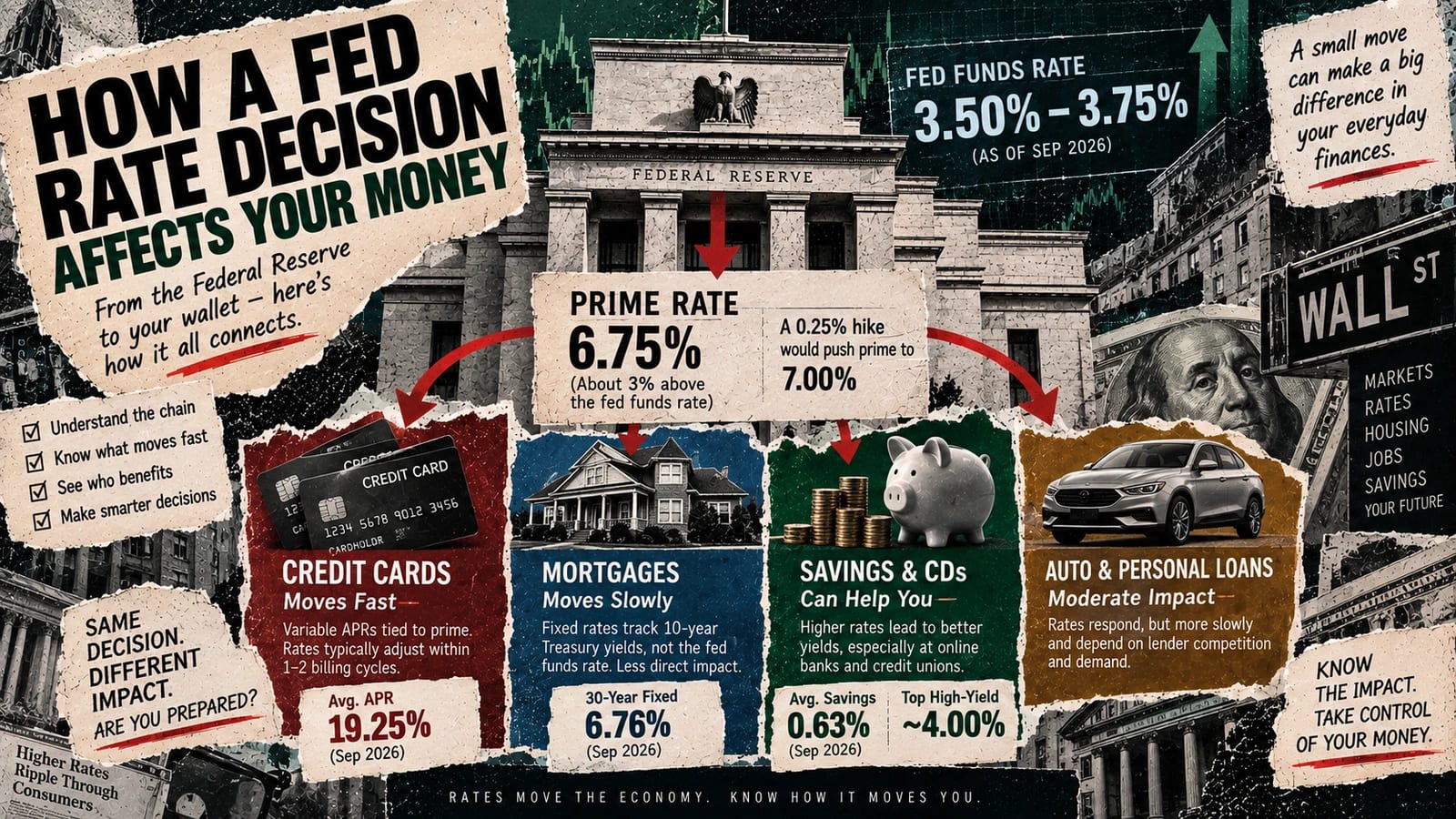
How the Fed's Rate Decisions Actually Affect Your Wallet: A Complete Guide
A complete guide to how Fed rate decisions move through the prime rate to your credit cards, mortgage, and savings account, with current September 2026 rates for each.
Fresh Reporting
Browse All Stories →Latest from The Ledger
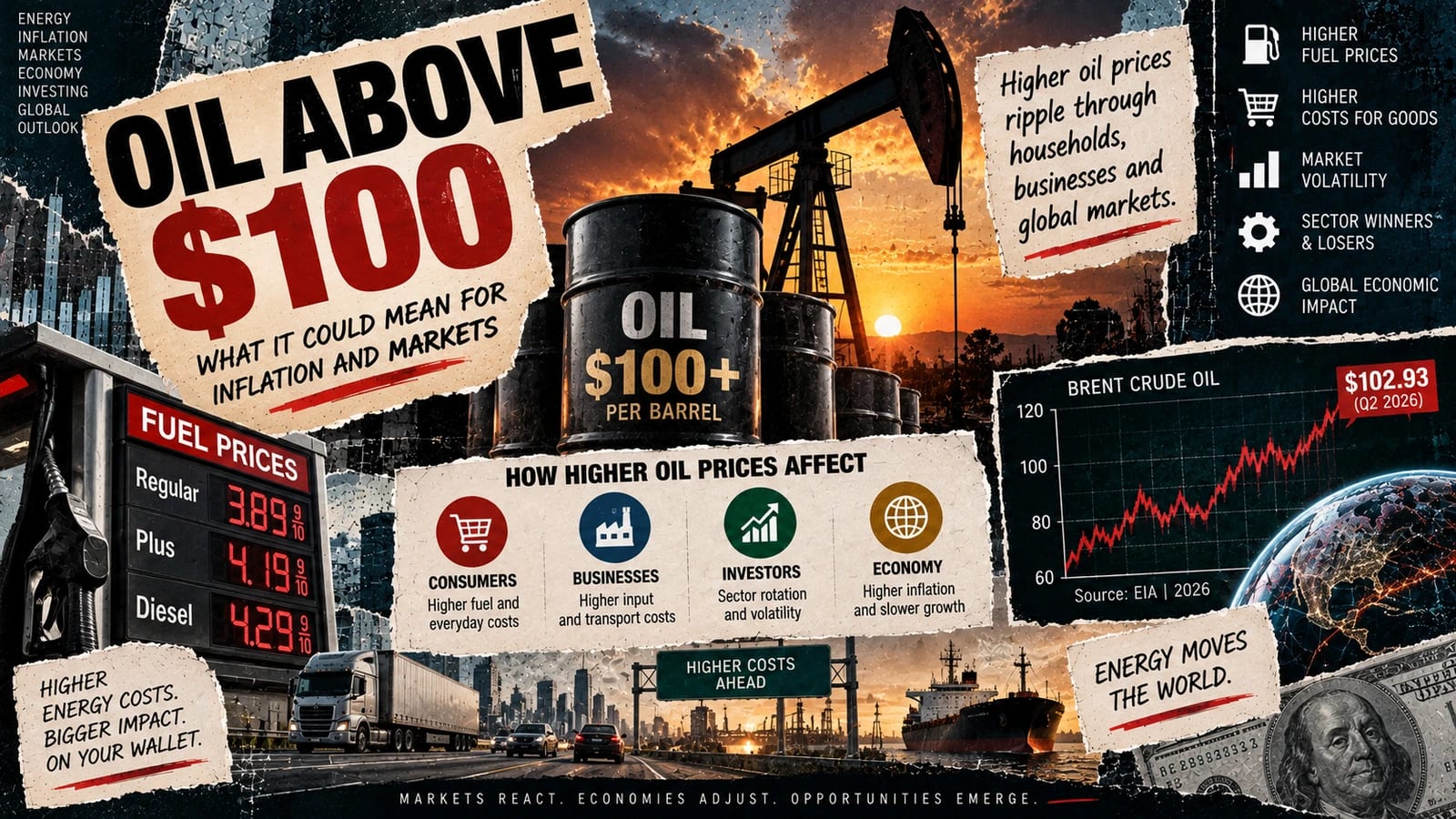
Oil Above 100 USD Inflation Pressures and Market Shifts
Oil above USD 100 per barrel raises inflation, pressures consumer spending, and reshapes sector performance. This guide explains the transmission channels, Fed dilemma, and practical implications.

Leave a Comment
Your email address will not be published. Required fields are marked *