••
Surge in Student Loan Defaults: Key Insights for Borrowers
Federal student loan defaults surged to 3.6 million in six months as pandemic-era protections ended. Here's what's driving the wave and how borrowers can still recover.
Share Article:
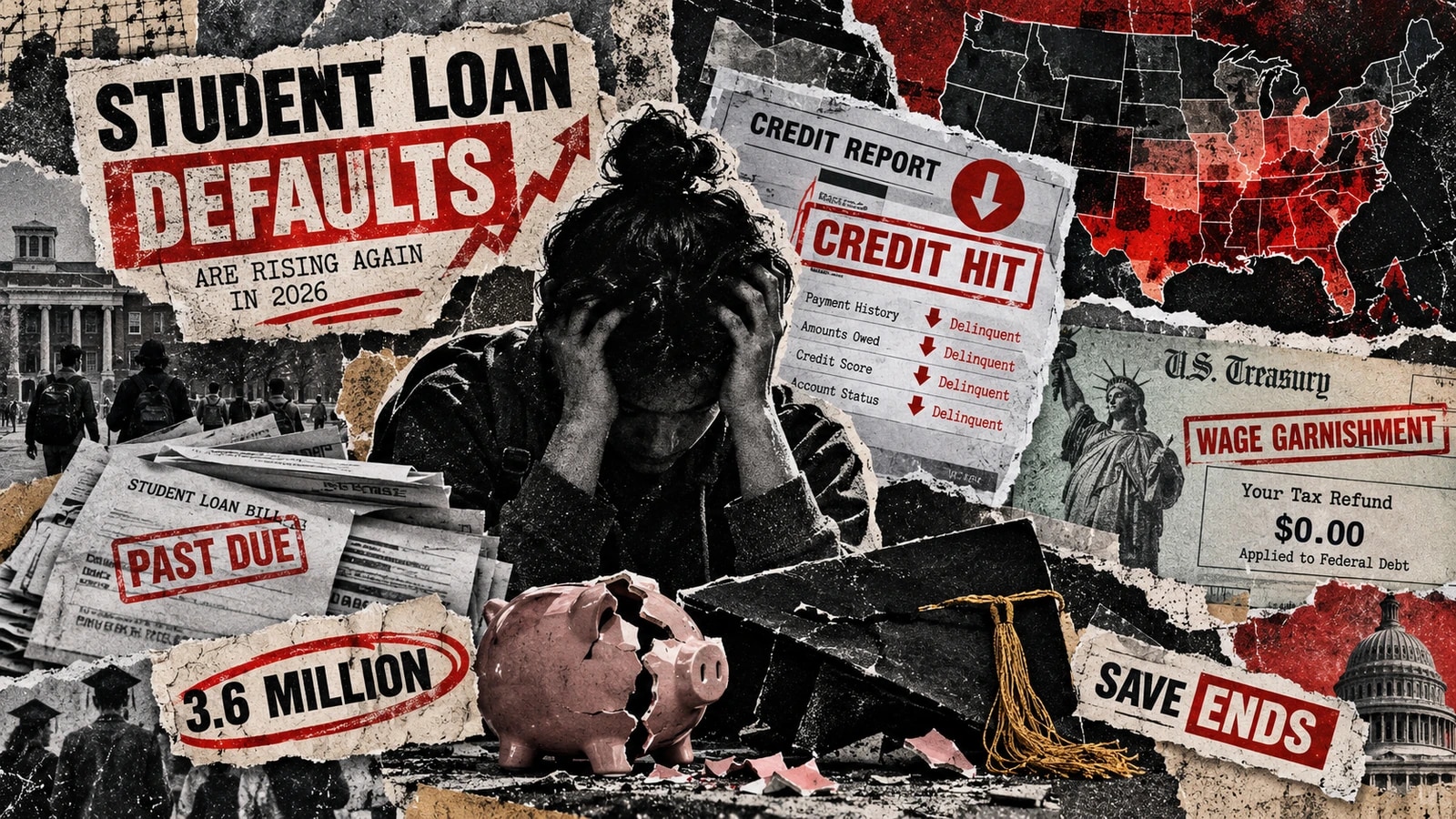
Student loan defaults surged in early 2026, with 3.6 million federal borrowers entering default in just six months. After a five-year pandemic-era pause on collections, the consequences are back damaged credit, wage garnishment notices, and tax refund seizures. Here's what happened and what borrowers can still do.
3.6 Million Borrowers Defaulted in Six Months
The numbers came fast. Roughly 1 million federal student loan borrowers defaulted in the fourth quarter of 2025. Another 2.6 million followed in the first quarter of 2026, according to the Federal Reserve Bank of New York. That's 3.6 million people in six months.
The share of past-due student loan balances climbed to just over 10%, nearing levels last seen before the COVID-19 pandemic. The 90-plus-day delinquency rate hit 10.3% in the first quarter of 2026, approaching the pre-pandemic norm.
The context matters. Federal student loan payments were paused for 43 months starting in March 2020. A one-year "on-ramp" period then shielded borrowers from credit reporting through October 2024. Once that protection expired, the 270-day federal default clock started ticking. By early 2026, the first wave of defaults hit credit reports.
By December 2025, 7.7 million borrowers had defaulted on USD 181 billion in federal student loans, per Education Department data. Three million more were at least three months late. That's the highest combined rate of serious delinquency and default since the government began tracking it nearly a decade ago.
Who Is Defaulting Now — and Why It's Different
The profile of the typical defaulter has shifted. The average age of a newly defaulted borrower is now 38.9, up from 36.4 before the pandemic. Defaults among borrowers aged 50 and older are rising.
Perhaps more striking: most of these borrowers weren't struggling before. More than 75% were current on their loans or had no payment due in 2019 because they were in school, in grace periods, or enrolled in $0-payment income-driven repayment plans. Only about 4% were already in default before the pandemic pause.
This wasn't a wave of pre-existing deadbeats. It's borrowers who simply didn't restart payments after a lengthy pause — and then fell behind on everything else, too.
Newly defaulted student loan borrowers have delinquency rates of nearly 40% on auto loans, 56% on credit cards, and 20% on mortgages. Their average credit score dropped 91 points, from 567 to 476. That's a collapse in creditworthiness that locks people out of renting apartments, buying cars, or getting mortgages.
The Map of Default: Concentrated in the South
Defaults aren't spread evenly. Louisiana, Mississippi, Alabama, Georgia, and South Carolina each saw at least 10% of borrowers default between Q4 2025 and Q1 2026. Wyoming is the only state outside the South to top that threshold.
Even the lowest-default states saw at least 4% of borrowers enter default. No state was spared.
By raw volume, Texas (878,000 borrowers) and California (730,000) have the most people in default, simply because they have the most borrowers. Rates and raw counts tell two different stories.
What Default Actually Costs You
Federal student loan default triggers collection powers that most other debts don't carry. The government can garnish up to 15% of your disposable income without a court order. It can seize federal and state tax refunds through the Treasury Offset Program. Social Security benefits can be offset if you're retired or disabled.
You must generally be left with at least USD 217.50 per week after garnishment. Borrowers receive a 30-day notice before garnishment begins.
Default also strips away the tools that could have helped. You lose eligibility for federal financial aid, deferment, forbearance, and income-driven repayment plans.
The Education Department planned to resume wage garnishment in January 2026, sending initial notices to 1,000 borrowers. Then it reversed course, delaying involuntary collections indefinitely while it finalizes new repayment plans. The Treasury may begin contacting defaulted borrowers starting July 2026. Aggressive collections are expected to resume "in the near future."
The SAVE Plan Is Dead. Here's What Replaced It.
The Saving on a Valuable Education (SAVE) plan — an income-driven repayment option created under the Biden administration — was permanently eliminated in March 2026 by the Eighth Circuit Court of Appeals. About 7 million borrowers were stuck in SAVE forbearance, accruing interest since August 2025, waiting for clarity.
Starting July 1, 2026, the Education Department began sending 90-day notices instructing SAVE borrowers to switch plans. The earliest anyone will be moved off SAVE is September 29, 2026. Fail to choose, and you'll be auto-enrolled in a Standard repayment plan — which could mean much higher payments and lost progress toward forgiveness.
The replacement system is simpler and less generous. Under the One Big Beautiful Bill Act, all prior repayment options are replaced by just two: the Tiered Standard plan and the new Repayment Assistance Plan (RAP). RAP launches July 1, 2026, and is the only income-driven option for newly borrowed loans.
For borrowers who took out loans before July 2026, existing income-driven plans like PAYE and IBR remain available through their servicers, though the application process has been slow. Parent PLUS borrowers who haven't consolidated must do so by July 1, 2026, or lose access to all income-driven repayment options entirely.
How to Get Out of Default
Two main paths exist: rehabilitation and consolidation. They work differently, and the right choice depends on your goals.
Loan rehabilitation requires nine voluntary, reasonable monthly payments within 20 days of the due date, completed within 10 consecutive months. The payment is 10% to 15% of your discretionary income. On completion, the default notation is removed from your credit report entirely, and you regain eligibility for income-driven repayment. The downside: it takes nearly a year, and collection fees of up to 16% can be added to your balance.
Loan consolidation resolves default faster, sometimes in 30 to 90 days. You must agree to an income-driven repayment plan or make three consecutive voluntary payments first. But the default notation stays on your credit report for seven years.
The One Big Beautiful Bill Act allows borrowers to rehabilitate a defaulted loan twice, up from once. That change takes effect July 1, 2027.
The Education Department's delay on involuntary collections gives defaulted borrowers additional time to consolidate or complete rehabilitation. The department encourages borrowers to explore options with the defaulted federal loan servicer before enforcement resumes.
What Borrowers Should Do Now
Check your loan status at StudentAid.gov. If you're in default, contact your servicer — the Default Resolution Group for most federal loans — immediately. Starting the rehabilitation or consolidation process takes time, and delays narrow your options.
If you're on SAVE, watch for your 90-day notice and choose a new plan before the deadline. If you don't, you'll be auto-enrolled in Standard repayment, which for many borrowers means a significantly higher monthly bill.
Update your contact information with the Education Department and your servicer. Missing a critical notice because of an old address can cost you months of options.
Scammers are active. You never have to pay for student loan help. Red flags include "enroll now" pressure, "guaranteed forgiveness," requests for your FSA password, and demands for upfront fees.
Frequently Asked Questions
What caused the surge in student loan defaults?
The surge in student loan defaults was driven by the end of pandemic-era protections, which included a 43-month pause on payments. As these protections expired, borrowers faced immediate consequences, leading to 3.6 million defaults in just six months.
How many borrowers defaulted on student loans recently?
In early 2026, approximately 3.6 million federal student loan borrowers entered default. This included 1 million defaults in the fourth quarter of 2025 and 2.6 million in the first quarter of 2026.
What are the consequences of defaulting on student loans?
Consequences of defaulting on student loans include damaged credit scores, wage garnishment, and tax refund seizures. These repercussions can significantly impact a borrower's financial stability and future borrowing capabilities.
What can borrowers do to recover from default?
Borrowers can recover from default by exploring options like loan rehabilitation, consolidation, or repayment plans. It's essential to act quickly to minimize the long-term impact on credit and financial health.
Disclaimer: This article is for informational and educational purposes only and is not personalized financial, investment, or legal advice. Consult a licensed professional for advice specific to your situation.
Sources
- Federal Reserve Bank of New York — Federal Student Loan Defaults Return After Pandemic Pause
- U.S. Department of Education — Delays Involuntary Collections
- SoFi — Student Loan Default Rates by State: 2026 Data
- Forbes — New Details Emerge on Timing for Student Loans to Change Repayment Plans
- CBS News — Trump Administration Delays Wage Garnishment Plan
- The Boston Globe — Record Number of Student Loan Borrowers in Delinquency and Default
From the Desk
All Personal Finance →More in Personal Finance
High Yield Savings vs Money Market: Choosing the Best Option
Both accounts can park cash safely, but the better choice depends on rate stability, access, and fees. The math changes fast when balances rise or rates fall.

Fresh Reporting
Browse All Stories →Latest from The Ledger

AI Cybersecurity in 2026: How Artificial Intelligence Is Changing Online Security
Artificial intelligence is transforming cybersecurity in 2026. Learn how AI improves threat detection while creating new risks such as deepfake fraud, prompt injection, AI-powered phishing, and over-permissive agents.

Leave a Comment
Your email address will not be published. Required fields are marked *