••
Central Banks Grapple with Inflation Challenges in September 2026
The ECB has already hiked rates twice in 2026 on Iran-war-driven inflation, the Fed faces a genuinely split decision on September 16, and the Bank of Japan looks likely to follow. Here's what's confirmed and what's still pending.
Share Article:
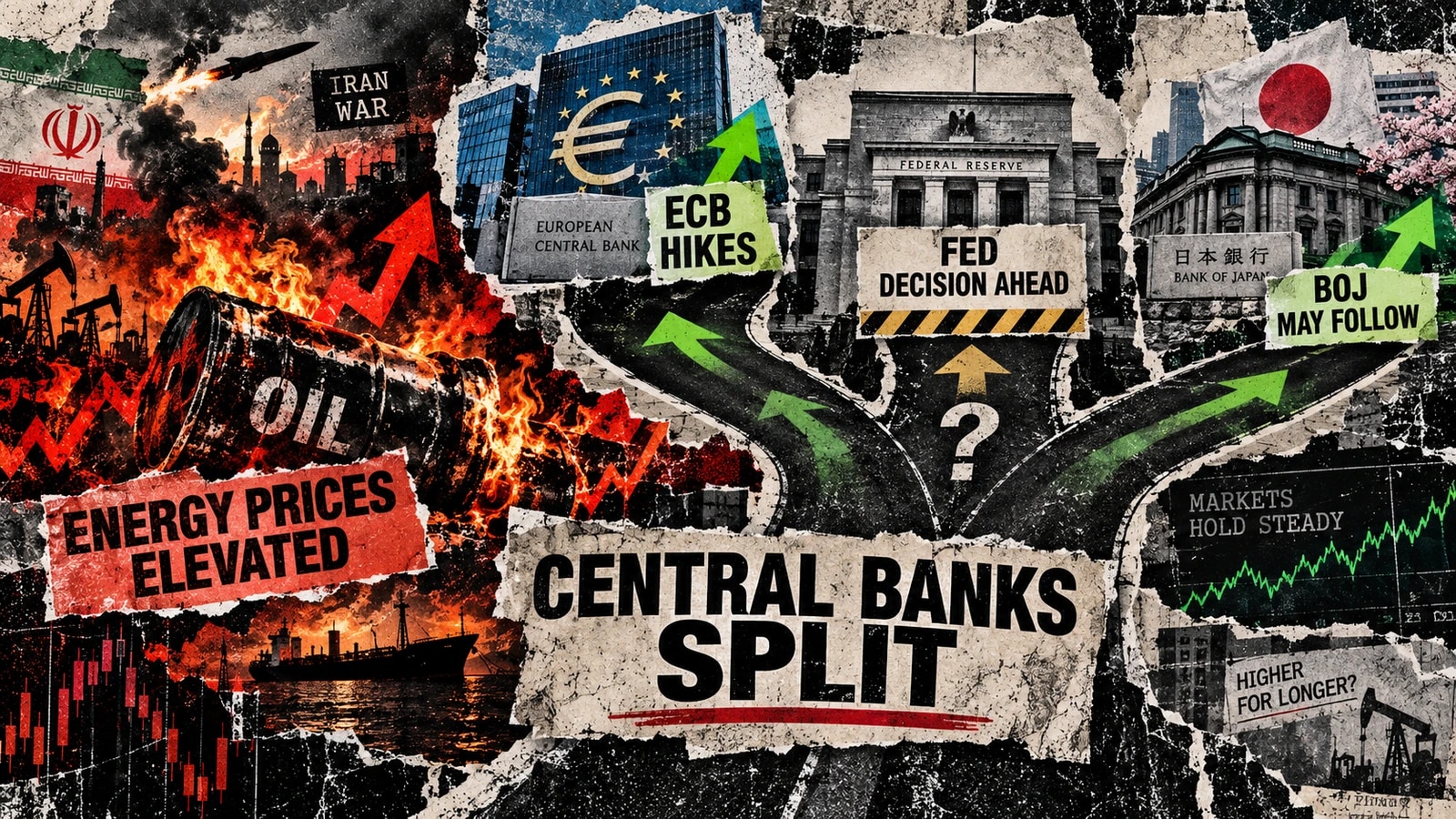
An energy shock tied to the ongoing conflict involving Iran has pushed inflation higher across the United States, the eurozone, and Japan. Central banks are grappling with inflation challenges in September 2026, but the world's major central banks are no longer moving in the same direction or on the same timetable.
For most of the past two decades, the Federal Reserve, the European Central Bank, and the Bank of Japan have tended to move in rough alignment, cutting or holding together as global financial conditions shifted in tandem. That pattern has broken down this year. With oil and broader energy costs climbing on the back of the Middle East conflict, each institution is now weighing a genuinely different set of domestic pressures, and their policy paths have started to diverge sharply.
Frankfurt Has Already Acted
The European Central Bank moved first. Its Governing Council, meeting in Berlin on September 10, 2026, voted to lift all three of its key rates by 25 basis points. The deposit facility rate climbs to 2.50%, the main refinancing rate to 2.65%, and the marginal lending facility to 2.90%, with the changes taking effect September 16. It was the ECB's second increase of the year, coming three months after a similar move in June.
The bank's messaging left little doubt about the driver: officials pointed to the Middle East conflict as a persistent source of price pressure likely to hold across a wide range of economic scenarios. That concern is backed by the numbers. Euro area inflation ran at 3.3% in August 2026, well above the ECB's 2% medium-term goal. The central bank's own staff now project inflation easing only gradually to 3.0% for 2026 as a whole, 2.3% in 2027, and back to the 2.0% target by 2028. In other words, the ECB isn't expecting a quick resolution; it's bracing for a multi-year grind back toward target, and it chose to tighten policy now rather than wait out the shock.
Washington Remains Genuinely Undecided
The Federal Reserve's situation looks different, both in substance and in the internal politics of the decision. The Fed has kept its target range parked at 3.50%–3.75% through every meeting so far this year. But the July 28–29 gathering revealed real disagreement inside the committee: the Federal Open Market Committee voted 9–3 to hold steady, with three policymakers dissenting in favor of a hike the first time in a decade that three members have broken the same way on a single decision. Fed Chair Kevin Warsh, who took over from Jerome Powell on May 22, 2026, acknowledged afterward that inflation was still running above the Committee's goal.
The data released since then hasn't made the choice any easier. Bureau of Labor Statistics figures published September 11 showed consumer prices up 3.4% year-over-year in August, keeping the pressure on ahead of the Fed's September 15–16 meeting. Wall Street forecasters are split on what comes next: JPMorgan Wealth Management is now calling for a quarter-point increase, while Goldman Sachs has argued a September hike is unlikely and expects the Fed to hold through the rest of the year. As of this writing, the Fed had not yet announced its decision, leaving open a question that, unlike in Frankfurt, has no clear consensus answer even among the people paid to predict it.
Tokyo May Be Next to Move
Japan presents a third pattern entirely. The Bank of Japan's policy rate already sits at 0.75%, its highest point since 1995, following a string of increases earlier this year. Governor Kazuo Ueda, speaking to reporters at a recent G20 finance ministers' meeting, signaled that the central bank would approach its September 17–18 meeting mindful of risks that prices could run hotter than expected, and noted that underlying inflation is edging closer to the BOJ's 2% goal. Traders took that as a signal: bets on a September rate increase have grown noticeably since Ueda's comments.
Put together, the three institutions are now on three distinct tracks within the same week and a half-the ECB having already tightened, the BOJ leaning toward following suit, and the Fed caught between a divided committee and forecasters who can't agree on the outcome.
Markets Haven't Flinched Yet
What's notable is how little of this uncertainty has shown up in market pricing so far. US equities have avoided the kind of broad selloff that policy divergence often triggers. The S&P 500 closed at 7,656.98 on September 11, 2026, a gain of 0.86% for the day and a level near record highs. That strength has been concentrated in a narrow group of large technology names, though, with smaller companies participating far less. The Cboe Volatility Index, a common gauge of expected market turbulence, sat at 15.84 that same day low by historical standards, and not the kind of reading typically associated with three central banks approaching potentially conflicting decisions within days of each other. Treasury yields, meanwhile, have crept higher in recent weeks as investors begin pricing in at least the possibility of further tightening somewhere in the system, even without knowing yet where it will land first.
Frequently Asked Questions
What actions have central banks taken regarding inflation in September 2026?
In September 2026, the European Central Bank raised its key rates by 25 basis points, while the Federal Reserve is considering its options. The Bank of Japan is also expected to adjust its policies as inflation pressures differ across regions.
How is the Iran conflict affecting global inflation in September 2026?
The ongoing conflict in Iran has led to increased oil and energy prices, contributing to higher inflation rates in the United States, eurozone, and Japan. Central banks are responding to these inflationary pressures with varying policy measures.
What are the current inflation rates set by the European Central Bank?
As of September 16, 2026, the European Central Bank's deposit facility rate is 2.50%, the main refinancing rate is 2.65%, and the marginal lending facility is 2.90%. These rates reflect the ECB's response to inflation driven by the Middle East conflict.
Disclaimer: This article is for informational and educational purposes only. It is not personalized financial, investment, or legal advice. Consult a licensed professional for advice tailored to your circumstances.
From the Desk
All Markets →More in Markets
Fed's Rate Hike Focuses on Wall Street, Analyst Claims
A recent analyst's statement shifts the narrative of the Federal Reserve's rate hike strategy from inflation control to appeasing Wall Street.
Fresh Reporting
Browse All Stories →Latest from The Ledger

AI Cybersecurity in 2026: How Artificial Intelligence Is Changing Online Security
Artificial intelligence is transforming cybersecurity in 2026. Learn how AI improves threat detection while creating new risks such as deepfake fraud, prompt injection, AI-powered phishing, and over-permissive agents.


Leave a Comment
Your email address will not be published. Required fields are marked *