••
Best High-Yield Savings Accounts in 2026: What Savers Should Know
A look at where high-yield savings rates stand in 2026 after the Fed's rate pause, and what savers should check beyond the headline APY before opening an account.
Share Article:
Share:
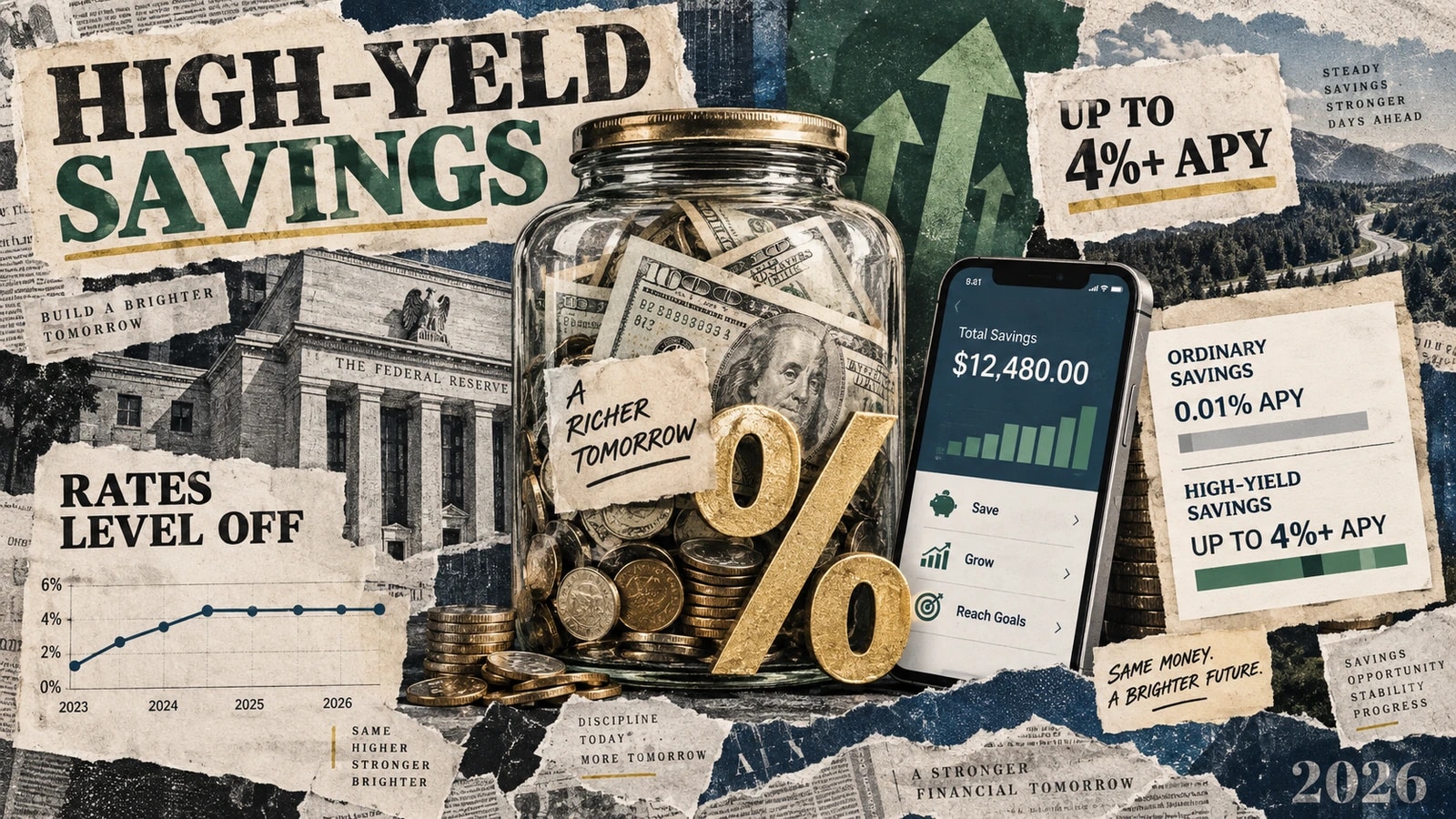
Savers who moved cash into high-yield savings accounts over the past few years are now watching a market that has leveled off. After the Federal Reserve's benchmark rate rose sharply in 2022 and 2023, then eased through three quarter-point cuts in 2025, the rate has held steady through five consecutive Federal Open Market Committee meetings in 2026. At its July 28–29 meeting, the Fed kept the federal funds rate in a target range of 3.50% to 3.75%, and Chair Kevin Warsh said the board saw no need for an immediate change.
That pause matters for anyone comparing savings accounts. Annual percentage yields on high-yield savings accounts generally track the federal funds rate, so a holding pattern at the Fed means most banks have stopped cutting rates for now, though a handful have trimmed yields modestly since June while a few have raised them. Understanding where rates stand today, and what actually separates a strong account from a mediocre one, can help savers avoid leaving money on the table.
Where Savings Rates Stand Right Now
The national average savings account rate was 0.38% as of early September 2026, largely unchanged since April. That figure includes both online banks and traditional brick-and-mortar institutions, and it is dragged down heavily by large banks that pay close to nothing on standard savings accounts.
High-yield savings accounts, by contrast, are paying roughly ten times that average. Among widely available, non-promotional accounts:
- Axos Bank has advertised an APY as high as 4.21% for customers who meet balance or activity requirements.
- Newtek Bank's Personal High Yield Savings account, named a top pick in NerdWallet's 2026 rankings, pays 4.20% APY with no monthly fee.
- Ally Bank's Savings Account and the American Express High-Yield Savings Account each pay around 3.00% APY with no minimum deposit.
- Capital One 360 Performance Savings also pays close to 3.00% APY.
- Laurel Road's High Yield Savings Account has offered around 3.50% APY.
Some credit unions advertise far higher headline rates, including accounts promoted at 8% to 10% APY. These offers typically apply only to a small slice of the balance, often the first USD 500 to USD 1,500, with everything above that capped amount earning a much lower rate, sometimes under 1%. Membership in these credit unions can also be restricted by location, employer, or age. A 10% APY sounds compelling in a headline, but on a capped balance of USD 1,000 it may generate less annual interest than a simpler 4% APY account with no cap.
Why Rates Have Plateaued
Savings account yields are not set independently. Banks generally adjust them in response to the federal funds rate, which the Fed uses to influence borrowing costs and, in turn, deposit rates across the banking system. With the funds rate unchanged since early 2026 after three cuts in 2025, banks have less incentive to move their own rates aggressively in either direction.
That does not mean stability is guaranteed through the rest of the year. Forecasters are divided on when the Fed might act again, and any future cut would likely pull savings rates lower within weeks, since online banks tend to adjust quickly. Savers who want to lock in a rate rather than ride a variable one might consider a certificate of deposit instead, though CDs trade flexibility for a fixed rate and often impose an early withdrawal penalty.
What Actually Makes an Account Worth Choosing
A high headline rate is only one factor. Several details determine what a saver actually earns and how easily they can access their money.
Balance requirements and caps. Some accounts offer their best rate only on a limited balance, with a much lower rate on everything above that threshold. Others require a minimum balance just to earn any advertised rate at all, or reduce the rate substantially without regular direct deposits.
Fees. Monthly maintenance fees can erase months of earned interest on a modest balance. Most competitive high-yield accounts today charge no monthly fee and require no minimum opening deposit, but it is worth checking the fine print before opening one.
FDIC or NCUA insurance. Bank accounts should carry Federal Deposit Insurance Corporation coverage, and credit union accounts should carry National Credit Union Administration coverage, both of which insure deposits up to USD 250,000 per depositor, per institution, in most ownership categories. Confirming this coverage before depositing a large sum is a basic but important step.
Access to funds. High-yield savings accounts are meant to be liquid. Some online banks pair the account with a debit card or ATM access; others require a transfer to an external checking account before funds can be spent, which can take a day or more to complete.
Rate variability. Nearly every high-yield savings account carries a variable rate that the bank can change at any time without notice. The rate advertised on the day an account is opened is not a lasting guarantee.
Comparing a Few 2026 Options
| AccountApproximate APYNotable Condition | ||
|---|---|---|
| Axos Bank High Yield Savings | Up to 4.21% | Requires meeting balance or direct deposit criteria |
| Newtek Bank Personal High Yield Savings | 4.20% | No monthly fee |
| Laurel Road High Yield Savings | 3.50% | No stated cap reported |
| SoFi Savings (with direct deposit) | Up to 3.10% | Falls to 1.00% without qualifying direct deposit |
| Ally Bank Savings Account | 3.00% | No minimum deposit or monthly fee |
| American Express High-Yield Savings | 3.00% | No minimum deposit or monthly fee |
| Capital One 360 Performance Savings | 3.00% | No monthly fee |
These figures reflect rates reported in early-to-mid September 2026 and are subject to change without notice. Readers should verify current rates directly with each institution before opening an account.
How to Think About Choosing an Account
For most savers building an Emergency fund or setting aside money for a near-term goal, the practical difference between a 3.00% and a 4.20% APY is smaller in dollar terms than it looks in percentage terms, especially on balances under a few thousand dollars. On a USD 5,000 balance, the gap between 3.00% and 4.20% APY works out to roughly USD 60 a year before compounding, a meaningful but not dramatic sum.
That means fees, balance caps, and ease of access often matter as much as the headline rate itself. An account with a 4% APY and no restrictions may be more useful in practice than one advertising 10% that applies only to the first USD 500 of a balance.
Savers comparing options should also account for how they plan to use the money. Funds intended purely as an emergency reserve benefit most from full liquidity and no penalties, even if the rate is a bit lower than a capped promotional offer. Funds that will sit untouched for a fixed period might do better in a CD, where the rate is locked in regardless of what the Fed does next.
Disclaimer: This article is for informational and educational purposes only and is not personalized financial, investment, or legal advice. Consult a licensed professional for advice specific to your situation.
Sources
- NerdWallet — Best High-Yield Savings Accounts of September 2026
- Forbes Advisor — 10 Best High-Yield Savings Accounts Of September 2026
- CNBC Select — The Best High-Yield Savings Accounts of September 2026
- Yahoo Finance — Best High-Yield Savings Account Rates for September 2026
- WalletHub — Best High-Yield Savings Accounts of September 2026
Frequently Asked Questions
What are the best high-yield savings accounts in 2026?
The best high-yield savings accounts in 2026 offer rates significantly above the national average of 0.38%. Look for accounts that provide competitive annual percentage yields and favorable terms beyond just the APY.
How do high-yield savings account rates compare to the federal funds rate?
High-yield savings account rates generally track the federal funds rate. As of July 2026, the federal funds rate is between 3.50% and 3.75%, which influences the yields offered by these accounts.
What should savers consider before opening a high-yield savings account?
Before opening a high-yield savings account, savers should evaluate the APY, fees, withdrawal limits, and any minimum balance requirements. These factors can significantly impact the overall value of the account.
From the Desk
All Personal Finance →More in Personal Finance

Digital Wallets Personal Finance: Transforming Everyday Payments
How digital wallets are changing everyday payments, what the GENIUS Act means for stablecoin-based wallets, and what consumers should check before trusting a wallet balance over a savings account.

Fresh Reporting
Browse All Stories →Latest from The Ledger
Digital Wallets Personal Finance: Transforming Everyday Payments
How digital wallets are changing everyday payments, what the GENIUS Act means for stablecoin-based wallets, and what consumers should check before trusting a wallet balance over a savings account.


Leave a Comment
Your email address will not be published. Required fields are marked *