Bitcoin September 2026: The Fed, Treasury Debt and the New Liquidity Puzzle
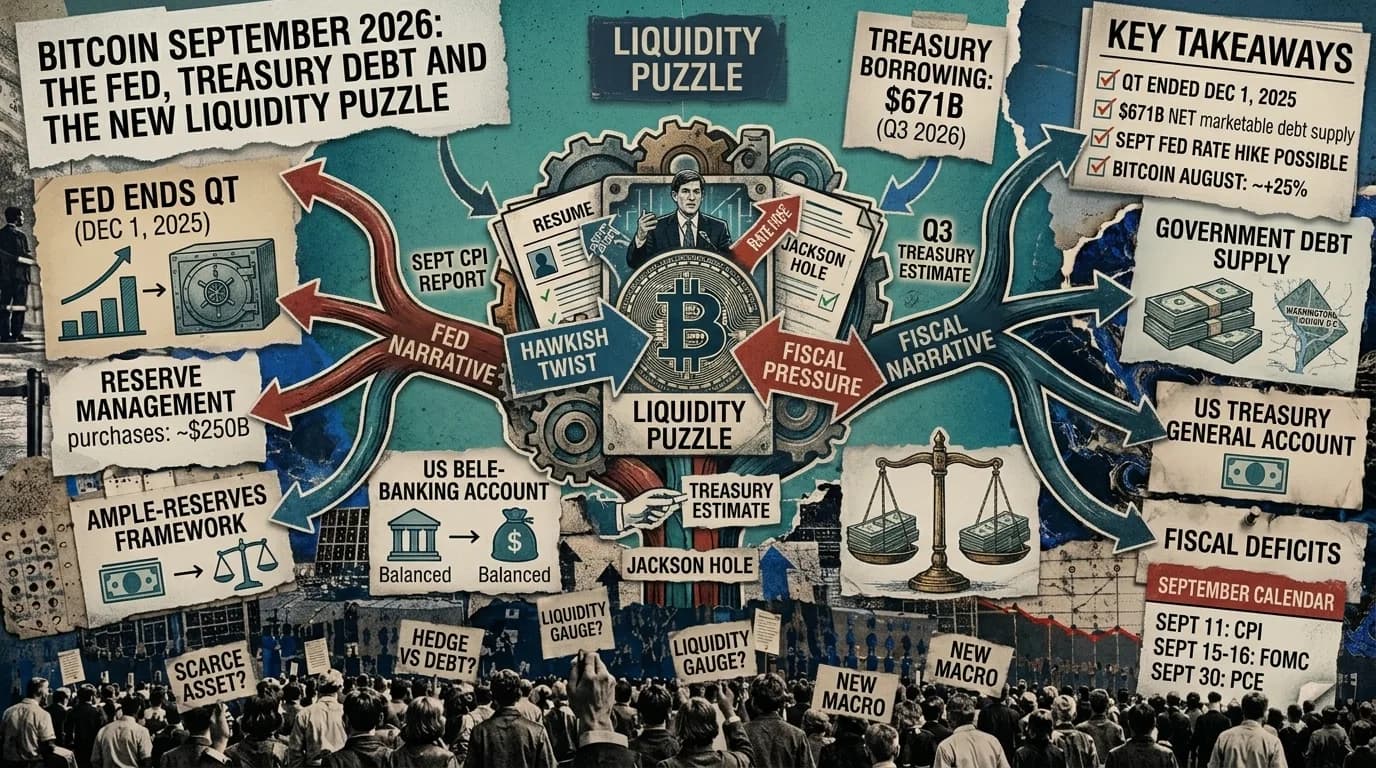
Bitcoin September 2026 begins with a complicated macro backdrop. The Federal Reserve has ended quantitative tightening, but renewed expectations for an interest-rate hike are creating a new source of pressure for risk assets. At the same time, the U.S. Treasury continues to issue large amounts of government debt, creating a policy mix that could have important consequences for Bitcoin.
For much of the past several years, investors have relied on a relatively simple macro framework: easier monetary policy and improving liquidity tend to support Bitcoin, while higher interest rates and tighter financial conditions tend to weigh on it.
September 2026 is proving more complicated.
The Fed is no longer shrinking its securities holdings through quantitative tightening (QT), while reserve-management purchases are helping maintain an ample level of reserves in the banking system. At the same time, inflation remains a concern, and policymakers have left open the possibility of another rate increase.
Meanwhile, Treasury borrowing remains substantial, creating another important variable for bond yields, financial conditions and risk assets.
Key Takeaways
- The Federal Reserve ended quantitative tightening on December 1, 2025.
- The Fed is now managing reserves under an ample-reserves framework rather than continuing balance-sheet runoff.
- The U.S. Treasury expects to borrow $671 billion in privately held net marketable debt during the July–September 2026 quarter.
- A September Fed rate hike remains possible as policymakers evaluate inflation and economic conditions.
- Bitcoin gained roughly 25% in August 2026, making it the strongest August for Bitcoin since 2017.
- The September CPI report, FOMC meeting and PCE inflation data are among the month's most important macro events.
Quantitative Tightening Is Over — But That Does Not Mean Full-Blown QE
The Federal Reserve ended the reduction of its securities holdings on December 1, 2025.
The decision concluded a balance-sheet runoff that had begun in June 2022. According to the Federal Reserve, its securities holdings fell by more than $2.2 trillion during that period.
Read the Federal Reserve's policy-normalization information
The end of QT is important because the Fed is no longer mechanically reducing reserves through balance-sheet runoff.
However, describing the move simply as “the Fed turning the liquidity tap back on” would be misleading.
The central bank has instead moved toward maintaining an ample level of reserves. It has also been conducting reserve-management purchases of Treasury bills. In its July 2026 Monetary Policy Report, the Fed said it had purchased nearly $250 billion of Treasury bills since early January, including approximately $160 billion classified as reserve-management purchases.
This creates a more stable reserve environment than active quantitative tightening, but it should not automatically be treated as a return to the large-scale quantitative easing used during the pandemic.
For Bitcoin investors, that distinction is important.
The Hawkish Twist: A September Rate Hike Is Still Possible
The bigger complication is the Federal Reserve's interest-rate policy.
At its July 28–29 meeting, the Federal Open Market Committee voted 9–3 to keep the federal funds target range at 3.50% to 3.75%. Three members preferred a 25-basis-point increase.
Read the Federal Reserve's July 2026 FOMC statement
Those dissents showed that a rate increase was already being seriously considered within the committee.
Fed Chair Kevin Warsh then highlighted the continuing inflation challenge during his August 28 speech at the Jackson Hole Economic Policy Symposium. His comments contributed to a rise in market expectations for a possible September rate increase.
The situation remained fluid in early September. Fed Governor Christopher Waller said on September 3 that he would be inclined to support keeping rates at their current level if inflation continued to improve, while also acknowledging that a rate increase could become appropriate if upcoming data showed renewed price pressure.
This makes the September decision highly dependent on incoming economic data.
What Could Influence the Fed?
Several factors could influence the September decision:
- Higher inflation: Could increase the case for a rate hike.
- Persistent core inflation: Could keep policy restrictive for longer.
- Strong economic activity: Could reduce the urgency for monetary easing.
- Softer inflation: Could support keeping rates unchanged.
- Further labor-market weakness: Could make policymakers more cautious about tightening.
The Fed's September 15–16 FOMC meeting is therefore one of the most important events on the September calendar.
For Bitcoin, a rate hike could push Treasury yields and the dollar higher, creating pressure on risk assets. A rate hold accompanied by dovish guidance could provide a more supportive environment.
Treasury Borrowing Adds Another Layer of Pressure
While the Federal Reserve focuses on monetary policy, the U.S. Treasury continues to raise substantial amounts of money through government debt issuance.
For the July–September 2026 quarter, the Treasury estimated that it would borrow $671 billion in privately held net marketable debt, assuming an end-of-quarter cash balance of approximately $950 billion.
Read the U.S. Treasury's Q3 2026 borrowing estimate
That represents a large amount of government debt supply.
However, Treasury borrowing should not automatically be described as a direct liquidity injection.
When investors purchase Treasury securities, cash is exchanged for government debt. When the government spends those funds, money can flow back into the private sector. Changes in the Treasury General Account and Federal Reserve operations can also affect banking-system liquidity.
The final impact therefore depends on the interaction between Treasury issuance, government spending, cash balances and Federal Reserve operations.
For Bitcoin, the important transmission channels include:
- Treasury yields
- Real interest rates
- The U.S. dollar
- Investor risk appetite
- Financial-market liquidity
Treasury Buybacks Add a Different Kind of Support
The Treasury is also expanding its buyback operations in longer-dated government debt.
Beginning September 9, the maximum size of certain liquidity-support buyback operations will increase from $2 billion to at least $4 billion per operation, covering longer maturity sectors of the Treasury market.
The objective is to improve liquidity in parts of the long-end Treasury market.
These operations should not be confused with Federal Reserve quantitative easing.
Treasury buybacks are primarily a debt-management and market-liquidity tool, rather than a monetary-policy program designed to increase the money supply.
For Bitcoin, the impact is indirect.
Long-term Treasury yields influence borrowing costs, asset valuations and the attractiveness of riskier investments. Improvements in Treasury-market liquidity can therefore have broader implications for financial conditions.
Why This Combination Is Unusual for Bitcoin
Historically, Bitcoin has responded strongly to changes in liquidity and financial conditions.
When interest rates fall and liquidity improves, investors can become more willing to hold higher-risk assets. When real yields rise, the dollar strengthens and financial conditions tighten, Bitcoin can face additional pressure.
September 2026 combines elements of both environments.
The Fed has stopped the structural balance-sheet drain created by QT. At the same time, it remains concerned about inflation and could potentially raise interest rates.
Meanwhile, the Treasury continues to issue large amounts of government debt.
This produces two major narratives for Bitcoin.
The Liquidity Narrative
The end of QT removes a major source of monetary tightening.
Reserve-management purchases also suggest that the Fed is focused on maintaining sufficient reserves rather than allowing them to decline indefinitely.
Potentially supportive factors include:
- The end of balance-sheet runoff
- Continued reserve-management purchases
- A more stable banking-system reserve environment
- The possibility of easier financial conditions later in the cycle
However, these factors do not guarantee higher Bitcoin prices.
The Fiscal Narrative
A second argument centers on government debt and long-term fiscal sustainability.
Some investors believe that persistent deficits and rising government debt could eventually increase demand for scarce assets such as Bitcoin and gold.
The argument is based on several long-term concerns:
- Large government borrowing requirements
- Elevated public debt
- Persistent fiscal deficits
- Concerns about fiat-currency purchasing power
- Growing institutional interest in alternative stores of value
This remains a long-term thesis rather than a reliable short-term Bitcoin trading signal.
Bitcoin's Strong August Sets the Stage for September
Bitcoin entered September after a powerful August rally.
The cryptocurrency gained roughly 25% during August 2026, making it Bitcoin's strongest August since 2017. Bitcoin moved from the low-$60,000 range earlier in the month to above $81,000 before consolidating closer to the upper-$70,000 area.
Read market coverage of Bitcoin's August performance
The rally is particularly notable because expectations for a September rate hike were increasing at the same time.
That suggests Bitcoin is increasingly being influenced by more than one macro narrative.
Investors may be considering monetary policy, fiscal deficits, Treasury-market conditions, institutional demand and Bitcoin's potential role as a scarce alternative asset.
Bitcoin Price Levels to Watch
Recent market analysis highlighted several important levels:
- Around $82,793: Major resistance
- Around $75,674: Important downside level
- Around $71,781: Deeper support
These levels should be viewed as market reference points rather than guaranteed support or resistance.
The September 2026 Economic Calendar
September contains several events that could quickly change the Bitcoin macro narrative.
September 4 — August Jobs Report
The August U.S. employment report was released on September 4.
The report showed:
- 162,000 nonfarm payroll gains
- 4.1% unemployment
The data kept the possibility of a September rate increase alive and contributed to higher Treasury yields.
September 11 — August CPI Report
The next major inflation event is the August Consumer Price Index report, scheduled for September 11.
A hotter-than-expected CPI reading could strengthen expectations for a rate hike. Softer inflation could have the opposite effect.
Check the Bureau of Labor Statistics CPI schedule
September 15–16 — FOMC Meeting
The Federal Open Market Committee will meet on September 15–16.
Markets will focus on:
- The interest-rate decision
- Inflation forecasts
- Economic projections
- Chair Warsh's guidance
- Expectations for future rate moves
September 30 — PCE Inflation Data
The Bureau of Economic Analysis is scheduled to release Personal Income and Outlays for August 2026 on September 30, including the PCE price index.
PCE inflation is especially important because it is closely followed by the Federal Reserve when evaluating price pressures.
Check the BEA release schedule
What Could This Mean for Bitcoin?
The bullish case for Bitcoin partly rests on the fact that quantitative tightening is no longer actively shrinking the Fed's balance sheet.
A stable reserve environment could also provide a more favorable backdrop than the previous tightening cycle.
At the same time, fiscal concerns could strengthen Bitcoin's appeal among investors who view scarce digital assets as a potential hedge against long-term monetary and fiscal deterioration.
The bearish case is centered on interest rates and inflation.
If inflation remains elevated, the Fed could keep rates higher for longer or potentially increase them. Higher Treasury yields and a stronger dollar could then create additional pressure on Bitcoin.
Bullish Factors to Watch
- End of quantitative tightening
- Continued reserve-management operations
- Cooling inflation
- Lower Treasury yields
- A weaker U.S. dollar
- Continued institutional demand
- Strong Bitcoin ETF flows
Bearish Factors to Watch
- A September rate hike
- Higher-than-expected CPI or PCE inflation
- Rising real Treasury yields
- A stronger U.S. dollar
- Falling risk appetite
- Tighter financial conditions
- Further increases in Treasury yields
The important point is that these forces can operate at the same time.
The end of QT does not guarantee lower interest rates.
Heavy Treasury borrowing does not guarantee an immediate liquidity surge.
And a Bitcoin rally does not prove that monetary policy has become fully supportive.
Instead, Bitcoin September 2026 is likely to be shaped by the interaction between monetary policy, fiscal policy, inflation and market liquidity.
The Bottom Line
Bitcoin enters September 2026 at an unusual macro crossroads.
The Federal Reserve has ended quantitative tightening and is managing reserves rather than continuing to shrink its securities portfolio. At the same time, inflation remains important enough to keep the possibility of a rate increase alive.
The Treasury is borrowing heavily while expanding longer-term buyback operations designed to support liquidity in parts of the government bond market.
For Bitcoin, this creates a more complicated environment than the simple “more liquidity equals higher prices” narrative.
The critical questions are whether inflation will cool enough for the Fed to remain on hold, whether Treasury-market conditions improve, how the U.S. dollar behaves and whether investors continue treating Bitcoin as both a risk asset and a potential hedge against long-term fiscal deterioration.
The September CPI report, the September FOMC decision and the September 30 PCE release could provide some of the clearest signals yet.
For investors, watching Bitcoin alone may not be enough. Treasury yields, the U.S. dollar, Federal Reserve policy and government financing conditions could be just as important as the Bitcoin chart itself.
Frequently Asked Questions
Is quantitative tightening still happening in September 2026?
No. The Federal Reserve ended its balance-sheet runoff on December 1, 2025. The Fed is now managing reserves under an ample-reserves framework.
Could the Fed raise interest rates in September 2026?
Yes. A rate increase remains possible, although the decision depends heavily on incoming inflation and economic data.
Why does Treasury borrowing matter for Bitcoin?
Treasury borrowing can influence bond yields, financial conditions, the U.S. dollar and investor risk appetite. Its effect on Bitcoin depends on how debt issuance interacts with government spending and Federal Reserve operations.
Is Treasury buying bonds the same as quantitative easing?
No. Treasury buybacks are primarily debt-management and market-liquidity operations. They are different from Federal Reserve quantitative easing.
What are the most important September 2026 dates for Bitcoin?
The major dates include the September 11 CPI report, the September 15–16 FOMC meeting, and the September 30 PCE inflation release.
Sources
Disclaimer: This article is for informational and educational purposes only and does not constitute financial, investment, trading, tax or legal advice. Cryptocurrency markets are highly volatile, and readers should conduct their own research and consult a qualified financial professional before making investment decisions.



Leave a Comment
Your email address will not be published. Required fields are marked *