••
Zero-Knowledge Proofs and Modular Blockchains: The Next Evolution of Crypto Privacy and Scaling
Reported ByMoneyAllotment Editorial Team
Sunday, 6 September 2026•6 Reads
Share:
The Journal of Everyday Wealth & Economics
Blockchain technology has spent years trying to solve two problems that often pull in opposite directions: scale transaction capacity without sacrificing decentralization, and protect user privacy without weakening verifiability.
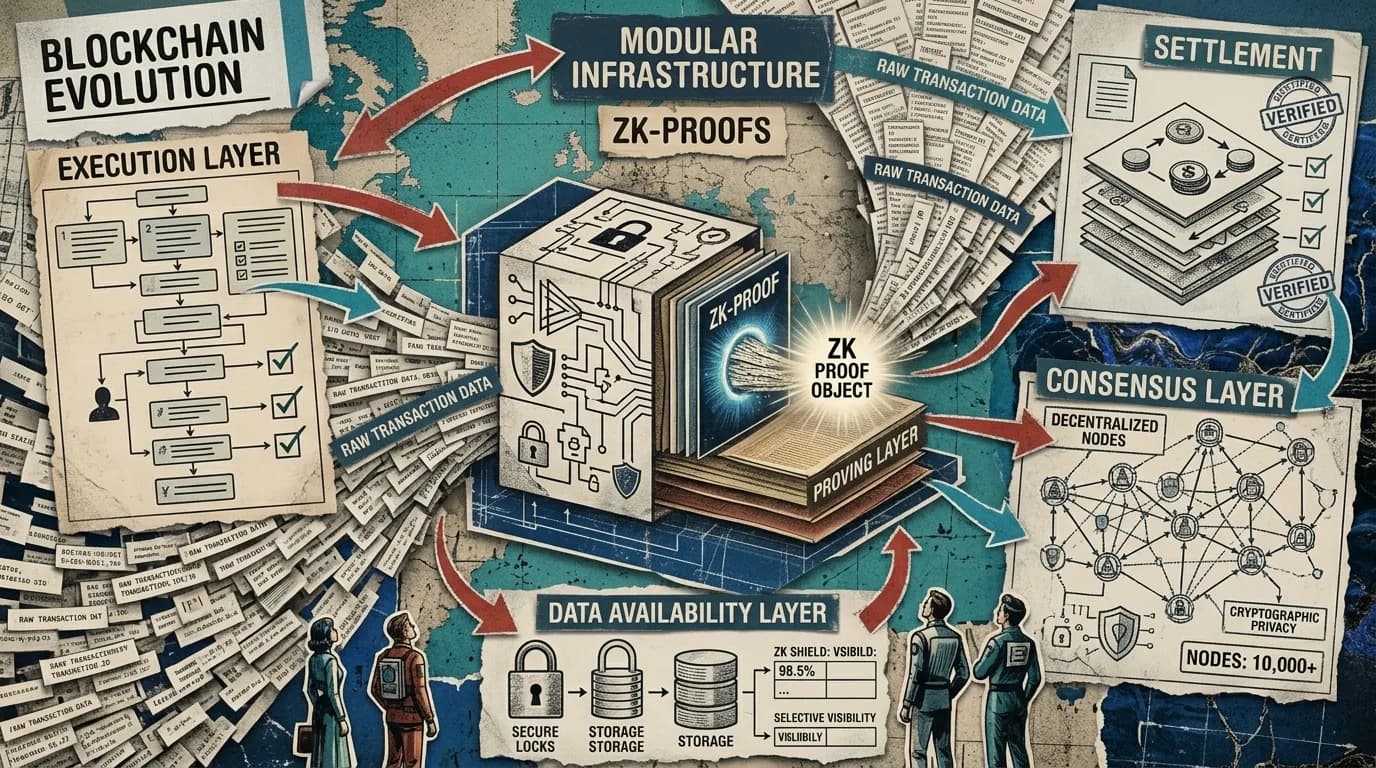
Zero-knowledge (ZK) proofs and modular blockchain architecture are increasingly being positioned as complementary answers. ZK proofs allow a network to verify that a computation was performed correctly without necessarily revealing the underlying information. Modular blockchains, meanwhile, split blockchain responsibilities such as execution, settlement, consensus and data availability across specialized components.
The combination could reshape how blockchain infrastructure is designed. But the technology is not automatically private, decentralized or inexpensive simply because it uses “ZK.”
A zero-knowledge proof is a cryptographic method that allows one party, the prover, to demonstrate that a statement is true to another party, the verifier, without revealing the underlying secret information.
For crypto networks, the more important application is often verifiable computation rather than privacy alone. A system can execute a large number of transactions outside a base blockchain, generate a compact cryptographic proof showing that the computation was correct, and submit that proof for verification.
Ethereum's documentation describes this mechanism as the foundation of ZK-rollups. Instead of requiring Ethereum to execute every transaction again, a rollup can process transactions off-chain and submit a validity proof showing that the resulting state transition is correct.
Learn more about Ethereum's ZK-rollup architecture
This creates an important distinction: zero-knowledge technology can improve scaling and verifiability even when the transactions themselves remain publicly visible.
The phrase “zero-knowledge” is sometimes used as shorthand for blockchain privacy, but that can be misleading.
A ZK proof can hide sensitive inputs, but a blockchain application can still expose information through public transaction metadata, wallet addresses, events, calldata, application interfaces or off-chain infrastructure.
Ethereum's 2026 privacy roadmap makes this distinction explicit. Privacy is increasingly being framed around selective disclosure: users should be able to prove something about themselves without automatically exposing all of the underlying information.
For example, a user could prove that they satisfy an eligibility requirement without revealing their complete identity or the underlying document used to establish it.
Read Ethereum's privacy roadmap
That distinction matters for developers and investors evaluating ZK projects. A network advertising ZK technology is not necessarily a fully private blockchain.
Traditional blockchains require nodes to process and verify large amounts of transaction data. As activity increases, this creates pressure on computation, storage, bandwidth and fees.
ZK-rollups move much of the transaction execution away from the base layer. Transactions are grouped into batches, processed by an off-chain execution environment and represented by a state update accompanied by a validity proof.
The base blockchain verifies the proof rather than independently re-executing every transaction.
This creates a powerful economic advantage: the expensive work can be aggregated across many transactions, while verification on the settlement layer remains comparatively efficient.
Recursive proving can push this concept further by allowing one proof to verify other proofs. That creates the possibility of aggregating very large amounts of computation into increasingly compact verification workloads.
Ethereum's current scaling roadmap is explicitly focused on expanding rollup capacity, increasing data availability and improving the economics of Layer 2 networks.
See Ethereum's current scaling roadmap
Proofs establish that a state transition is valid. They do not automatically solve the separate problem of whether the underlying data is available to network participants.
This is where modular blockchain architecture becomes important.
A rollup needs enough data to reconstruct its state and allow users or independent operators to verify what happened. If an operator produces a valid-looking state commitment while withholding critical transaction data, independent parties can face difficulties reconstructing the chain.
Ethereum's rollup design therefore treats data availability as a fundamental part of the security model.
The introduction of blob-based data availability through EIP-4844, activated in the Dencun upgrade, was designed to reduce the cost of publishing rollup data. Ethereum subsequently added PeerDAS through the Fusaka upgrade, expanding the network's approach to distributing and sampling blob data.
Read Ethereum's Dencun documentation
The long-term direction is increasingly clear: execution does not have to happen on the same layer that provides consensus, settlement and data availability.
A traditional monolithic blockchain attempts to perform most major functions within one integrated system. A modular architecture separates these functions so different layers can specialize.
A simplified modular stack can look like this:
| Blockchain Function | Typical Responsibility |
|---|---|
| Execution | Processes transactions and runs applications |
| Settlement | Finalizes state updates and verifies proofs |
| Consensus | Establishes agreement on transaction ordering |
| Data Availability | Makes transaction data available for verification |
| Proving | Generates cryptographic validity proofs |
This architecture allows multiple execution environments to share common infrastructure.
Celestia, for example, describes itself as a modular data-availability network where execution and settlement can exist above the data-availability and consensus infrastructure. Its design uses data availability sampling so light nodes can assess whether block data is available without downloading the entire block.
Explore Celestia's modular data-availability architecture
The strategic attraction is specialization. A blockchain layer optimized for execution does not necessarily need to solve every consensus or data-storage problem itself.
The relationship between ZK proofs and modular blockchains becomes clearer when the two technologies are viewed as separate parts of one infrastructure stack.
A modular system can outsource execution to specialized networks. ZK proving can then provide cryptographic evidence that the outsourced computation was performed correctly.
The result is a pipeline in which:
This arrangement can increase flexibility. Developers can design application-specific execution environments while relying on established settlement and data infrastructure.
The same concept is also extending beyond Layer 2 rollups. Ethereum is researching ZK-based verification of Layer 1 block execution itself, with the goal of allowing validators to verify proofs instead of repeatedly re-executing every transaction.
Read about Ethereum's zkEVM research for Layer 1 verification
ZK infrastructure is not free.
Generating validity proofs can require substantial computational resources, specialized hardware and sophisticated cryptographic engineering. While proof verification can be relatively inexpensive compared with re-executing large computations, producing the proof can remain a major operational cost.
There is also a centralization question.
If proving becomes dominated by a small number of highly specialized operators, a theoretically decentralized network could develop practical dependencies on a narrow infrastructure base. Ethereum's ZK-rollup documentation identifies specialized proving hardware and centralized sequencing as important areas of concern.
The architecture therefore creates a new optimization problem: increasing efficiency without concentrating control.
The next phase of ZK and modular blockchain development is likely to be shaped by several competing forces.
Proof-generation economics: Networks need proving infrastructure that can handle increasing transaction demand without making participation prohibitively expensive.
Sequencer centralization: Many rollups still rely on operators that order transactions. Decentralizing sequencing is a separate challenge from proving transaction correctness.
Data availability: A valid proof does not eliminate the requirement for sufficient state data to remain reconstructible and accessible.
Interoperability: A fragmented modular ecosystem could produce many specialized chains that are technically efficient but difficult for users and applications to move between.
Privacy design: A ZK application can still leak information through transaction metadata and surrounding infrastructure.
Cryptographic and smart-contract risk: The security of a ZK system ultimately depends on its proving system, verifier implementation, circuit design and other critical contracts being correctly engineered.
The important shift is that blockchain scaling is moving away from the idea that every node must perform every task.
ZK proofs make computation increasingly verifiable without requiring universal re-execution. Modular architecture allows different blockchain functions to be separated and optimized independently. Data-availability systems provide another specialized layer designed to support this separation.
Together, these technologies point toward a blockchain ecosystem where applications may use different execution environments, proving systems and data layers while anchoring their security or settlement to larger networks.
The outcome is unlikely to be a single “ZK chain” replacing every existing blockchain. A more plausible evolution is a diverse infrastructure stack in which ZK proofs become a common verification layer and modular design becomes a common way of assembling blockchain networks.
For crypto, that could be a more significant development than simply making transactions faster. The deeper change is architectural: blockchain networks are gradually becoming systems of specialized components that can compute, prove, settle and publish data independently while still working together.
Disclaimer: This article is strictly for informational and educational purposes and does not constitute financial, investment, or legal advice. Consult a certified financial advisor before making any investment decisions.
Senior Editorial Correspondent · MoneyAllotment
Financial & Technology Writer MoneyAllotment Editorial Team
This article was researched, written, and verified in accordance with MoneyAllotment's editorial standards. Our financial reporting is strictly independent and unaffected by commercial affiliations.
Be the first to share your perspective on this report.
Want to become a Web3 developer but don't know where to start? This roadmap covers Solidity, EVM fundamentals, smart contract security, Foundry testing, Rust, Solana, blockchain infrastructure, and low-level protocols—showing how to progress from beginner coding skills to serious Web3 and protocol d

XRP Ledger activity changed sharply in Q2 2026 as order-book trading volume rose 79% while active trading accounts fell about 40%. Meanwhile, tokenized assets and RLUSD pushed the value held on XRPL above $4 billion, signaling a shift toward larger-value financial activity.

Leave a Comment
Your email address will not be published. Required fields are marked *