Zero to Web3 Developer Roadmap: Smart Contract Security, Rust, and Low-Level Protocols: Where to Start
Becoming a Web3 developer is no longer just a matter of learning Solidity and connecting a wallet to a frontend. The deeper path leads into smart contract security, blockchain execution environments, Rust, cryptography, peer-to-peer networking, consensus, and the low-level protocols that make decentralized systems work.
The challenge is knowing what to learn first.
A beginner who starts with advanced Rust or protocol research too early can spend months studying concepts that have little connection to the applications they want to build. A better approach is to move from application development toward the protocol layer in deliberate stages.
This roadmap covers that progression, with a particular focus on Ethereum and Solana because they expose two useful but very different development models.
Start With Blockchain Fundamentals, Not a Framework
Before choosing Solidity, Rust, or a framework, understand what a blockchain actually does.
You should be comfortable with:
- Public and private keys
- Digital signatures
- Hash functions
- Addresses
- Transactions
- Blocks
- State
- Consensus
- Gas and transaction fees
- Wallets and RPC endpoints
- Smart contracts and programs
Ethereum's developer documentation organizes these fundamentals around accounts, transactions, blocks, the Ethereum Virtual Machine (EVM), gas, nodes, networks, and consensus. Its EVM documentation also emphasizes concepts such as bytes, memory, hash functions, and Merkle trees. Ethereum developer documentation and EVM documentation
This stage should answer one basic question: what happens from the moment a user signs a transaction until blockchain state changes?
Without that mental model, framework abstractions can hide the most important concepts.
For most beginners, Ethereum-style development is an effective starting point because the EVM model is widely documented and exposes many important programming concepts.
Learn Solidity first, but do not treat Solidity as ordinary backend programming.
Study:
- State variables and storage
- Functions and visibility
- Events and logs
- Mappings and arrays
- Structs
- Inheritance and interfaces
- Custom errors
- ABI encoding
- Function selectors
msg.sender, msg.value and transaction context- Contract-to-contract calls
delegatecall- Storage layout
- Gas costs
The official Solidity documentation recommends learning smart-contract basics, then Solidity itself, followed by compiler usage and its security considerations. It also stresses testing, code review, audits, and correctness practices before production deployment. Solidity documentation
At this stage, build small contracts rather than copying large DeFi protocols.
A good progression is:
| Project | What You Learn |
|---|
| Counter | State and transactions |
| Simple token | Standards, balances and events |
| Escrow | Conditions and access control |
| Multisignature wallet | Signatures and authorization |
| Auction | State machines and edge cases |
| Simple AMM | Pricing logic and invariants |
The objective is not to launch a token. The objective is to understand how blockchain state changes under adversarial conditions.
Stage 2: Learn Smart Contract Security Before Building Large Protocols
Security should not be a final step after development. It should become part of the development process.
Ethereum's security guidance specifically recommends strong access control, version control, independent review, testing, and static analysis. It also warns that smart-contract vulnerabilities are unusually serious because deployed code can control valuable assets and vulnerabilities can be difficult to reverse. Ethereum smart contract security
Start with the major vulnerability classes:
Access Control
Ask who is allowed to perform every privileged action.
A mint function, upgrade function, withdrawal function, oracle update, or emergency function can become a catastrophic vulnerability if authorization is incorrectly implemented.
OpenZeppelin provides widely used implementations and patterns for ownership and role-based access control. OpenZeppelin Access Control
Reentrancy
Understand how an external call can allow execution to re-enter a contract before its state has been safely updated.
Do not merely memorize the classic reentrancy example. Learn why checks-effects-interactions, pull-payment designs, mutexes, and architectural separation can reduce the attack surface.
Arithmetic and Accounting Errors
Study precision loss, rounding, incorrect share calculations, balance accounting, price calculations, and assumptions around token decimals.
Many serious protocol failures are not obvious "hacks." They are situations where the program does exactly what the code says while violating the economic invariant the developers intended.
Oracle and External-Protocol Risk
A contract may be locally correct while becoming unsafe when its assumptions about prices, tokens, bridges, or external protocols fail.
Learn how manipulated prices, stale data, unexpected token behavior, and composability can affect an otherwise well-written contract.
Upgradeability and Privileged Roles
Understand proxies, implementation contracts, storage compatibility, upgrade authorization, admin keys, timelocks, and emergency controls.
Security is therefore more than finding a bug in Solidity. It is understanding the entire system's trust assumptions.
The 2026 OWASP Smart Contract Top 10 is also a useful security-awareness reference for studying current classes of smart-contract weaknesses. OWASP Smart Contract Top 10
Stage 3: Learn Testing Like a Security Engineer
A serious Web3 developer needs more than unit tests.
Learn:
- Unit testing
- Integration testing
- Fuzz testing
- Invariant testing
- Fork testing
- Negative testing
- Differential testing
Foundry's invariant testing system can execute randomized sequences of function calls and repeatedly check properties that should remain true. This is particularly valuable for protocols where a vulnerability only appears after a specific sequence of actions rather than in one isolated transaction. Foundry invariant testing
For example, an AMM might define an invariant relating reserves and pricing. A token might require that total balances equal total supply. A lending protocol might define conditions that must remain true after deposits, borrowing, repayments, liquidations, and withdrawals.
That shift—from "does this function work?" to "what must always remain true?"—is one of the most important steps toward protocol-level development.
Stage 4: Learn Rust
Once you understand smart contracts and security concepts, Rust becomes much easier to appreciate.
Rust matters heavily in blockchain infrastructure. Solana programs are primarily developed in Rust, and major blockchain infrastructure projects also use Rust for performance-critical systems. Solana's official documentation describes native Rust development as the lower-level route that gives developers granular control over program logic and optimization. Solana Rust development
Do not begin by memorizing advanced Rust syntax.
Learn in this order:
- Ownership and borrowing
- References
- Structs and enums
- Pattern matching
- Traits
- Generics
- Error handling
- Collections
- Iterators
- Lifetimes
- Async programming
- Concurrency
- Memory layout
- Unsafe Rust
Rust's ownership system is central because it provides memory-safety guarantees through compiler-checked rules rather than requiring a garbage collector. The Rust Programming Language
Later, learn what unsafe means and why it exists. The Rustonomicon explains that unsafe forms a boundary where certain programmer guarantees cannot be fully checked by the compiler. The Rustonomicon
The goal is not simply to become a Rust developer. It is to become comfortable reasoning about memory, data ownership, concurrency, and performance.
Stage 5: Learn Solana's Execution Model
Solana is a valuable second platform because its programming model differs significantly from the EVM.
Solana programs are stateless executable accounts, while mutable application state is stored in separate accounts passed into instructions. Transactions contain instructions, and programs operate on the accounts supplied to them. Solana core concepts
That leads to a different security mindset.
Study:
- Accounts
- Programs
- Instructions
- Transactions
- Program Derived Addresses (PDAs)
- Cross-Program Invocations (CPIs)
- Signers
- Account ownership
- Account validation
- Compute units
- Serialization
- Program upgrades
Anchor can make development considerably faster, and its documentation includes account constraints, testing tools, PDAs, CPIs, and guidance around common Sealevel attacks. Anchor documentation
However, do not stay permanently behind the framework abstraction. After building several Anchor programs, implement small examples using native Rust. This exposes what the framework is actually doing for you.
Stage 6: Go Below the Smart Contract Layer
This is where a Web3 developer begins to look more like a blockchain engineer.
For Ethereum, study:
- EVM opcodes
- Stack-based execution
- Memory
- Storage
- Calldata
- ABI encoding
- Gas accounting
- Logs
- Transaction execution
- Execution clients
- Consensus clients
- RPC
- Mempools
- P2P networking
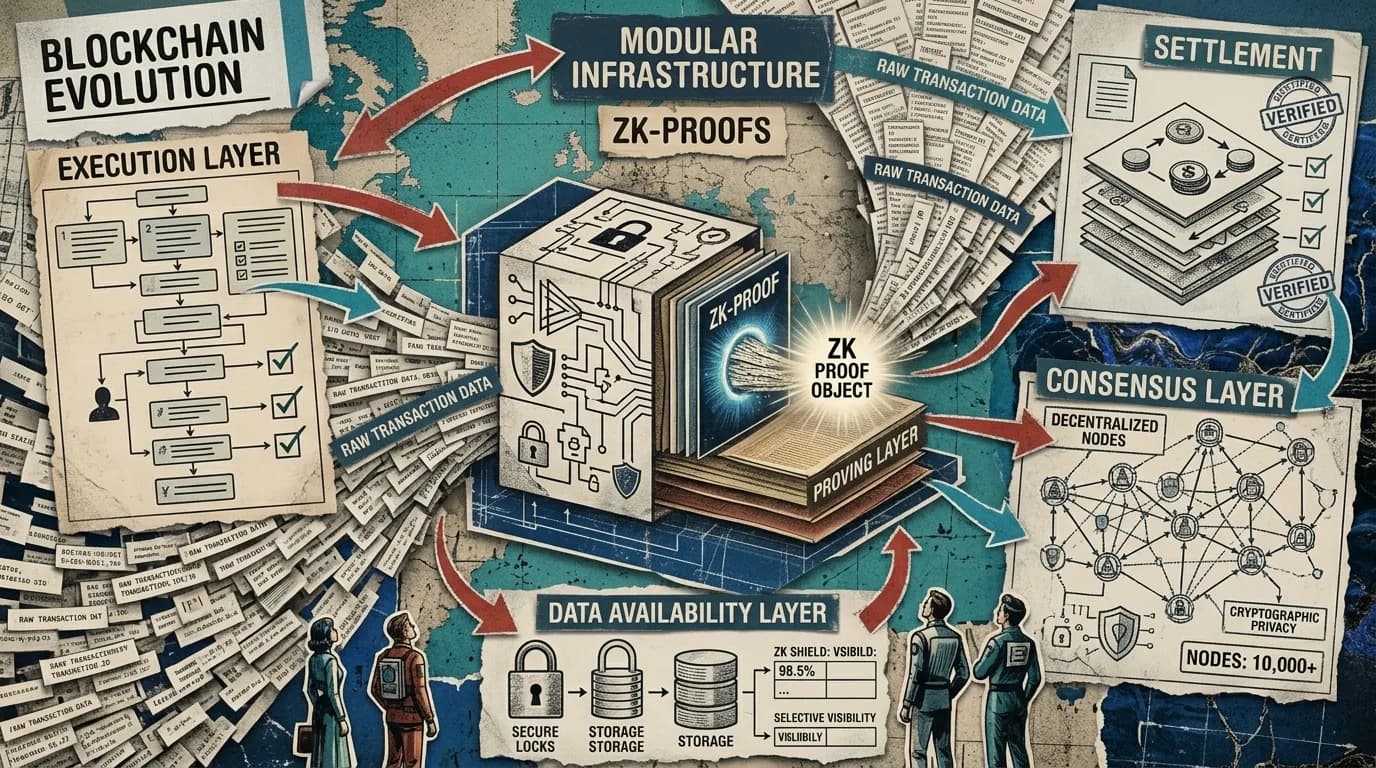
Ethereum currently uses separate execution and consensus clients. The execution layer handles transactions, state and EVM execution, while the consensus layer participates in proof-of-stake coordination. Ethereum nodes and clients
Running a local node is an excellent learning project because it connects application development to the infrastructure underneath it.
From there, move into distributed-systems fundamentals:
- Peer discovery
- Gossip protocols
- Message propagation
- Serialization
- State machines
- Fork choice
- Byzantine fault tolerance
- Proof of stake
- Cryptographic commitments
- Merkle structures
- Networking failure modes
You do not need to become a consensus researcher before writing useful Web3 software. But understanding these mechanisms helps you reason about what blockchains can and cannot guarantee.
A Practical Zero-to-Web3 Sequence
A realistic learning sequence looks like this:
| Stage | Core Skill | Main Outcome |
|---|
| 1 | Blockchain fundamentals | Understand transactions and state |
| 2 | Solidity + EVM | Build basic contracts |
| 3 | Smart contract security | Identify attack surfaces |
| 4 | Foundry + fuzzing | Test protocol behavior |
| 5 | Rust | Understand memory-safe systems programming |
| 6 | Solana + Anchor | Build account-based programs |
| 7 | Native Solana Rust | Understand lower-level execution |
| 8 | EVM internals | Read bytecode and reason about gas |
| 9 | Nodes + networking | Understand blockchain infrastructure |
| 10 | Consensus + cryptography | Approach protocol engineering |
The most efficient path is therefore not Solidity versus Rust. Learn Solidity and the EVM first to understand smart-contract application development, then use Rust to move deeper into blockchain infrastructure and alternative execution models.
What to Build Along the Way
Your portfolio should demonstrate increasingly difficult forms of reasoning.
Start with a token and escrow contract. Then build a multisignature wallet, an auction, and a small exchange or lending prototype.
After that, deliberately break your own projects.
Write tests for unauthorized access. Try reentrant calls. Fuzz numerical inputs. Manipulate assumptions about token behavior. Test unusual transaction sequences. Create malicious mock contracts.
Then build a small Solana program and reproduce the same idea using accounts, PDAs and CPIs.
Finally, build infrastructure rather than another token: a blockchain indexer, RPC-based monitoring system, transaction decoder, simplified P2P network, or miniature blockchain client.
Those projects demonstrate something employers and protocol teams actually care about: the ability to understand systems, reason about failure, and work below convenient abstractions.
The destination is not simply "Web3 developer." The deeper skill is being able to move between application code, execution environments, economic assumptions, security boundaries, and distributed systems—and understand how a failure at one layer can affect every layer above it.
Disclaimer: This article is strictly for informational and educational purposes and does not constitute financial, investment, or legal advice. Consult a certified financial advisor before making any investment decisions.


Leave a Comment
Your email address will not be published. Required fields are marked *