XDOF is reportedly in late-stage talks for a Series B at a valuation of about $1.2 billion. The robotics data startup raised $70 million in June and is seeing rapid demand for physical AI infrastructure.
Robotics Data Startup XDOF Series B Nears $1.2B Valuation
XDOF, a robotics infrastructure startup focused on collecting the real-world data needed to train physical AI systems, is reportedly in late-stage talks for a Series B that could value the company at around $1.2 billion.
According to a September 4, 2026 report from TechCrunch, the proposed financing is being led by 8VC. The terms have not been finalized, however, and the size of the round remains undisclosed. The reported $1.2 billion valuation could also change before the transaction closes.
The funding talks come less than three months after XDOF emerged from stealth with a $70 million Series A, underscoring the growing investor interest in the infrastructure required to build general-purpose robots.
XDOF Funding and Operational Snapshot
Metric / Dimension
Milestone Details
Founded
October 2024
Public launch
Emerged from stealth on June 17, 2026
Founders
Philipp Wu, Yide Shentu, Nemo Jin
Prior funding
$70M Series A, backed by Thrive Capital, Spark Capital, a16z, Lux Capital and WndrCo
Reported Series B
~$1.2B valuation, with 8VC reportedly leading; terms remain unfinalized
Commercial traction
About 20 customers, including several frontier AI labs; TechCrunch reported annualized revenue approaching $50M
Flagship dataset
ABC-130K, with 134,806 episodes, 3,553 hours and 195 bimanual manipulation tasks
The $70 million financing was announced when XDOF emerged from stealth on June 17. Cooley, which advised the company on the transaction, confirmed that the funding was a Series A.
XDOF's founders are Philipp Wu, Yide Shentu and Nemo Jin. Wu and Shentu are closely associated with the earlier GELLO teleoperation research, while Jin joined the founding team as the company's operations-focused co-founder.
Why XDOF Is Betting on Robotics Training Data
The opportunity behind XDOF is based on a fundamental difference between language AI and physical AI.
Large language models benefited from enormous collections of digital text and other internet-scale information. Robots do not have a comparable source of ready-made training data showing how to manipulate objects, coordinate two hands, respond to physical environments or complete tasks over time.
That creates a data bottleneck.
XDOF says it works with robotics laboratories and companies to provide production-scale datasets, robotic systems and tooling for physical AI. Its approach spans hardware, operations and policy training rather than treating data collection as a simple labeling exercise.
The company's roots go back to GELLO, a low-cost teleoperation framework developed by Philipp Wu, Yide Shentu and other researchers. GELLO allows a human operator to control a robotic arm through a corresponding controller while demonstrations are recorded for robot learning. The original research identified the scale and quality of demonstration data as a major constraint on imitation learning.
That research provides a useful explanation for XDOF's business model: instead of asking every robotics company to build its own physical data-collection operation, XDOF aims to supply the infrastructure needed to collect and process that information at scale.
How the XDOF Robotics Data Pipeline Works
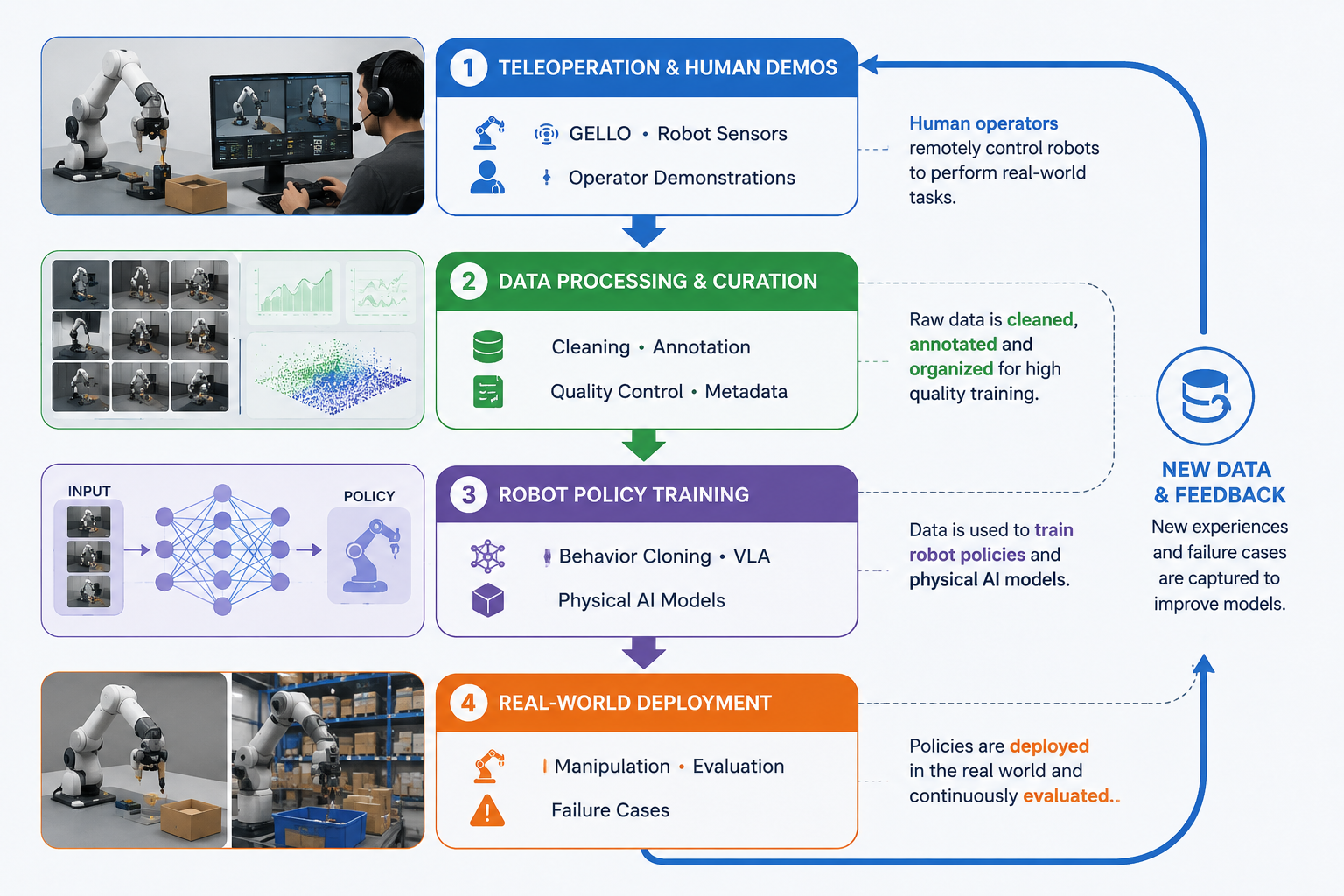
The company's strategy can be understood as a continuous data feedback loop rather than a one-time dataset sale:
Robotics AI Data Pipeline Infographic
That loop is important commercially. A static database can become commoditized, but a system that continually identifies difficult cases, collects additional demonstrations and feeds them back into model development can become embedded in a customer's workflow.
XDOF has described its business in similar terms, combining data collection with data cleaning, tooling and annotation.
ABC-130K Puts the Data Strategy Into Practice
One of XDOF's most visible public projects is ABC-130K, developed with collaborators including UC Berkeley researchers.
The official ABC project says the dataset contains 134,806 episodes across 195 tasks, totaling 3,553 hours of bimanual manipulation data. The tasks cover activities such as pick-and-place, folding, handover, insertion, tool use and assembly.
The project goes beyond simply releasing video. ABC also provides robot-learning models and research infrastructure intended to make the dataset useful for behavior-cloning experiments. The project includes the ABC-DiT and ABC-VLA policy approaches alongside open training material.
This makes ABC-130K strategically useful for XDOF. It demonstrates that the company can participate across several parts of the robotics-data stack rather than operating solely as a collection contractor.
The Reported $1.2B XDOF Series B Is Not Yet a Completed Deal
The most important qualification around the current story is that the Series B remains a reported negotiation.
TechCrunch said its sources described the financing as being in late-stage talks, with 8VC reportedly leading. The publication was unable to determine the total amount being raised or whether the reported $1.2 billion valuation includes the new investment. XDOF and 8VC did not respond to requests for comment at the time of publication.
That means investors and readers should not interpret the figure as an official post-money valuation yet.
Nevertheless, the reported number is notable because it follows so quickly after XDOF's $70 million Series A. The company had only just come out of stealth in June, while TechCrunch reported that annualized revenue was approaching $50 million and that XDOF was already working with about 20 customers, including several frontier AI laboratories.
If the transaction closes around the reported valuation, it would signal that investors see robotics data infrastructure as a potentially large standalone market rather than simply a supporting service for robot manufacturers.
Why Physical AI Data Could Become a Major Infrastructure Market
The comparison often made around XDOF is to companies such as Scale AI or Mercor in the software-AI data ecosystem. The analogy is not exact, but it captures an important business idea: model developers need specialized data operations, and those operations can become infrastructure businesses in their own right.
Physical AI makes that problem more difficult because the data must reflect the real world.
A text model can ingest millions of documents without physically interacting with them. A robot-training pipeline may require a physical robot, sensors, a human operator, controlled environments and repeated demonstrations. The cost and complexity of generating those examples can therefore be substantially higher.
XDOF's approach combines teleoperation with other forms of data collection. The company has also described plans around teleoperators and people wearing body sensors to capture human movement and everyday activities.
That creates both an opportunity and a challenge. Demand for physical-world datasets could rise sharply as more companies build robot foundation models, but scaling collection operations is much more capital- and operations-intensive than collecting digital data.
What to Watch Next for XDOF
The immediate milestone is whether the reported Series B actually closes and on what terms.
For the robotics industry, several other indicators may prove just as important: whether XDOF continues expanding its customer base, whether its reported revenue run rate is sustained, how quickly its datasets grow, and whether customers increasingly use its infrastructure across model training and deployment.
The broader investment question is also becoming clearer. As physical AI moves from laboratory demonstrations toward real-world applications, the limiting factor may not always be model architecture or robot hardware. Reliable, diverse and scalable training data could become one of the most valuable parts of the stack.
XDOF's rapid funding progression suggests investors are betting that this infrastructure layer can become a significant business. The reported $1.2 billion Series B valuation, however, should remain classified as a proposed financing outcome until the company or investors officially confirm the transaction.
Financial & Technology Writer
MoneyAllotment Editorial Team
Editorial Integrity & Transparency
This article was researched, written, and verified in accordance with MoneyAllotment's editorial standards. Our financial reporting is strictly independent and unaffected by commercial affiliations.
Reader Discussion (0)
Be the first to share your perspective on this report.
Leave a Comment
Your email address will not be published. Required fields are marked *
Want to become a Web3 developer but don't know where to start? This roadmap covers Solidity, EVM fundamentals, smart contract security, Foundry testing, Rust, Solana, blockchain infrastructure, and low-level protocols—showing how to progress from beginner coding skills to serious Web3 and protocol d


Leave a Comment
Your email address will not be published. Required fields are marked *