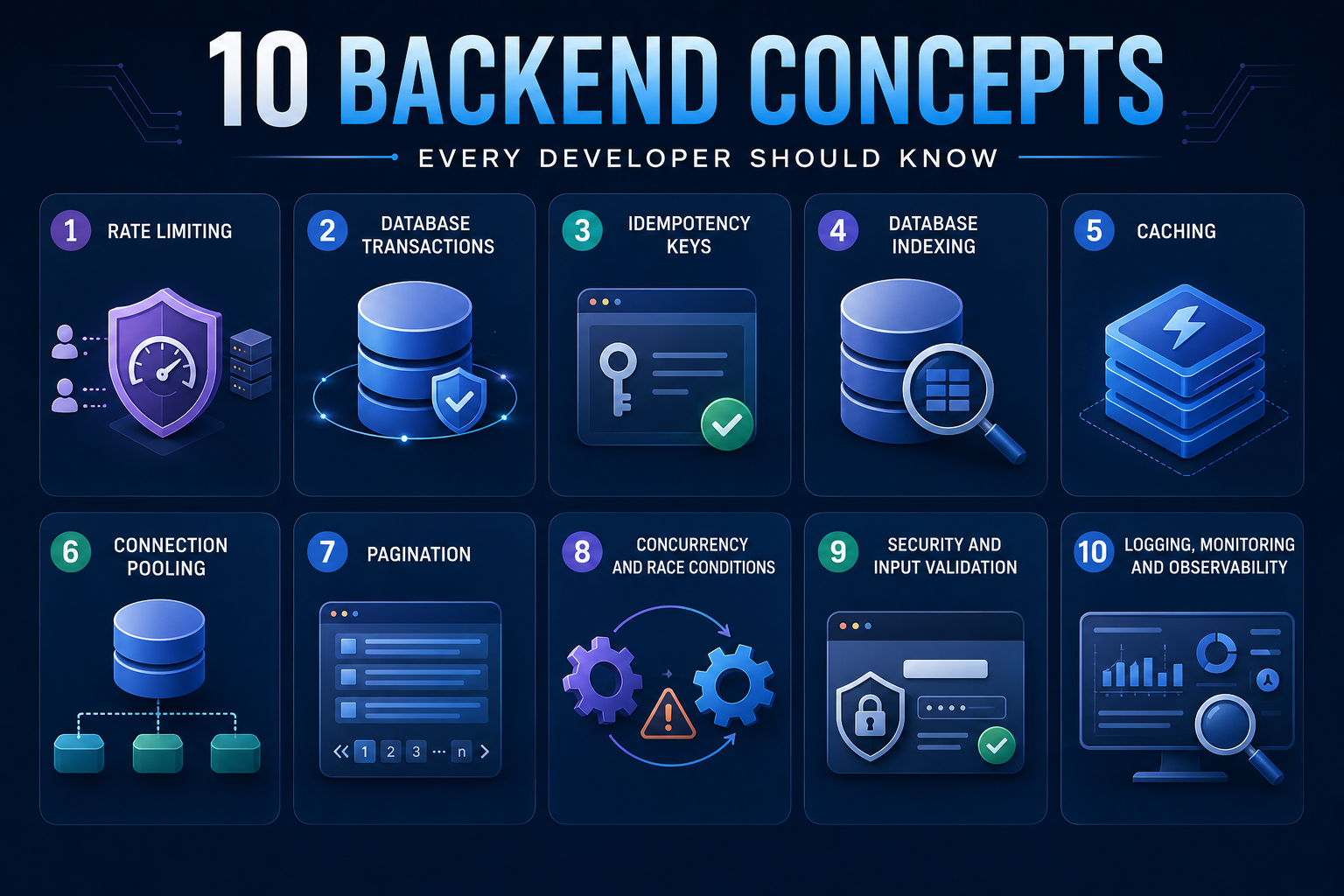
10 Backend Concepts Every Developer Should Know
Learning a backend framework is one thing. Building a backend system that keeps working when traffic increases, requests are repeated and databases become busy is another.
A developer can know Spring Boot, Node.js, Django or .NET and still run into serious production problems without understanding the fundamentals behind APIs, databases and distributed systems.
Concepts such as rate limiting, database transactions, idempotency and indexing are not limited to one programming language. They show up in almost every serious backend application.
Here are 10 concepts worth understanding before calling an API production-ready.
1. Rate Limiting
APIs should not allow a single client to send unlimited requests.
Rate limiting puts a limit on how many requests can be made during a particular period. A public API, for example, might allow a client to make 100 requests per minute.
This becomes especially important for endpoints such as login, OTP verification and password reset. Without controls in place, these endpoints can be abused or overwhelmed.
Rate limiting can be implemented at different layers, including an API gateway, reverse proxy or application itself. Distributed applications often keep the limit state in a shared store such as Redis so that multiple servers can enforce the same policy.
A good rate-limit strategy depends on the endpoint. A general data API and a login endpoint usually should not have identical limits.
2. Database Transactions
A transaction is used when several database operations together represent one business action.
Consider a money transfer. The application may need to deduct money from one account, add it to another account and create a transaction record.
If one step succeeds while another fails, the data could become inconsistent.
Transactions provide a way to group related database changes into a single unit of work.
Backend developers should understand more than just a framework annotation such as @Transactional. They should know transaction boundaries, isolation levels, rollback behavior and common problems such as deadlocks.
The question to ask is simple:
Which operations must succeed together?
That answer usually determines where the transaction belongs.
3. Idempotency
Idempotency becomes extremely important when an API can be retried.
Suppose a customer submits a payment request. The server processes it successfully, but the response is lost because of a temporary network problem.
The client sends the request again.
Without protection, the backend may create a second payment.
An idempotency key allows the client to attach a unique identifier to the operation. The server can remember the result associated with that key and return the existing result if the same operation is retried.
This pattern is commonly useful for:
Payments Orders Wallet transfers Subscription creation Other operations that should not be duplicated
Retries are a normal part of distributed systems, so backend APIs should be designed with retries in mind.
4. Database Indexing
As a table grows, database queries can become expensive.
An index helps the database find rows more efficiently for specific query patterns.
For example, an application may frequently request transactions for a particular customer:
SELECT * FROM transactions WHERE userid = 1250 ORDER BY createdat DESC;
An appropriate index can make this query much faster.
But adding indexes everywhere is not a solution. Indexes take storage and need to be updated whenever data changes. Too many indexes can therefore increase write costs.
Developers should understand primary keys, unique indexes, composite indexes and query execution plans.
Using EXPLAIN is often more useful than guessing why a query is slow.
5. Caching
Caching can reduce repeated database work.
If thousands of users request the same data, the application does not necessarily need to execute the same database query thousands of times.
A cache such as Redis can keep frequently requested data for a certain period.
A common flow is:
Request ↓ Check cache ↓ Cache hit → Return data ↓ Cache miss ↓ Read database ↓ Store result in cache ↓ Return response
The difficult part is not putting data into a cache. It is deciding when cached data should expire or be invalidated.
That is why developers often hear the phrase:
Cache invalidation is one of the hard parts of computer science.
A cache should solve an actual performance problem rather than being added automatically to every endpoint.
6. Connection Pooling
Opening a new database connection for every request is expensive.
Connection pooling allows the application to maintain a controlled collection of reusable database connections.
When a request needs database access, it can borrow a connection from the pool and return it after the operation is completed.
In a Spring Boot application, HikariCP is a common connection-pooling implementation.
Important settings include maximum pool size, connection timeout and connection lifetime.
More connections do not always mean better performance. If the database is already under heavy load, increasing the connection pool can make the problem worse.
The pool should match the workload and the capacity of the database.
7. Pagination
Large API responses can quickly become a performance problem.
Imagine a transaction table containing hundreds of thousands of rows. Returning every record from:
GET /transactions
would waste memory, bandwidth and database resources.
Pagination allows the API to return a manageable amount at a time.
Traditional applications may use page and size parameters:
GET /transactions?page=1&size=50
For very large datasets, cursor or keyset pagination can be a better choice because it can avoid some of the performance problems associated with large offsets.
The correct pagination strategy depends on the type of data and how the client navigates through it.
8. Concurrency and Race Conditions
Multiple users can modify the same data at almost exactly the same time.
That creates concurrency problems.
Imagine an account with a balance of Rs. 10,000. Two withdrawal requests for Rs. 8,000 arrive almost simultaneously.
If both requests read the same old balance before either update is committed, both operations could incorrectly succeed.
This is a race condition.
Backend systems may use approaches such as:
Optimistic locking Pessimistic locking Atomic database operations Appropriate transaction isolation Distributed locking when required
Concurrency bugs are often difficult to reproduce because the application may work correctly most of the time and fail only under particular timing conditions.
9. Security and Authorization
The backend should never blindly trust data sent by the frontend.
Client-side validation improves user experience, but it is not a security boundary. The server must validate values and enforce authorization itself.
Authentication and authorization are also different concepts.
Authentication asks:
Who are you?
Authorization asks:
What are you allowed to do?
A user may be correctly logged in and still have no permission to access another customer's financial records.
Backend developers should also understand common issues such as SQL injection, broken access control, sensitive data exposure, insecure secrets and insufficient input validation.
Security should be part of the design rather than something added after the API is finished.
10. Logging and Observability
Eventually, something will fail in production.
When that happens, useful logs and metrics can make the difference between finding the problem quickly and spending hours trying to reproduce it.
A useful request log might include:
Request ID Endpoint HTTP method Status code Execution time Service name Exception information
In a microservice architecture, correlation or trace IDs are especially useful because a single request may pass through several services.
Metrics such as request rate, error rate, latency, CPU usage, memory usage and database connection usage can provide a much clearer picture of system health.
Logging everything is not the goal. The goal is to capture enough information to understand what happened without leaking sensitive data.
How These Concepts Work Together
These concepts become more valuable when they are considered as part of one system.
Take a payment API as an example.
A request might pass through:
Authentication ↓ Rate limiting ↓ Input validation ↓ Idempotency check ↓ Database transaction ↓ Concurrency protection ↓ Database ↓ Logging and tracing
Behind that flow there may also be connection pooling, indexes, caching and monitoring.
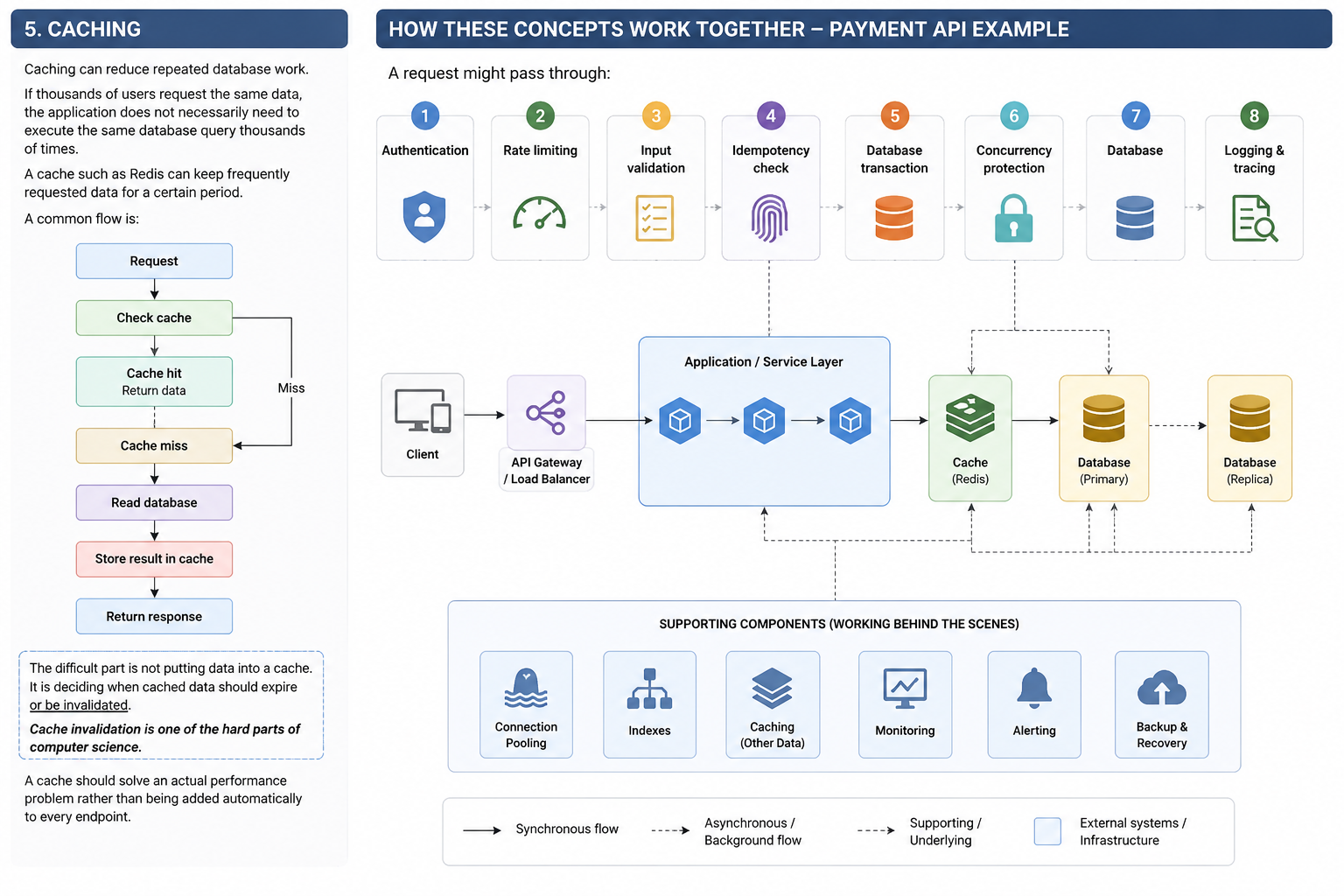
This is why production backend development is more than writing controllers and database queries. The difficult problems usually appear at the boundaries: retries, failures, concurrency, large datasets and unexpected traffic.
Why Framework Knowledge Alone Is Not Enough
Frameworks make backend development faster, but the underlying concepts remain the same.
A Spring Boot developer may use JPA transactions. A Node.js developer may use a PostgreSQL transaction library. A .NET developer may use Entity Framework.
The syntax changes, but the engineering problem does not.
A developer who understands the underlying concept can move between technologies much more easily because they are solving the same class of problems with different tools.
The Bigger Picture
A good backend is not simply one that returns the correct JSON response on a local machine.
It should also behave predictably when users retry requests, several users modify the same record, traffic suddenly increases or the database contains millions of rows.
That is where concepts such as backend development concepts, rate limiting, transactions, idempotency, indexing, caching, concurrency and observability become important.
Understanding these fundamentals will usually make a bigger difference to production-quality backend work than learning another framework without understanding what happens underneath it.
Nimesh
admin
Financial journalist and contributing editor covering economics, markets, and personal finance.
Reader Discussion (0)
Be the first to share your perspective on this report.
Leave a Comment
Your email address will not be published. Required fields are marked *